
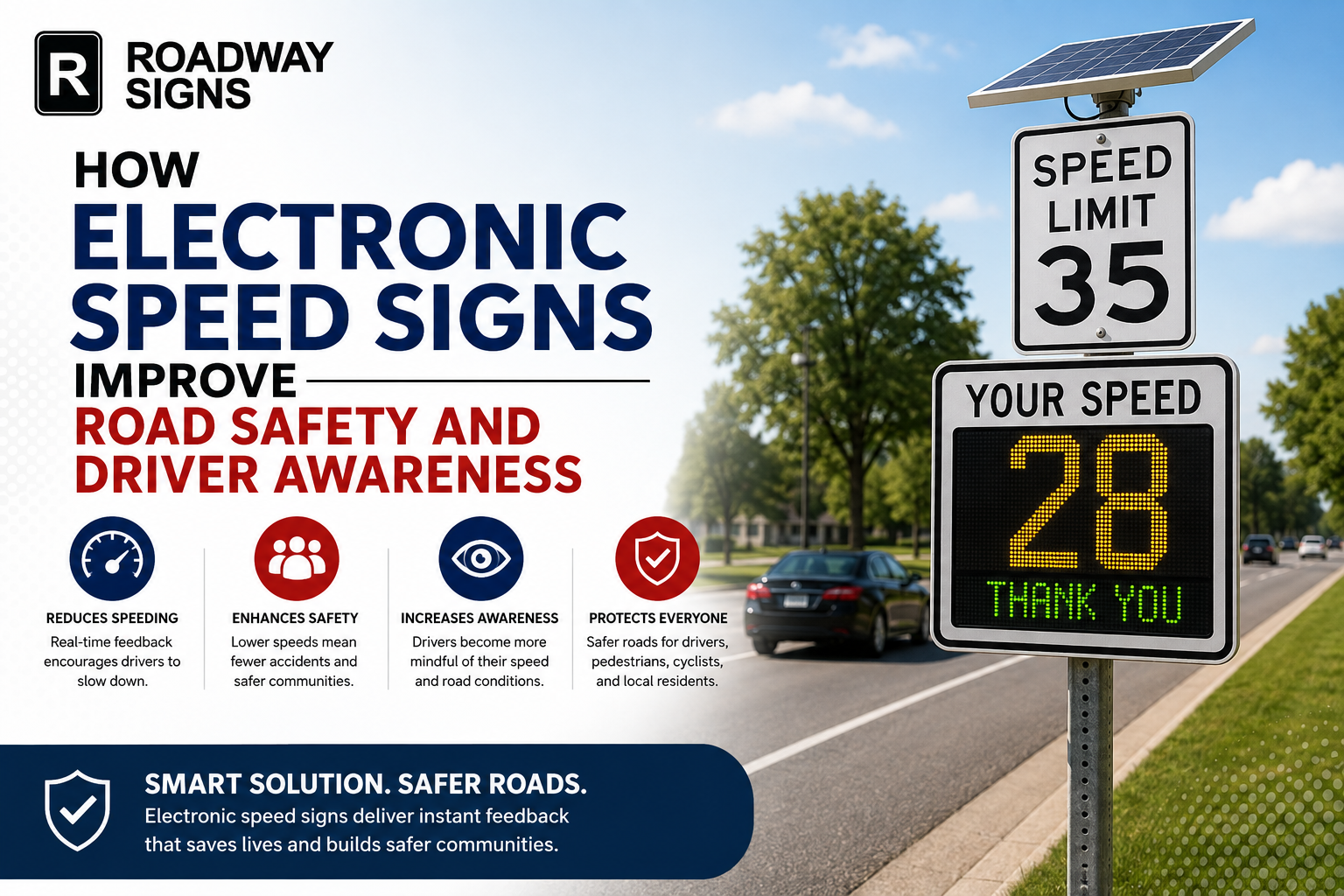
Speeding continues to be among the most difficult issues in managing traffic safety, causing a considerable portion of crashes yearly. Speed limit signs are passive devices since they only notify motorists of the permissible speed but do not control speeding, relying on the will and conscience of the motorist only. The electronic speed signs differ from them by the fact that they interact with the motorist in real-time and offer feedback that has been proven to help decrease speeds.
This guide explores how the electronic speed signs operate, what safety advantages they offer, and why municipalities, school areas, and private communities have come to use them as a key traffic calming measure.
What Are Electronic Speed Signs?
The electronic speed signs, which are popularly known as radar speed signs or feedback signs, are advanced traffic devices that use radar/lidar technology to determine the speed of an oncoming vehicle and display the speed back to the driver. While static signs merely display the speed limit, electronic speed signs establish a feedback mechanism where the driver sees his or her speed and is immediately able to compare it with the posted speed limit.
There are a number of basic features in all electronic speed signs:
-
A radar/lidar speed detector
-
An LED display that shows the speed of the vehicle
-
Solar or electrical power supply options for continuous operation
-
Optional data logging capabilities for traffic analysis
-
Weather-resistant, durable housing built for outdoor, year-round use
Most of today’s units are also equipped with other additional facilities, such as warnings when a vehicle exceeds its limit, the programming of speeds, and the capacity to show customized messages under certain circumstances.
Why Electronic Speed Signs Are More Effective Than Static Signage
Static speed limit signs are very important for defining the legal speed on a road, but drivers may not always follow them. Drivers can also underestimate their speed, particularly on wider, straighter roads with lighter traffic. For more information, see The Importance of Speed Limit Signs on Modern Roads.
The electronic speed sign helps fill this gap. When drivers can see their actual speed displayed alongside the speed limit, the comparison becomes more direct and noticeable. This immediate feedback can encourage drivers to reduce their speed and pay closer attention to the posted limit.
The Psychology Behind Driver Feedback
The effectiveness of electronic speed signs is rooted in behavioral psychology. Static signs convey a law; however, electronic speed signs convey the penalty for breaking it at that very moment. When a driver is confronted with "YOUR SPEED: 42 MPH" on a 30 MPH zone, he/she will have a reaction right then, just because that law becomes personal for him/her.
It turns out to be much more efficient than any punishment in form of fines since speeding tickets are usually given afterwards, not during the act of speeding, and concern only a tiny minority of all the drivers.
Key Safety Benefits of Electronic Speed Signs
Reduced Vehicle Speeds in High-Risk Areas
Variable speed limit signs prove to be highly effective especially where speed limits need to be reduced such as in school zones, neighborhoods, hospitals, and areas that are close to crosswalks. This is because variable speed limit signs remind motorists about their actual speeds, thus reducing the average speed at those particular places.
Improved Awareness in School and Pedestrian Zones
Children, senior citizens walking on the roads, and people cycling are highly susceptible in locations where there is not enough compliance of speed among the drivers. The installation of electronic speed boards around schools, parks, and other places having many pedestrians helps in alerting the drivers all the time.
Data-Driven Traffic Management
Electronic variable speed limit boards often come with data logging features, which help local governments and traffic planners gather useful data regarding speeds, traffic flow, and peak hours. This information is then used to make decisions based on facts about what needs to be done to enhance safety and traffic control.
Cost-Effective Long-Term Traffic Calming
Unlike infrastructure modifications like adding speed bumps or narrowing roads, the use of electronic speed boards is one of the more cost-effective solutions available. Even solar-powered electronic speed boards have become a practical option for cities with limited infrastructure budgets. For more information, read Solar-Powered Speed Limit Sign: Benefits and Applications.
Increased Driver Attentiveness Overall
More than just slowing down, the mere act of having a lit and active display encourages drivers to become more attentive in their surroundings. Those who would normally be distracted are compelled to look at the display to determine their speed, and this also makes them more aware of their surroundings, such as any road signs, pedestrians, and other cars on the road.
Where Electronic Speed Signs Make the Biggest Impact
While electronic speed signs can be effective on nearly any roadway, certain locations consistently show the most significant safety improvements:
-
School zones, where speed compliance during arrival and dismissal times is critical
-
Residential neighborhoods, where cut-through traffic often exceeds posted limits
-
Construction zones, where temporary speed reductions protect workers and equipment
-
Curves and areas with limited visibility, where speed contributes disproportionately to collision risk
-
Community entry points, where a visible speed reminder helps establish a lower-speed environment from the outset
Municipalities and traffic planners often prioritize these installation types when working with limited signage budgets, as they tend to deliver the most measurable safety return.
Choosing the Right Electronic Speed Sign for Your Location
All electronic speed signs are not created equal, and choosing the appropriate unit will depend on the particular requirements of the installation site. Some key factors to consider include:
1. Power Supply – Units with solar power supplies work well in places where electrical power supply can be challenging to access, whereas hardwired units can be more suitable for permanent installations in areas with significant traffic.
2. Display Brightness – Ensure that the unit has high brightness displays that are clearly visible in both direct sunshine and low-light conditions.
3.Durability and Weather Protection – Units that will be installed in areas with tough weather conditions need to have extreme temperature, moisture, and ultraviolet ray protection.
4.Data Collection/Reporting Capabilities – Municipalities that are committed to effective traffic planning can benefit from having units that come with a data logger feature.
5.Customizability Options – Units that allow you to set your own thresholds, alerts, and custom messages will work well in places with varying traffic volumes, like school zones with restricted speed limits at certain times of the day.
Consulting with a professional traffic safety signage supplier ensures that your unit satisfies all the requirements of the installation site.
Compliance and Installation Considerations
Speed displays mounted along public streets are usually expected to conform to the requirements for traffic control device standards, which include correct distance from the placement, appropriate height of installation, and visibility. Cooperation with a professional signage provider allows one to meet both these expectations and place the devices in the most visible way for drivers.
The placement of a speed display is no less critical than the technology. A speed sign mounted too close to the intersection, hidden by trees, or not providing adequate visibility will be much less efficient compared to those mounted wisely in the traffic control scheme of the area.
Final Thoughts
In the list of devices that have been proven to be among the most efficient ways of influencing driver behavior and creating a safer driving environment, electronic speed signs should take one of the leading positions. The main advantage of these signs is that they give each particular driver personalized feedback on their speed instantly and thus solve the problem of the gap between speed limits indicated by traditional road signs and real driving behavior in an efficient way.
If your city, school district, or community aims to address problems related to speeding and increase safety in areas prone to it, electronic speed signs are one of the most efficient and low-cost solutions that have already proved their worth.
Visit our website Roadway Signs and find all the needed products designed to meet all safety requirements.
 English
Join our community to interact with posts!