
Market Overview
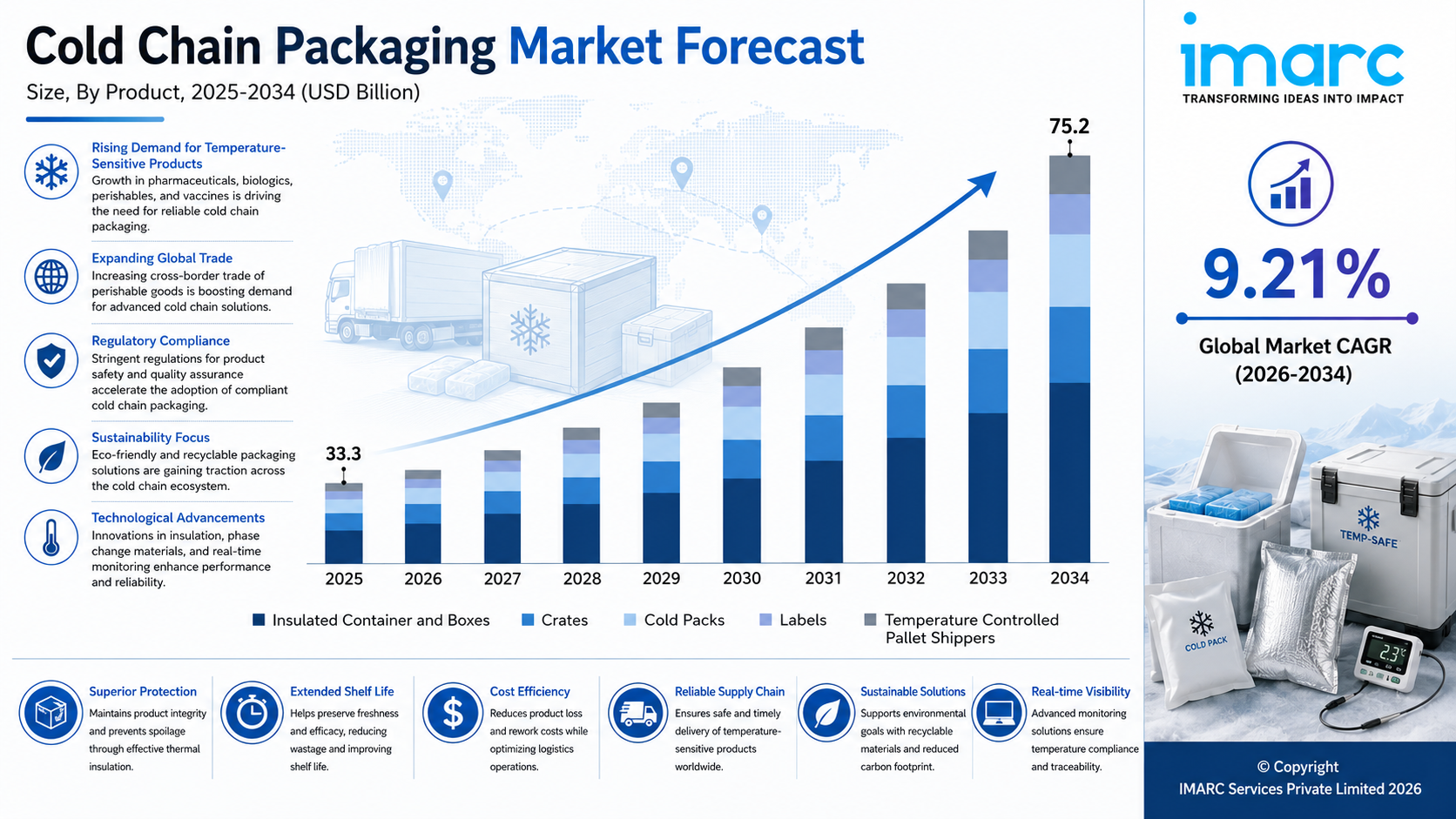
The global cold chain packaging market size reached USD 33.3 Billion in 2025. Looking forward, IMARC Group expects the market to reach USD 75.2 Billion by 2034, exhibiting a growth rate (CAGR) of 9.21% during 2026-2034. Europe currently dominates the regional landscape, accounting for a market share of 33.7% in 2025, supported by strict food safety regulations, pharmaceutical expansion, e-commerce growth, sustainability initiatives, advanced logistics infrastructure, and increasing demand for temperature-sensitive goods. Rising investments in innovative thermal insulation and temperature-controlled solutions are further driving the cold chain packaging market across the region.
Cold Chain Packaging Market Key At a Glance
-
Base Year: 2025
-
Historical Period: 2020–2025
-
Forecast Period: 2026–2034
-
Market Size (2025): USD 33.3 Billion
-
Market Forecast (2034): USD 75.2 Billion
-
CAGR (2026–2034): 9.21%
-
Leading Region: Europe
-
Leading Product Segment: Insulated Containers and Boxes
-
Leading End User: Food
Cold Chain Packaging Market Report: Key Highlights
-
Market Size & Growth: The global cold chain packaging market trends reached USD 33.3 Billion in 2025 and is projected to reach USD 75.2 Billion by 2034, registering a CAGR of 9.21% during 2026–2034.
-
Regional Leadership: Europe represents the largest regional market, accounting for 33.7% of the market in 2025, supported by advanced logistics infrastructure, strict regulatory standards, pharmaceutical expansion, e-commerce growth, and increasing demand for temperature-sensitive goods.
-
By Product: The market includes insulated containers and boxes, crates, cold packs, labels, and temperature-controlled pallet shippers, with insulated containers and boxes representing the largest segment with a 43.2% share.
-
By End User: The market covers food, dairy, pharmaceutical, and others, with food representing the largest end-user segment with a 52.7% share.
-
Key Market Drivers: Rising demand for fresh, organic, and frozen foods, pharmaceutical industry expansion, increasing e-commerce adoption, stringent temperature-control regulations, and technological advancements are supporting market growth.
-
Key Market Trends: Growing demand for perishable goods, increasing use of reusable packaging, adoption of IoT-enabled monitoring systems, advancements in insulation materials, and increasing sustainability initiatives are shaping the market.
-
Key Market Challenges: Maintaining temperature stability during transportation while managing costs and meeting regulatory requirements remains an important challenge for industry participants.
-
Key Market Opportunities: Development of recyclable, compostable, reusable, and digitally connected packaging solutions is creating new opportunities across food, pharmaceutical, and specialty cold chain applications.
Request For a Sample Report: https://www.imarcgroup.com/cold-chain-packaging-market/requestsample
What Is Driving Cold Chain Packaging Market Growth in 2026?
Growing Demand for Perishable Goods
The growing demand for fresh, organic, and frozen food products is one of the major factors driving the cold chain packaging market. Consumers are increasingly seeking fresh fruits, vegetables, dairy products, meat, seafood, and other perishable goods, creating a greater need for dependable temperature-controlled packaging solutions throughout transportation and storage.
Changing consumer preferences toward healthier and more convenient food choices are further increasing demand for effective cold chain infrastructure. The expanding middle-class population and rising appetite for foreign and exotic perishable products are also supporting market expansion, as these products require appropriate temperature control to preserve their quality during distribution.
In addition, strict food safety regulations and quality standards are increasing the demand for sophisticated packaging solutions. Rising investments in advanced packaging technologies and climate-controlled storage facilities are further contributing to market growth.
Significant Expansion in the Pharmaceutical Industry
The expansion of the pharmaceutical industry is another major factor supporting the growth of the cold chain packaging market. The increasing development and distribution of temperature-sensitive medications, vaccines, and biologics require precise temperature control to preserve product effectiveness and integrity.
Products such as mRNA vaccines and certain biologics are particularly sensitive to temperature fluctuations, increasing the need for specialized packaging solutions during transportation. The global market for mRNA vaccines and therapies reached US$ 57.7 Billion in 2023, highlighting the scale of this pharmaceutical application.
Furthermore, pharmaceutical companies increasingly operate on a global scale, requiring temperature-sensitive products to be transported across international supply chains. This is increasing demand for advanced cold chain logistics and packaging solutions, including insulated boxes, temperature-monitoring devices, and enhanced data-tracking technologies.
Technological Advancements in Cold Chain Packaging
Technological advancements are transforming cold chain packaging by improving temperature monitoring, operational efficiency, and product safety. The incorporation of Internet of Things (IoT) sensors enables real-time monitoring of temperature, humidity, and other environmental conditions, helping ensure that sensitive products remain within their designated temperature ranges.
Advances in insulation materials are also improving thermal protection while helping reduce transportation costs and environmental impacts. In addition, automated packaging systems can increase operational efficiency and reduce the likelihood of human errors during packing, supporting cost savings and improved reliability.
The growing adoption of smart packaging, GPS tracking, IoT-enabled systems, and real-time temperature monitoring is therefore expected to continue strengthening the cold chain packaging market outlook.
Cold Chain Packaging Market Trends
Growing Demand for Perishable Goods
The increasing consumption of fresh and frozen food products is creating sustained demand for cold chain packaging solutions. Fruits, vegetables, dairy, meat, seafood, and other temperature-sensitive products require controlled conditions to preserve freshness, quality, and safety throughout the supply chain.
The increasing preference for healthier food choices is further supporting this trend. Reports indicate that 50% of consumers value healthy eating, while 33% consider sustainable eating a significant concern. This shift in consumer preferences is encouraging businesses to strengthen their cold chain capabilities.
Increasing Adoption of Reusable Cold Chain Technologies
The development and adoption of reusable cold chain packaging technologies are emerging as an important market trend. Reusable systems can provide extended temperature control while reducing dependence on traditional cooling methods such as dry ice.
These solutions can help reduce shipping costs, packaging waste, and environmental impacts while improving temperature management. In the United States, Candor Expedite introduced Candor Food Chain in 2024, utilizing Cool Chain's reusable technology to maintain shipment temperatures for up to nine days without dry ice.
The temperature-managed solution accommodates frozen, refrigerated, and ambient products in a single truck, while real-time GPS and temperature tracking enhance shipment visibility and efficiency.
Increasing Focus on Sustainability
Sustainability is becoming increasingly important within the cold chain packaging industry. Manufacturers are focusing on developing recyclable, compostable, and reusable packaging solutions to reduce waste and environmental impacts.
Businesses are also adopting packaging systems designed to improve material efficiency and reduce emissions throughout the supply chain. The growing demand for environmentally responsible packaging from consumers and businesses is encouraging companies to invest in sustainable cold chain technologies.
Integration of IoT and Smart Packaging Technologies
The integration of IoT sensors, GPS tracking, and smart packaging technologies is enhancing the visibility and reliability of cold chain operations. These technologies enable real-time tracking of temperature, humidity, and other environmental conditions.
Such capabilities can help identify temperature deviations and minimize the risk of product spoilage, particularly for pharmaceuticals, vaccines, food products, and other highly sensitive goods. As regulatory requirements become more stringent, real-time monitoring technologies are also supporting compliance and improving supply chain transparency.
Cold Chain Packaging Market Segmentation Analysis
IMARC Group provides an analysis of the key trends in each segment of the global cold chain packaging market, along with forecasts at the global, regional, and country levels for 2026-2034. The market has been categorized based on product and end user.
By Product
-
Insulated Containers and Boxes
-
Large
-
Medium
-
Small
-
X-Small
-
Petite
-
-
Crates
-
Dairy
-
Pharmaceutical
-
Fisheries
-
Horticulture
-
-
Cold Packs
-
Labels
-
Temperature Controlled Pallet Shippers
Insulated containers and boxes represent the largest product segment, accounting for a 43.2% share. These products are widely used because of their ability to maintain stable internal temperatures and protect temperature-sensitive products from fluctuations during transportation.
Insulated containers and boxes are essential for products such as vaccines, drugs, and fresh produce, where even minor temperature deviations can compromise product quality or efficacy. Their availability in multiple sizes and configurations allows them to accommodate different shipment requirements, ranging from small single-use boxes to large reusable containers.
The durability of these containers, combined with the use of advanced materials and their potential for repeated use, further supports their cost-effectiveness and contributes to the positive market outlook.
By End User
-
Food
-
Dairy
-
Pharmaceutical
-
Others
The food segment dominates the market, accounting for a 52.7% share, owing to the rising demand for cold chain packaging solutions throughout the food and beverage industry.
Food products require strict temperature control to maintain quality and safety, encouraging continued innovation in packaging materials and technologies. The increasing complexity of global food supply chains, changing consumer preferences, and the need for longer shelf lives are further strengthening demand for cold chain packaging.
The integration of insulated containers and refrigerated transportation with specialized solutions such as temperature-controlled thermal liners and gel packs is helping address the specific requirements of the food sector.
By Region
-
North America
-
United States
-
Canada
-
-
Asia Pacific
-
China
-
Japan
-
India
-
South Korea
-
Australia
-
Indonesia
-
Others
-
-
Europe
-
Germany
-
France
-
United Kingdom
-
Italy
-
Spain
-
Russia
-
Others
-
-
Latin America
-
Brazil
-
Mexico
-
Others
-
-
Middle East and Africa
Europe dominates the global cold chain packaging market, holding a 33.7% share in 2025. The region's leadership is supported by sophisticated transportation systems, refrigeration units, storage capabilities, strict regulatory requirements, and growing demand for temperature-sensitive products across pharmaceutical, food, and chemical industries.
The European Union's stringent quality standards and regulatory compliance requirements are also encouraging the adoption of advanced packaging solutions that protect product integrity during transportation.
In 2024, PCI Pharma Services announced a $365 million investment in cold chain packaging and drug-device combination product assembly across the United States and Europe. The investments included a 545,000-square-foot Center of Excellence in Rockford, Illinois, and a new pharmaceutical packaging facility near Dublin, Ireland, both incorporating temperature-regulated storage.
Key Regional Insight: Europe's Strategic Position
Europe's leading position in the global cold chain packaging market is anchored by its advanced logistics infrastructure and stringent regulatory environment. Sophisticated transportation systems, refrigeration facilities, and storage capabilities enable the secure movement of temperature-sensitive products across the region.
The pharmaceutical sector is an important contributor to regional demand, particularly as biologics, vaccines, and temperature-sensitive medications require strict temperature management. The food industry is also supporting market expansion as consumers increasingly demand fresh, frozen, and organic products.
Furthermore, the continued growth of e-commerce is increasing demand for reliable packaging solutions for the transportation of perishable goods. Sustainability initiatives and investments in environmentally friendly materials are further shaping the regional market.
United States Cold Chain Packaging Market Analysis
The United States represents a significant market, supported by strong demand for temperature-sensitive products across biotechnology, pharmaceuticals, food and beverage, and other industries.
The expansion of e-commerce is increasing the requirement for effective cold chain logistics, particularly for frozen foods, fresh products, vaccines, and other temperature-sensitive goods. The healthcare industry's expansion, including vaccine distribution and personalized medicine, is also strengthening demand for specialized packaging solutions.
Regulatory pressures, including stringent FDA requirements concerning temperature control during transportation, are encouraging the adoption of advanced packaging materials and monitoring technologies.
In addition, the growing focus on sustainable packaging is encouraging manufacturers to develop eco-friendly materials. IoT-enabled sensors and real-time tracking technologies are further improving operational efficiency and reducing waste.
Europe Cold Chain Packaging Market Analysis
The European cold chain packaging market is influenced by rising demand for temperature-sensitive products across food and beverages, pharmaceuticals, and chemicals. The pharmaceutical sector is particularly important due to increasing requirements for biologics, vaccines, and temperature-sensitive medications.
The EU's Good Distribution Practice (GDP) guidelines are supporting improved standards for temperature-sensitive logistics. At the same time, increasing consumer interest in fresh, frozen, and organic food products is encouraging the use of sophisticated packaging solutions.
The growth of e-commerce across Europe is further strengthening demand for cold chain packaging. Sustainability is also a significant regional trend, with manufacturers developing environmentally conscious materials to meet consumer expectations and environmental requirements.
Asia Pacific Cold Chain Packaging Market Analysis
The Asia Pacific cold chain packaging market is experiencing strong expansion due to increasing demand for perishable food products, medicines, and vaccines. The rapid growth of e-commerce platforms, particularly in China and India, is strengthening demand for dependable cold chain logistics.
Growing consumer awareness of food safety and government initiatives to improve cold chain infrastructure in developing economies are also supporting regional market expansion.
The East Asia and Pacific region is among the world's fastest-urbanizing areas, with an average annual urbanization rate of 3%. This trend is increasing demand for temperature-controlled packaging solutions for fresh food and healthcare products.
Growing emphasis on sustainability is also encouraging manufacturers to develop environmentally friendly alternatives to conventional cold chain materials.
Latin America Cold Chain Packaging Market Analysis
The Latin American market is driven by rising demand for perishable food products, vaccines, and pharmaceuticals. High levels of urbanization are contributing to increasing demand for temperature-controlled logistics in urban centers.
The growth of e-commerce, particularly in Brazil and Mexico, is further strengthening demand for efficient cold chain solutions. Government initiatives aimed at improving cold chain infrastructure, together with growing emphasis on food safety and regulatory compliance, are also supporting market expansion.
Middle East and Africa Cold Chain Packaging Market Analysis
The Middle East and Africa cold chain packaging market is driven by increasing demand for temperature-sensitive products, particularly across the food and pharmaceutical sectors.
The growing urban population is creating additional demand for effective cold chain logistics across both urban and rural locations. The expansion of e-commerce in countries such as the UAE and South Africa is further increasing the need for reliable packaging solutions for perishable goods.
The expanding pharmaceutical sector is also contributing to market growth as temperature-sensitive medicines and healthcare products require specialized packaging and transportation solutions.
Competitive Landscape in the Cold Chain Packaging Industry
Leading companies in the cold chain packaging market are expanding their product portfolios with advanced insulation materials, phase-change technologies, and IoT-integrated tracking solutions. Companies are investing in research and development to improve temperature stability, reduce material weight, and enhance cost-effectiveness.
Strategic mergers, acquisitions, and collaborations are helping companies strengthen global distribution networks and manufacturing capabilities. Sustainability is another major focus, with businesses developing recyclable, compostable, and reusable packaging solutions.
Digitalization initiatives, including real-time tracking and predictive analysis, are improving supply chain efficiency and regulatory compliance. At the same time, growth in emerging markets is encouraging localized production and distribution strategies.
Tailored and modular packaging designs are also gaining importance, allowing manufacturers to address the specific requirements of pharmaceutical products, food items, and specialty chemicals.
Key Cold Chain Packaging Market Players Include
-
Cascades Inc.
-
Chill-Pak
-
Cold Chain Technologies Inc.
-
CoolPac
-
Creopack Inc.
-
Cryopak Industries Inc.
-
DGP Intelsius Ltd.
-
Pelican Products, Inc.
-
Sealed Air Corporation
-
Sofrigam
-
Softbox Systems Ltd. (CSafe Global LLC)
-
Sonoco Products Company
Recent Developments
-
In November 2024, Jones Family of Companies Inc. and ECO Fiber Inc. established a partnership to expand their presence in the sustainable cold chain packaging industry. The initiative, ECO Fiber Packaging, combines ECO Fiber's packaging expertise with the Jones Family's experience in textiles and sustainability to develop environmentally responsible packaging solutions.
-
In October 2024, BioCare collaborated with AeroSafe Global to strengthen its cold chain processes using reusable, temperature-controlled shipping technology. The partnership utilizes AeroSafe's insulated containers to support the safe transportation of temperature-sensitive products while reducing waste and carbon emissions. BioCare aims to reduce emissions by 65%, landfill waste by 90%, and achieve a 98.6% packaging return rate.
-
In September 2024, Tower Cold Chain and CRYOPDP entered into a partnership to enhance their product offerings in pharmaceutical supply chains, particularly for clinical research. The collaboration combines CRYOPDP's dry vapor shippers for cryogenic products with Tower's KTEvolution range of reusable boxes for smaller payloads.
-
In March 2023, Ranpak Holdings Corp. launched the RecyCold® climalinerTM, a paper-based thermal liner designed for cold chain shipping. The solution can maintain ideal temperatures for up to 48 hours while offering recyclability and improved sustainability. Its thinner and more flexible design allows multiple configurations while supporting food-waste reduction and cost efficiency.
Market Drivers, Challenges & Opportunities
Major Market Drivers
-
Growing Demand for Perishable Goods: Increasing consumption of fresh, organic, and frozen food products is driving demand for temperature-controlled packaging solutions.
-
Pharmaceutical Industry Expansion: The growing need for vaccines, biologics, mRNA therapies, and other temperature-sensitive medicines is strengthening demand for specialized cold chain packaging.
-
E-Commerce Growth: Expanding online grocery and e-commerce activity is increasing the need for reliable packaging solutions for perishable goods.
-
Stringent Regulatory Requirements: Food safety standards and pharmaceutical transportation regulations are encouraging businesses to adopt advanced temperature-controlled packaging.
-
Technological Advancements: IoT sensors, GPS tracking, smart packaging, advanced insulation, and automated packaging systems are improving efficiency and reliability.
Key Challenges
-
Temperature Management: Maintaining consistent temperature conditions throughout transportation and storage remains a critical requirement for temperature-sensitive products.
-
Cost Considerations: Advanced cold chain packaging solutions can involve higher material and technology costs, creating pressure for manufacturers to improve cost-effectiveness.
-
Environmental Impact: Reducing packaging waste and dependence on conventional materials while maintaining strong thermal performance remains an important industry challenge.
Emerging Opportunities
-
Reusable Packaging Solutions: Increasing adoption of reusable cold chain technologies is creating opportunities for sustainable and cost-effective solutions.
-
Smart and Connected Packaging: IoT-enabled sensors, GPS tracking, and real-time temperature monitoring are creating opportunities for digitally integrated cold chain systems.
-
Sustainable Materials: Development of recyclable, compostable, and paper-based thermal packaging is creating new avenues for market participants.
-
Advanced Insulation Technologies: Innovations in thermal insulation and phase-change technologies can improve temperature stability while reducing packaging weight and transportation costs.
-
Growth in Pharmaceutical Applications: Increasing demand for biologics, vaccines, and temperature-sensitive medicines is creating significant opportunities for specialized cold chain packaging providers.
Cold Chain Packaging Market FAQs
1. What is the current size of the cold chain packaging market?
The global cold chain packaging market reached USD 33.3 Billion in 2025 and is expected to reach USD 75.2 Billion by 2034, expanding at a CAGR of 9.21% during 2026–2034.
2. What is driving the growth of the cold chain packaging market?
The market is driven by rising demand for fresh, organic, and frozen foods, pharmaceutical industry expansion, e-commerce growth, stringent food and pharmaceutical regulations, sustainability initiatives, and technological advancements in cold chain packaging.
3. Which region dominates the cold chain packaging market?
Europe dominates the market, accounting for 33.7% of the global market in 2025, supported by advanced logistics infrastructure, strict regulatory standards, pharmaceutical expansion, e-commerce growth, and increasing demand for temperature-sensitive products.
4. Which product segment holds the largest share in the cold chain packaging market?
Insulated containers and boxes represent the largest product segment, accounting for 43.2% of the market. Their ability to maintain stable internal temperatures and availability in multiple sizes and configurations support their widespread use.
5. Which end-user segment dominates the cold chain packaging market?
The food segment dominates the market, accounting for 52.7%, owing to the growing requirement for temperature control to maintain the quality and safety of food products throughout transportation and storage.
6. What are the key trends in the cold chain packaging market?
Key trends include increasing demand for perishable goods, adoption of reusable cold chain technologies, growing sustainability initiatives, advancements in insulation materials, and increasing integration of IoT, GPS tracking, and smart packaging technologies.
Conclusion: Cold Chain Packaging Market Outlook to 2034
The global cold chain packaging market is set for strong growth through 2034, supported by increasing demand for temperature-sensitive food and pharmaceutical products, expanding e-commerce activity, stringent regulatory requirements, technological advancements, and growing sustainability initiatives.
While maintaining temperature stability, managing costs, and reducing environmental impacts remain important challenges, the development of reusable packaging, advanced insulation materials, IoT-enabled monitoring systems, and sustainable packaging alternatives is creating significant opportunities for market participants.
Europe is expected to maintain its leading position, supported by advanced logistics infrastructure, stringent regulatory standards, pharmaceutical expansion, and increasing demand for fresh, frozen, and temperature-sensitive products. North America, Asia Pacific, Latin America, and the Middle East and Africa also offer significant growth opportunities as e-commerce expands, healthcare requirements increase, and cold chain infrastructure continues to develop.
Companies investing in innovative thermal insulation, reusable packaging technologies, sustainable materials, real-time monitoring systems, and digitally connected cold chain solutions will be well positioned to capture opportunities as the market evolves through 2034.
About the Author
IMARC Group is a leading global market research company providing data-driven insights and strategic consulting services across diverse industries. The company delivers comprehensive research reports covering automotive, technology, healthcare, chemicals, packaging, food & beverages, consumer goods, and industrial sectors, helping organizations make informed business decisions and identify emerging growth opportunities.
Media & Sales Contact
IMARC Group
United States: +1-201-971-6302
India: +91-120-433-0800
United Kingdom: +44-753-714-6104
 English
Join our community to interact with posts!