
Healthcare technology infrastructure has changed shape. Medical devices that once operated as isolated systems are increasingly connected to clinical networks, hospital IT environments, cloud services, and other digital infrastructure. Infusion pumps, patient monitors, imaging systems, diagnostic equipment, connected beds, and other medical technologies now generate and exchange data as part of modern care delivery.
That connectivity creates operational value, but it also expands the attack surface. Healthcare organizations must protect devices that are difficult to patch, operate continuously, and directly influence clinical workflows. For technology and security leaders, the question is no longer whether connected medical devices require cybersecurity. It is which security platform can provide sufficient visibility, contextual risk assessment, threat detection, and remediation support across highly heterogeneous healthcare environments.
That question is shaping the Connected Medical Device Security (CMDS) market, with vendors approaching the category through medical device visibility, network security, asset intelligence, vulnerability management, IoT security, and broader cyber risk platforms.
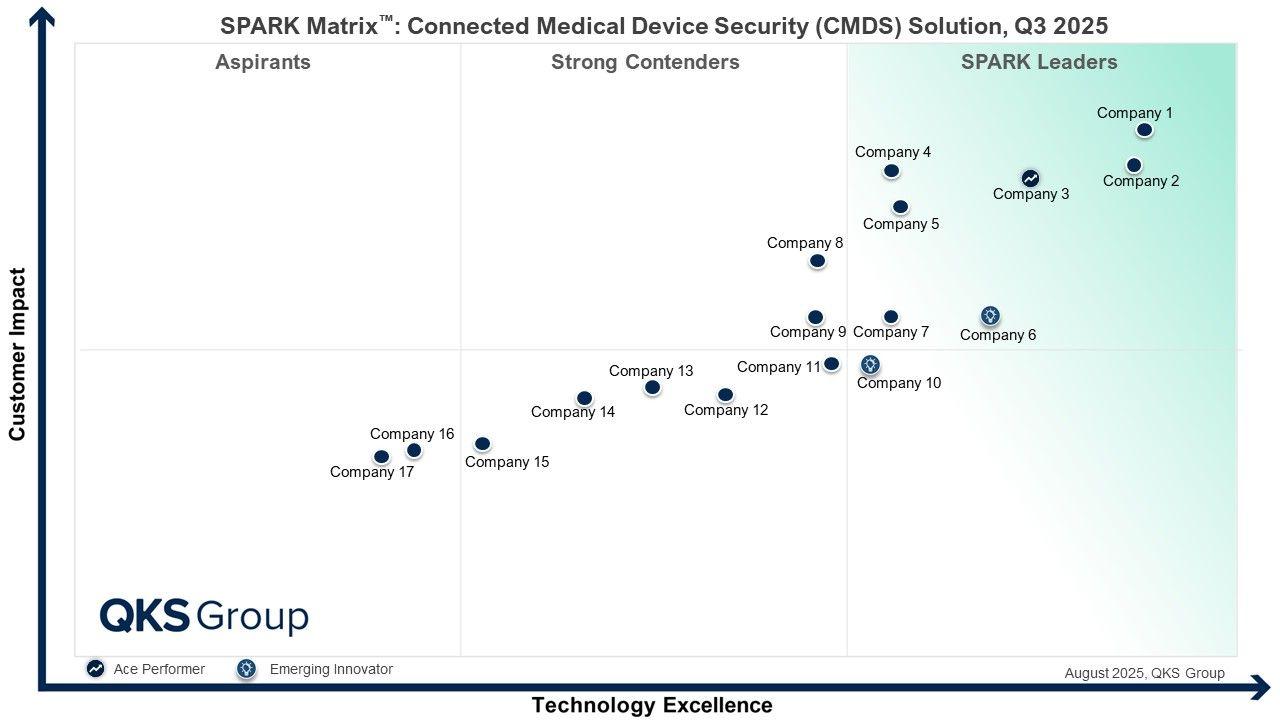
QKS Group's Connected Medical Device Security market research examines this evolving landscape through emerging technology trends, market dynamics, future outlook, competition analysis, and vendor evaluation. Its proprietary SPARK Matrix™ provides a structured assessment of leading vendors and their competitive differentiation.
Click Here For More Information: https://qksgroup.com/market-research/spark-matrix-connected-medical-device-security-cmds-solution-q3-2025-9102
What's Actually Changing for Healthcare Security Teams
Medical device connectivity is expanding the healthcare attack surface. Connected medical devices increasingly communicate with clinical applications, electronic health record systems, hospital networks, and cloud environments. This creates additional pathways that attackers may exploit while making it harder for security teams to maintain a complete inventory of connected assets.
Asset visibility has become a foundational requirement. Healthcare organizations often operate thousands of devices from different manufacturers, generations, and technology environments. Security teams need to identify what devices are connected, where they are located, how they communicate, what software they run, and how critical they are to patient care.
Traditional IT security approaches do not always translate to medical devices. Many clinical devices cannot be treated like conventional endpoints. Some may have long operational lifecycles, limited security controls, specialized operating systems, or restrictions on software updates. Security platforms therefore need to provide protection without disrupting clinical operations.
Risk context matters more than asset counts. Knowing that a vulnerable medical device exists is only the first step. Healthcare security teams need to understand the potential clinical and operational impact of that vulnerability. Contextual risk scoring can help organizations prioritize remediation based on device criticality, exposure, vulnerabilities, network behavior, and potential patient-safety implications.
Why Connected Medical Device Security Is Becoming Strategic
CMDS platforms are increasingly moving beyond passive asset discovery. Modern solutions combine asset intelligence, network monitoring, vulnerability assessment, behavioral analytics, threat detection, and risk prioritization.
The strongest platforms connect cybersecurity intelligence with clinical and operational context. This is important because the consequences of compromising a medical device can extend beyond data loss. An attack could potentially disrupt clinical workflows, affect device availability, expose sensitive patient information, or create safety concerns.
Healthcare organizations therefore need security strategies that account for both cyber risk and operational impact.
Integration with IT, OT, and clinical workflows is also becoming increasingly important. Security teams need to collaborate with biomedical engineering, clinical technology, infrastructure, compliance, and other stakeholders rather than treating medical device security as an isolated cybersecurity function.
Vendors Worth Shortlisting
Armis has established a strong position in asset intelligence and cyber exposure management, with capabilities relevant to discovering and monitoring connected medical devices and broader healthcare infrastructure. Its ability to provide visibility across heterogeneous environments makes it relevant for organizations seeking centralized asset intelligence.
Claroty brings extensive expertise in cyber-physical systems and healthcare environments. Its approach is relevant for healthcare delivery organizations seeking visibility and security across medical devices alongside broader operational technology environments.
Forescout provides device visibility, classification, network security, and risk assessment capabilities across connected environments. Its ability to identify and monitor diverse device populations makes it relevant for large healthcare organizations with complex networks.
Cynerio focuses specifically on healthcare cybersecurity and connected medical device environments. Its healthcare orientation makes it relevant for organizations looking for security capabilities tailored to clinical devices and healthcare operational requirements.
Asimily emphasizes connected device security, risk management, vulnerability intelligence, and remediation prioritization. Its positioning is relevant for healthcare organizations seeking to understand device-level exposure and prioritize security actions.
Ordr provides connected device discovery, asset intelligence, and security capabilities across IoT, IoMT, and enterprise environments. Its focus on understanding device behavior and communication relationships can support healthcare organizations managing highly distributed device ecosystems.
Nozomi Networks brings strong capabilities in IoT and OT security, with relevance to healthcare environments where medical devices coexist with operational and connected infrastructure.
Palo Alto Networks brings medical device security capabilities into a broader cybersecurity portfolio, allowing healthcare organizations to consider connected device protection alongside network, cloud, endpoint, and security operations capabilities.
The SPARK Matrix™ assessment also evaluates Cisco, Fortinet, Microsoft, Nuvolo, Phosphorus Cybersecurity, Plixer, Sepio, Tenable, and TXOne Networks, reflecting the breadth of the competitive CMDS landscape.
Check SPARK Plus Study Here: https://qksgroup.com/sparkplus
What Healthcare Organizations Should Evaluate
Five criteria separate credible CMDS candidates:
- Medical device visibility — the ability to discover, classify, inventory, and continuously monitor connected medical devices
- Contextual risk scoring — prioritization based on device criticality, vulnerabilities, network exposure, behavior, and clinical impact
- Real-time threat detection — identification of anomalous communication, malicious behavior, and potential compromise without disrupting clinical operations
- IT, OT, and clinical integration — integration with existing security, network, asset management, clinical, and operational workflows
- Vulnerability and remediation support — actionable intelligence that helps teams address exposure while accounting for patching limitations and device availability requirements
Healthcare organizations should also evaluate scalability, deployment architecture, regulatory support, vendor collaboration, reporting, security integrations, and the ability to operate across multi-site healthcare environments.
SBOM and Vulnerability Management Are Becoming More Important
Software supply chain transparency is becoming an increasingly important component of connected medical device security. A Software Bill of Materials (SBOM) can provide greater visibility into the software components embedded within devices and help organizations understand potential exposure when vulnerabilities emerge.
However, SBOM availability alone does not solve the remediation challenge. Medical device manufacturers, healthcare organizations, and security vendors need to coordinate around vulnerability disclosure, patch availability, compensating controls, and risk prioritization.
Vendor cooperation is therefore becoming a critical part of CMDS success. Healthcare organizations need security platforms that can support communication between cybersecurity teams and medical device manufacturers while maintaining visibility into unresolved risks.
Use Cases Across Healthcare Environments
Hospitals and health systems can use CMDS platforms to maintain visibility across large populations of connected clinical devices and prioritize risks across multiple facilities.
Medical device-heavy clinical environments can use behavioral monitoring to identify unusual communication patterns without relying solely on traditional endpoint security agents.
Healthcare security operations centers can integrate CMDS intelligence with SIEM, SOAR, network security, and incident-response workflows to accelerate investigation and response.
Biomedical engineering teams can use device intelligence to understand device inventory, software versions, vulnerabilities, and operational dependencies while coordinating with cybersecurity teams.
These use cases demonstrate why CMDS increasingly needs to bridge cybersecurity and clinical operations.
Future Outlook: 2025–2028
Between 2025 and 2028, connected medical device security is expected to become increasingly integrated with broader healthcare cybersecurity and cyber-physical security strategies.
AI-driven security analytics will become more prominent. AI can help identify unusual device behavior, correlate security events, prioritize vulnerabilities, and reduce the burden on security teams managing large device populations.
Healthcare organizations will also increasingly expect continuous asset intelligence rather than periodic device discovery. As device ecosystems become more dynamic, security teams will need real-time understanding of device connectivity, exposure, and behavior.
Regulatory expectations will continue to influence platform requirements. Security teams will increasingly prioritize solutions that support stronger documentation, risk management, vulnerability processes, and software supply chain visibility.
The convergence of IoMT security, network security, vulnerability management, and cyber-physical security will also encourage vendors to expand their platforms beyond traditional device monitoring.
Download Sample Report Here: https://qksgroup.com/download-sample-form/spark-matrix-connected-medical-device-security-cmds-solution-q3-2025-9102
Conclusion: From Device Visibility to Continuous Risk Reduction
The Connected Medical Device Security market is evolving as healthcare organizations recognize that connected clinical devices represent both an operational advantage and a cybersecurity responsibility.
The strongest CMDS platforms will go beyond identifying devices. They will provide contextual risk intelligence, real-time threat detection, vulnerability visibility, and integration with IT, OT, and clinical workflows.
QKS Group's research and proprietary SPARK Matrix™ provide healthcare organizations with a structured framework for evaluating leading CMDS vendors and understanding their competitive positioning. Vendors such as Armis, Asimily, Claroty, Cynerio, Forescout, and Ordr, alongside broader cybersecurity providers, demonstrate the increasingly competitive nature of this market.
For healthcare technology and security leaders, the strategic objective is clear: medical device security must move from passive visibility toward continuous risk reduction. As connected clinical environments become more complex, organizations that can combine asset intelligence, contextual risk scoring, threat detection, vulnerability management, and strong vendor collaboration will be better positioned to protect both digital infrastructure and the continuity of patient care.
 English
Join our community to interact with posts!