
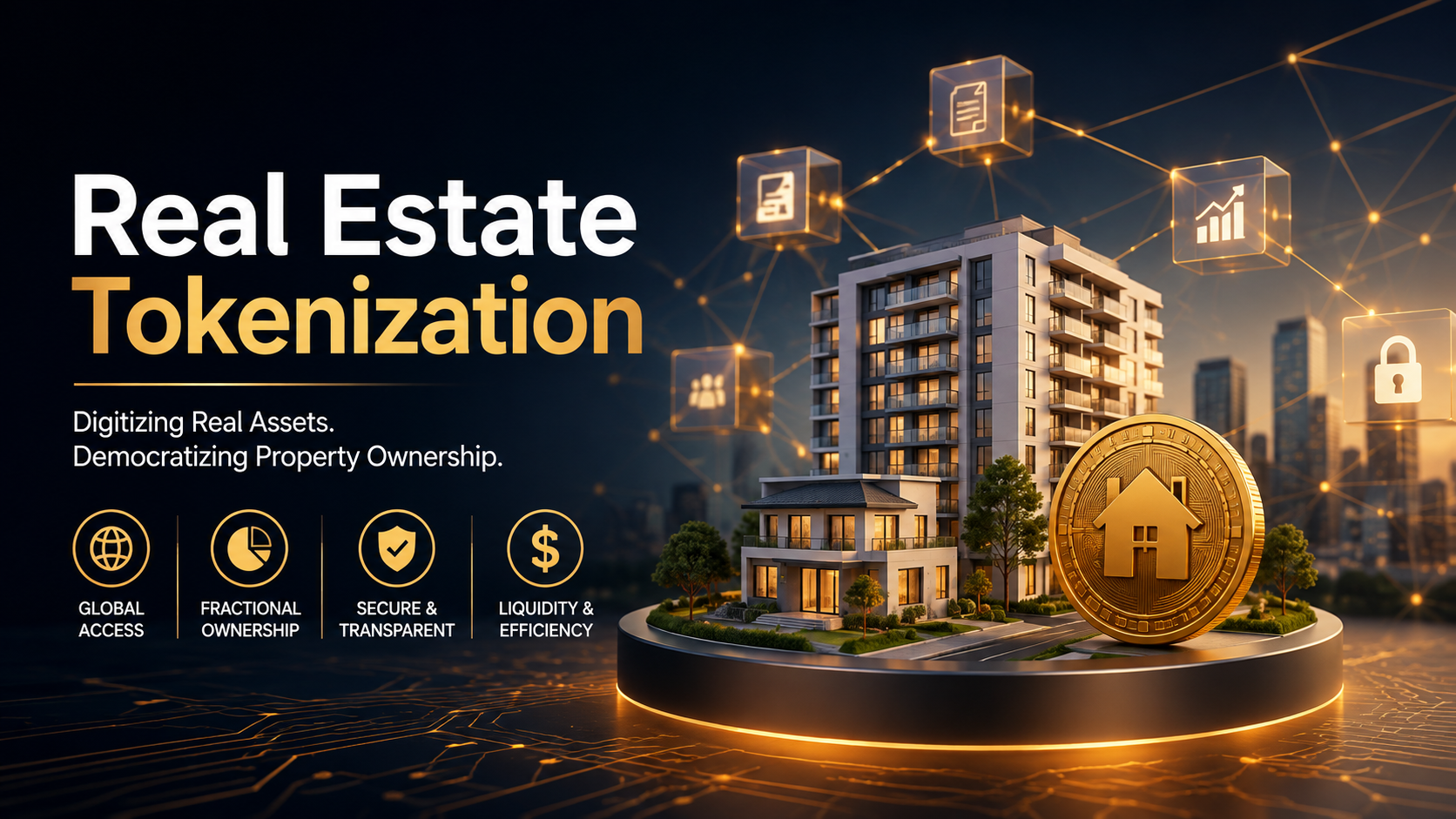
Real estate has traditionally been viewed as a long-term investment requiring significant capital, extensive paperwork, and complex ownership structures. Investors often need to commit substantial funds to acquire a property, while developers and asset owners depend on banks, private funds, or institutional investors to raise capital.
Real estate tokenization is introducing a different approach. By representing ownership interests, economic rights, or other legally defined interests in real estate through blockchain-based tokens, property investment can be divided into smaller and potentially more flexible units.
This creates opportunities for developers, property owners, investment managers, and investors to explore new ways of structuring capital, distributing income, and managing ownership.
Rather than replacing traditional real estate tokenization investment entirely, tokenization can complement existing structures by adding blockchain-based infrastructure to traditionally illiquid assets.
What Is Real Estate Tokenization?
Real estate tokenization is the process of representing legally defined interests connected to a real estate asset through digital tokens recorded on a blockchain.
A token may represent:
- A fractional ownership interest
- An economic interest in a property-holding entity
- A claim to rental income
- An interest in a real estate fund
- Certain contractual rights associated with a property
The exact rights depend on the legal and financial structure behind the token.
For example, a commercial building could be held through a special purpose vehicle (SPV). Eligible investors could then acquire tokens representing defined interests in that structure. Rental income generated by the property could be distributed according to the terms governing those tokens.
This combination of legal structuring and blockchain infrastructure creates a more flexible framework for real estate investment.
Why Real Estate Investment Structures Are Changing
Traditional property investment structures can create several barriers for investors and asset owners.
Purchasing an entire property requires substantial capital. Selling an ownership interest can take considerable time. Income distribution may require manual accounting and intermediary involvement. Ownership records can also be fragmented across different institutions and databases.
Tokenization addresses some of these limitations by creating digitally represented interests that can be divided, transferred, tracked, and programmed according to predefined rules. The result is a potential shift from large, static ownership structures toward more granular and programmable investment models.
How Real Estate Tokenization Creates Flexible Investment Structures
1. Fractional Ownership Models
Fractionalization is one of the most important features of tokenized real estate. Instead of requiring one investor to purchase an entire property, a legally structured property interest can be divided into multiple tokenized units. Each investor can acquire a portion according to the offering terms. For example, a property investment structure could issue 100,000 tokens representing defined economic interests. Investors could purchase smaller quantities instead of committing capital to the entire property. This can lower minimum investment requirements and make certain real estate opportunities accessible to a broader pool of eligible investors.
2. Multiple Investor Classes
Tokenization can support more sophisticated ownership structures. A real estate project could potentially create different classes of digital interests with different economic rights. For example, one class could receive priority distributions while another could have greater exposure to capital appreciation. These structures must be carefully designed to comply with applicable securities and property laws, but blockchain technology can help automate the rules associated with different investor categories. This flexibility can help developers and fund managers design investment products around specific investor requirements.
3. Flexible Capital-Raising Models
Developers often need capital at different stages of a property lifecycle, including acquisition, development, construction, refinancing, and expansion. Tokenization can support alternative capital-raising models by allowing developers to offer fractional interests in a legally structured project. Rather than selling the entire property or relying exclusively on conventional financing, developers may be able to combine:
- Bank financing
- Institutional capital
- Private investors
- Tokenized investment interests
This creates a more diversified capital structure.
4. Flexible Income Distribution
Real estate generates different types of cash flows depending on the property and investment structure. Tokenization can make it possible to program distribution mechanisms for rental income, interest, or other defined cash flows. Smart contracts can calculate investor entitlements according to predefined rules and automate certain distribution processes once required conditions are satisfied. For example, investors could receive distributions based on their token holdings, while different investor classes could follow different priority structures.
5. Improved Ownership Transferability
Traditional real estate ownership transfers can involve extensive documentation, legal reviews, settlement procedures, and administrative costs. Tokenized interests can potentially be transferred digitally, subject to the legal restrictions governing the asset. Smart contracts can also restrict transfers based on eligibility requirements, jurisdiction, holding periods, or other compliance rules. This creates a more programmable approach to ownership management.
Real Estate Assets That Can Support Tokenized Structures
Tokenization can potentially be applied across multiple property categories.
Residential Real Estate
Apartment buildings, multifamily properties, rental homes, and student housing can be structured into fractional investment opportunities.
Commercial Real Estate
Office buildings, retail centers, and mixed-use properties can provide income-generating opportunities for token holders.
Industrial Real Estate
Warehouses, logistics facilities, and manufacturing properties can be structured around rental income and long-term appreciation.
Hospitality Properties
Hotels, resorts, and serviced apartments can potentially be tokenized to provide exposure to operating revenues or property-level interests.
Real Estate Development Projects
Developers can explore tokenized funding structures for construction and redevelopment projects, subject to applicable regulations.
Benefits of More Flexible Real Estate Investment Structures
Greater Accessibility
Tokenization can reduce investment minimums by dividing a property interest into smaller units. This allows a broader range of investors to participate where regulations permit.
Portfolio Diversification
Investors can potentially allocate smaller amounts across multiple properties, locations, and asset classes rather than concentrating capital in a single asset.
Operational Efficiency
Blockchain-based records and smart contracts can automate certain ownership, reporting, and distribution processes, reducing administrative workloads.
Greater Transparency
Blockchain creates a shared digital record of transactions and token ownership, potentially improving visibility for investors, operators, and other authorized participants.
Potential Liquidity Improvements
Tokenized interests may be easier to transfer than traditional private real estate interests if an appropriate compliant secondary market exists. However, tokenization itself does not guarantee liquidity. A functioning marketplace requires sufficient buyers, sellers, regulatory permission, and supporting infrastructure.
The Role of Smart Contracts
Smart contracts are an important component of flexible tokenized real estate structures.
They can automate predefined processes such as:
- Token issuance
- Ownership tracking
- Investor eligibility rules
- Rental income calculations
- Distribution schedules
- Transfer restrictions
- Redemption mechanisms
For example, when rental income is received and all required conditions are met, a smart contract can calculate each eligible investor's distribution according to the governing agreement. This reduces dependence on manual processing and creates a more programmable investment environment.
How Tokenization Can Support Real Estate Developers
Real estate developers can benefit from flexible capital structures in several ways.
Access to a Broader Investor Base
Tokenized offerings can potentially reach a wider pool of eligible investors than conventional private fundraising models.
Partial Ownership Sales
Developers may be able to sell a defined percentage of an asset rather than disposing of the entire property.
Capital Recycling
After a project reaches a certain stage, developers could potentially tokenize or sell an interest in the completed asset and use the proceeds to finance another development.
Alternative Exit Strategies
Tokenization can create additional options for monetizing property interests, including partial sales, structured income interests, and secondary transfers where permitted.
How Tokenization Can Benefit Investors
Investors may gain access to investment structures that provide greater flexibility in capital allocation. Instead of purchasing a complete property, investors can potentially acquire smaller interests across different assets.
For example, an investor could diversify across:
- Residential properties
- Commercial buildings
- Logistics facilities
- Hospitality assets
- Development projects
This approach can provide more granular exposure to the real estate market. Tokenized structures may also provide improved visibility into ownership records and distributions, depending on the platform and legal framework.
Challenges of Flexible Tokenized Investment Structures
Despite the potential advantages, tokenization does not eliminate the complexities associated with real estate investment.
Regulatory Compliance
Tokenized real estate interests may qualify as securities or other regulated financial instruments depending on their structure and jurisdiction. Issuers must address requirements related to investor eligibility, disclosures, KYC/AML procedures, securities regulations, and transfer restrictions.
Legal Enforceability
Blockchain records alone do not establish property ownership. The legal structure must clearly connect the token to enforceable rights. This makes legal architecture just as important as blockchain technology.
Liquidity Risk
A token may be technically transferable but still difficult to sell if there is insufficient market demand.
Therefore, investors should distinguish between token transferability and actual market liquidity.
Property-Level Risk
Tokenization does not eliminate traditional real estate risks. Property values, vacancy rates, tenant defaults, operating costs, interest rates, and market conditions can still affect investment performance.
Technology Risks
Smart contract vulnerabilities, cybersecurity threats, wallet security issues, and platform failures can introduce additional risks.
The Future of Flexible Real Estate Investment
The future of real estate tokenization is likely to involve a combination of traditional financial structures and blockchain infrastructure.
Rather than completely replacing REITs, private funds, SPVs, or conventional property financing, tokenization may enhance these models by introducing programmable ownership, digital settlement, and more granular investment structures.
Interoperability between blockchain networks and traditional financial systems will also become increasingly important. Investors may eventually be able to manage tokenized real estate alongside other digital financial assets through integrated investment platforms.
Artificial intelligence, property analytics, automated compliance, and real-time asset data could further strengthen these systems.
As regulatory frameworks mature and institutional adoption increases, tokenized real estate could become an important component of modern investment infrastructure.
Conclusion
Real estate tokenization is creating new possibilities for flexible investment structures by combining traditional property ownership frameworks with blockchain-based digital infrastructure.
Fractional ownership, multiple investor classes, programmable income distribution, digital transfer mechanisms, and alternative fundraising models can provide greater flexibility to both investors and property owners.
However, successful tokenization depends on much more than issuing digital tokens. Strong legal structures, regulatory compliance, accurate asset valuation, secure technology, transparent disclosures, and genuine market liquidity are essential.
 English
Join our community to interact with posts!