
Cold calling has a math problem. A rep dials fifty numbers and reaches two people. Ringless voicemail skips the dial entirely — it drops a pre-recorded message straight into a prospect's voicemail inbox, no ring, no wasted minute waiting for a "hello?" that never comes. So which one actually gets a callback? Short answer: ringless voicemail wins on volume and reply rate, cold calling still wins when a live conversation has to happen on the first touch.
Quick Verdict
Use voicemail drops if: your team spends hours calling and leaving voicemails, you have lots of contacts in a day, the offer doesn‘t need a live back-and-forth (reminders, promos, re-engagement).
Use cold calling if: the deal really does “require a live touch one” conversation, or your list is small enough that dial time isn‘t the killer.
Most teams don't pick one. They run voicemail drops as the first touch, then let calls handle the callbacks it generates.
At a Glance
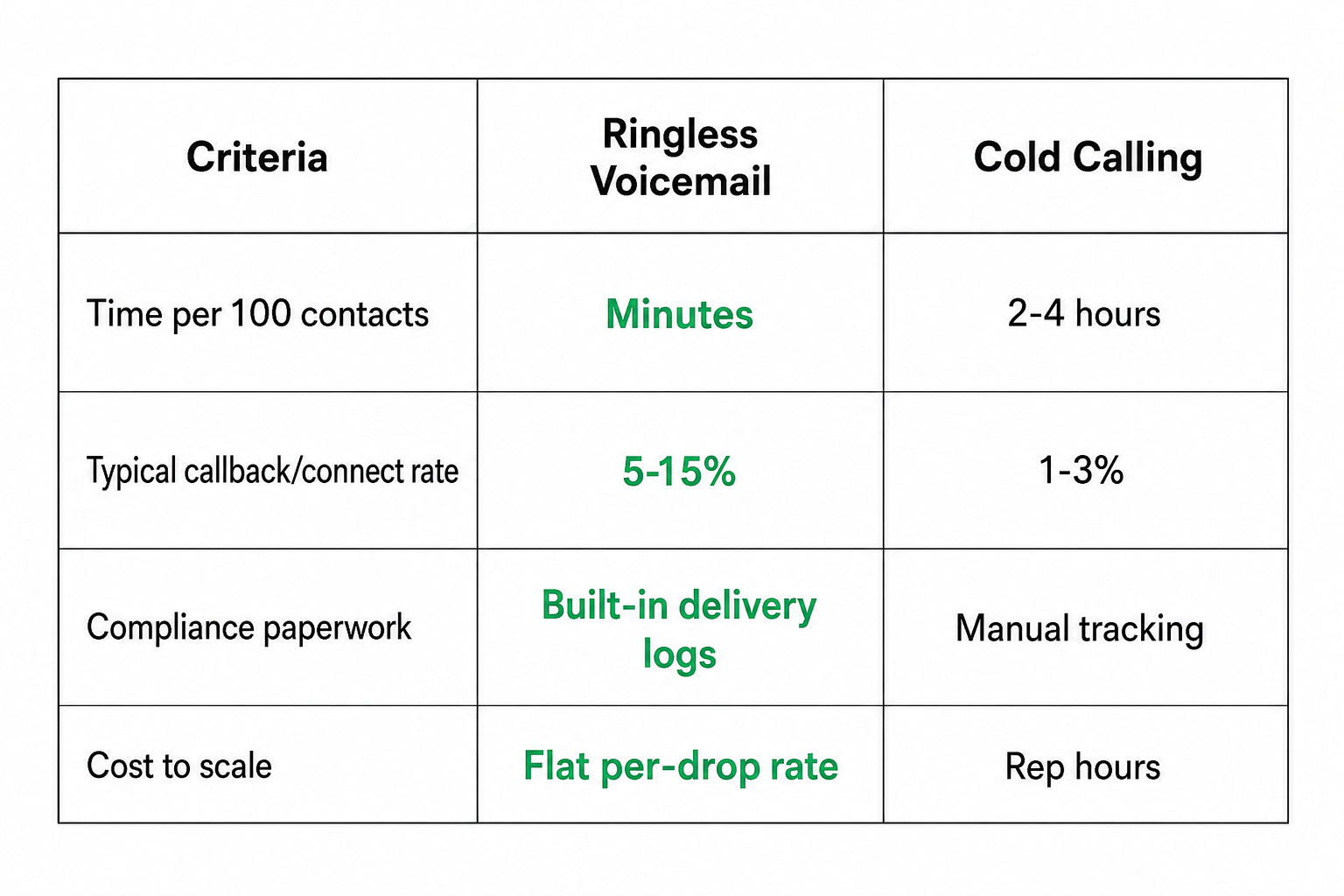
Speed and Volume
This isn't close. A rep dialing manually gets through maybe 60-80 calls a shift, and most of those hit voicemail anyway — the rep just spent 45 seconds getting there. A drop campaign delivers thousands of messages in the time it takes to record one. One dealership dropped 800 voicemails on a Saturday morning and had 47 people walk in that weekend asking about the promo. No cold-calling shift produces that kind of same-day volume.
Callback Rate
Cold calling has a built-in problem: most calls that connect at all connect to voicemail, and a robotic-sounding message triggers an instant hang-up. Voicemail drops sidestep that — the recipient hears it on their own time, with nothing to react against. Aggregate numbers across ringless campaigns land around 5-15% callback rates, well above the 1-3% connect rate most outbound teams see on cold dials. One SaaS sales VP tracked her SDR team stuck at a flat 2% connect rate for months; once voicemail drops went in as a pre-call touch, that number moved past 9%. The catch: a generic script underperforms in either format. It still has to sound like a person.
Compliance Risk
Neither tactic is risk-free. The FCC's 2022 ruling treats ringless voicemail to wireless numbers as a "call" under the TCPA, so it needs the same consent as an actual dial. The difference is documentation — a decent ringless voicemail software platform logs delivery timestamps and opt-outs automatically, where cold calling relies on the rep and CRM to track that manually. Manual tracking is where compliance gaps happen.
Cost to Scale
Cold calling's real cost isn't the phone bill, it's rep hours — and that cost doesn't shrink as volume grows. Double the list, double the hours. Voicemail platforms typically price per drop instead, so cost scales with volume, not headcount. DropDialer's plans, for reference, run from a free 7-day trial up to $149/mo for 750 drops and $995/mo for 9,000 — a flat cost regardless of team size.
Use Cases
- Real estate agents working expired listings: volume matters more than a scripted live pitch on first contact.
- Insurance renewal outreach: reminders don't need a live conversation, they need to reach the whole book before the deadline.
- Complex B2B, six-figure deals: cold calling still earns its place for the first real conversation with a decision-maker — voicemail can warm it up, not replace it.
- Time-sensitive promos: the dealership example above is the shape of what volume-driven offers need.
FAQ
Is ringless voicemail legal? Yes, with consent under the TCPA. The compliance bar is the same as a live dial, not lower.
Can I run both at once? Most teams do — voicemail drops for volume, calls for the warm callbacks they generate. That combination usually beats either tactic alone.
Does a robotic-sounding message hurt results? Significantly. Platforms with AI voice cloning or live-recorded messages tend to outperform generic text-to-speech by a wide margin.
Final Recommendation
If the goal is more callbacks with less rep time burned, voicemail drops are the stronger tactic — the data consistently shows higher response rates than cold dialing, at a fraction of the time cost. Cold calling isn't dead; it works best as the second step, the conversation a rep has once someone's already decided to call back. Run the two together, and each covers the other's weak point.
 English
Join our community to interact with posts!