
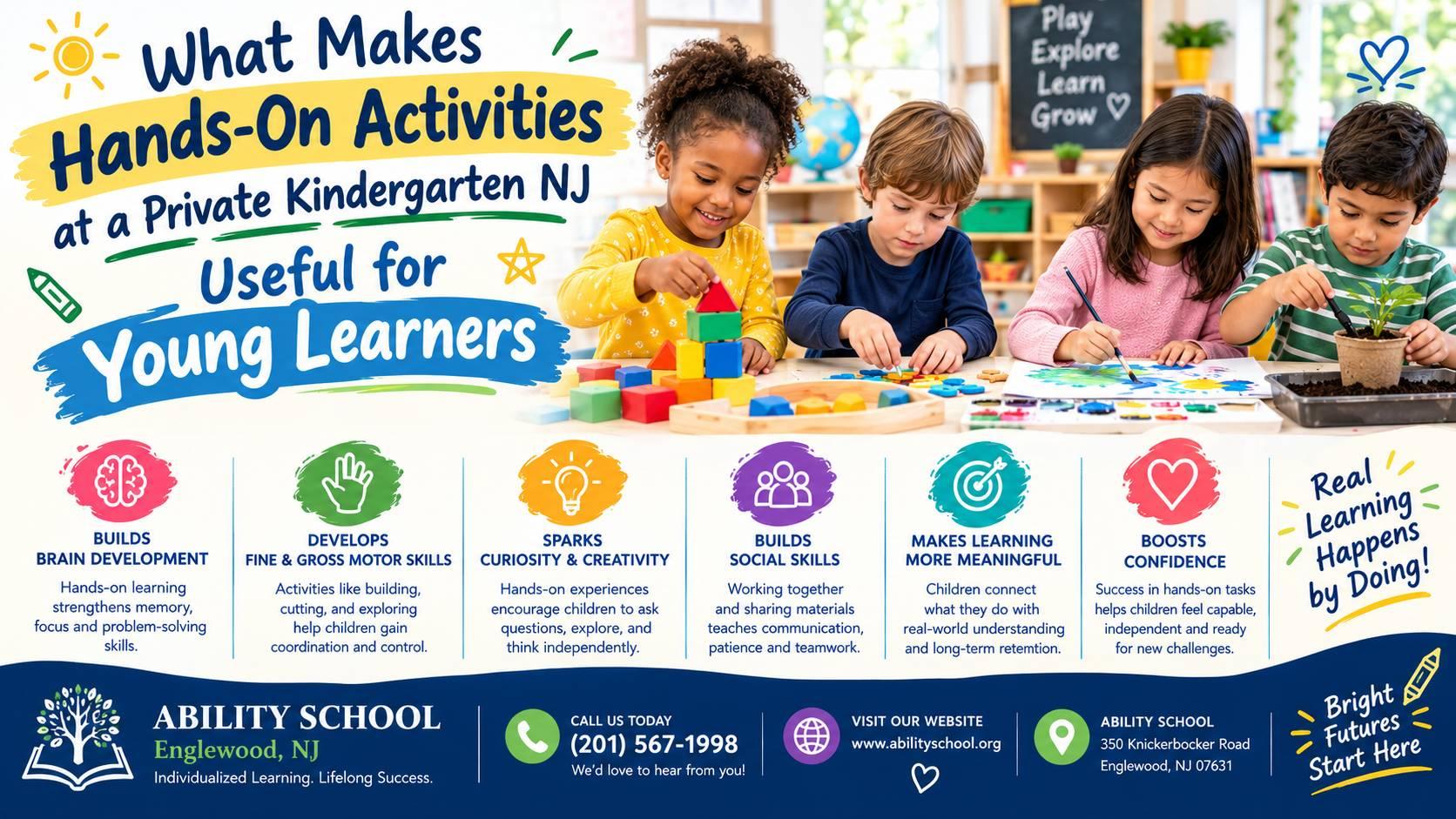
Have you noticed how quickly a young child remembers something after building it, touching it, sorting it, or trying it for themselves? Early learners often need more than an explanation on a board. A private kindergarten NJ program can use practical activities to turn basic ideas in reading, math, science, and language into something children can actually work with. The activity itself is not the goal. The learning behind it is.
How Hands-On Work Supports Early Academic Learning
Young children are still developing the ability to work with abstract ideas. A number such as eight can look simple to an adult, but a child may understand it better after counting eight objects, separating them into groups, and putting them together again.
The same applies to language. Letter cards, word-building exercises, picture matching, and reading aloud can give children several ways to process one lesson. Parents comparing the best private kindergarten, NJ options should therefore look at how schools connect activities with academic goals.
A classroom project should reinforce something specific. It might strengthen phonics, introduce measurement, improve handwriting control, or help a child notice patterns. Without that connection, an activity may keep children occupied without doing much for their academic progress.
Why Individualized Activities Work Better for Different Learners
Two kindergarten students can receive the same instruction and respond in very different ways. One may understand a new sound immediately. Another may need to repeat it with letter tiles, pictures, and spoken examples before it becomes clear.
This is where a private kindergarten, NJ program with individualized learning can offer a different classroom experience. Teachers can change the amount of practice, the level of difficulty, or the type of task based on the student in front of them.
Ability School uses individualized programs within its Lower School approach. Students can work at a pace that reflects their academic progress rather than moving through every subject at exactly the same speed.
That approach becomes useful during hands-on work because teachers can see the learning process. They notice where a child pauses, what type of instruction causes confusion, and whether the student can complete a similar task without help.
What Useful Hands-On Kindergarten Activities Can Include
Practical learning does not need complicated equipment. In many cases, simple materials work better because the child can concentrate on the concept instead of the presentation.
Examples can include:
-
arranging letter cards to build simple words and practice spelling;
-
sorting objects by shape, size, quantity, or category;
-
measuring classroom items and comparing their length or weight;
-
completing basic STEAM projects that involve planning, building, and testing;
-
drawing maps, diagrams, or models after learning about a place or science topic;
-
using field trips to connect a classroom subject with a museum, nature center, or community setting.
Each task gives the teacher another way to check comprehension. It also lets the student use information instead of repeating an answer from memory.
Why Mastery Should Come Before the Next Lesson
Early academic gaps do not always look serious. A child may remember several sight words, for example, while still struggling to connect letters with their sounds. Moving too quickly can hide that weakness for a while.
A private kindergarten, NJ classroom that focuses on mastery can slow the sequence when a student needs more practice. The teacher can return to the idea through a different activity, ask the student to demonstrate it, and check whether the skill still works in another situation.
This approach is especially relevant in reading, writing, spelling, and arithmetic. These subjects build in stages. Weakness in an earlier stage can make later work harder than it needs to be.
Hands-on learning gives teachers another way to check whether the child has understood the concept rather than memorized the answer.
How Practical Learning Can Build Better Study Habits
Kindergarten education is not only about finishing early academic topics. Children also begin learning how to approach work. They follow instructions, organize materials, ask questions, correct mistakes, and return to a task after getting something wrong.
Ability School connects this idea with its focus on helping students learn how to learn. Its Lower School curriculum also includes reading, writing, spelling, mathematics, geography, history, science, STEAM activities, art, music, field trips, and physical education.
Practical activities can support those study habits because the child has to make decisions during the task. A STEAM exercise, for instance, may require a student to try one design, notice that it does not work, and change it. That process teaches more than the final result.
How Parents Can Judge the Quality of Hands-On Learning
A colorful classroom does not automatically indicate strong experiential learning. Parents need to look at what happens before and after each activity.
Teachers should be able to explain the academic purpose behind a project. They should also observe how students perform, identify misunderstandings, and use the result when planning later instruction.
Strong early learning programs usually connect practical work with reading development, core academic skills, self-paced instruction, creative work, and real-world application. The different parts should support one another.
Choosing Hands-On Learning With a Clear Academic Purpose
Hands-on education works best when children do more than complete projects. They should use each activity to practice a skill, test an idea, correct an error, or connect new information with something they already know.
For parents comparing a private kindergarten, NJ program, the useful question is simple: what does the child learn from doing the activity? When practical work supports individualized instruction, strong academic foundations, and real comprehension, it becomes part of the learning process rather than an extra classroom exercise.
 English
Join our community to interact with posts!