
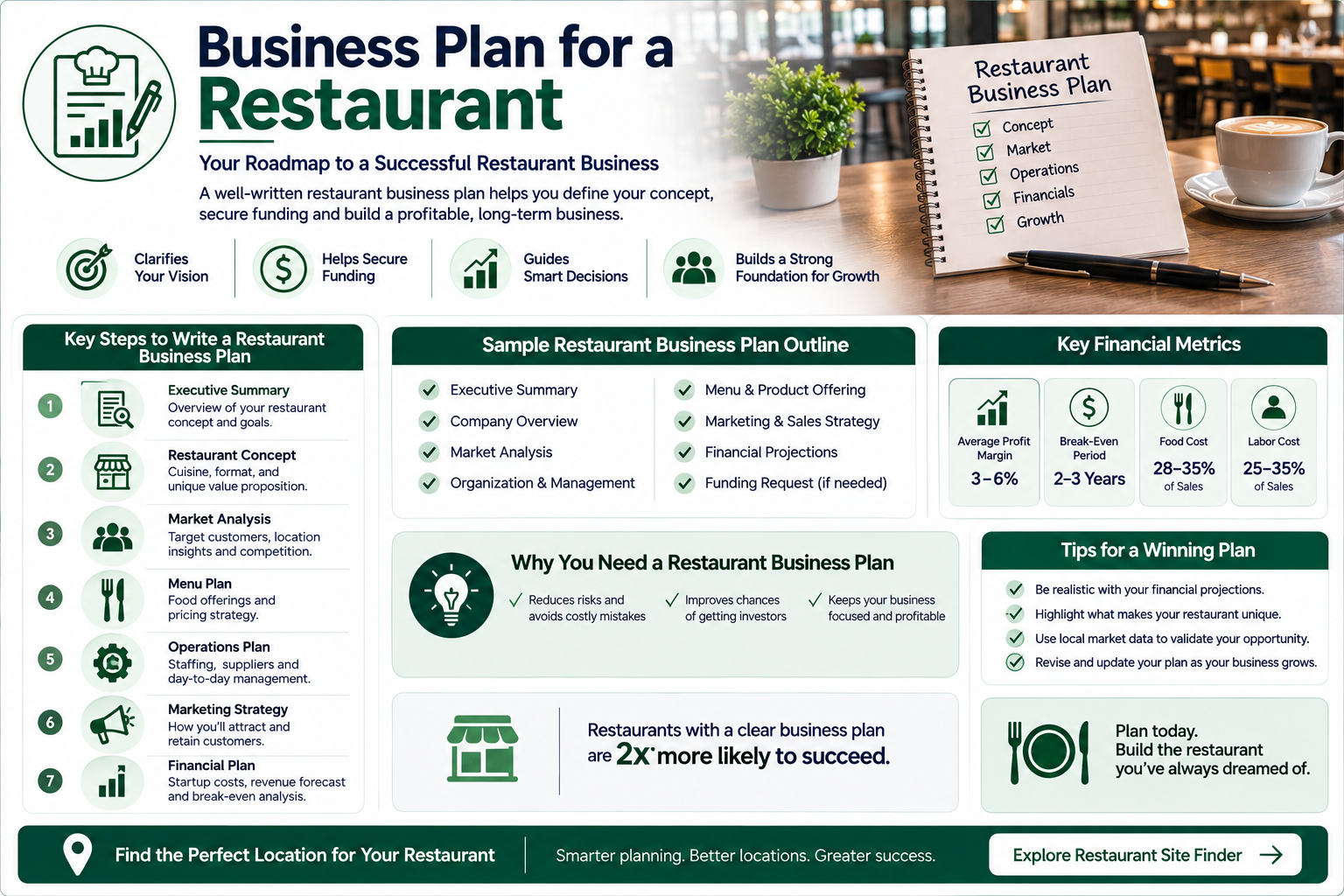
Learning how to write a business plan for a restaurant is important because a restaurant combines hospitality, operations, finance, marketing, staffing, purchasing, and customer experience. A business plan brings these areas into one document. It gives the owner a structured way to test whether the concept is realistic before committing significant capital. It can also help communicate the opportunity to investors, lenders, partners, and key employees.
Start With the Concept
Describe the restaurant clearly: cuisine, service style, target customer, price positioning, operating hours, location strategy, and the experience you want guests to remember. Avoid vague statements. A useful concept description should make it possible for someone else to understand what the restaurant sells and why customers would choose it.
Define the Target Market
A strong plan explains who the restaurant intends to serve and why those customers are attractive. Consider demographics, spending patterns, occasions, dietary preferences, work and residential patterns, and local demand. The target market should connect directly to menu pricing, service style, location, marketing, and hours.
Research the Competition
List direct competitors and alternatives. Review their menus, prices, ratings, service model, positioning, opening hours, delivery presence, and customer reviews. Look for gaps rather than simply copying successful businesses. A competitive analysis should answer what the restaurant can do better, differently, or more conveniently.
Build the Operations Plan
Explain how food will be sourced, stored, prepared, served, packaged, and delivered. Include equipment needs, suppliers, staffing roles, training, technology, food-safety processes, cleaning routines, and opening procedures. A concept is only as strong as the operating system that delivers it.
Create the Financial Model
The financial section should estimate startup costs, sales, food and beverage costs, labor, rent, utilities, marketing, technology, insurance, maintenance, taxes, debt service, and other expenses. Build conservative, base, and optimistic scenarios. A plan is more useful when it shows how the business behaves under different sales and cost assumptions.
Estimate Sales Realistically
Sales forecasts should be based on capacity, average check, expected transactions, operating days, seat turnover where relevant, delivery volume, and local demand. Avoid choosing a revenue number simply because it makes the investment look attractive. Explain the assumptions and identify which ones are most sensitive.
Marketing and Customer Acquisition
Describe how customers will discover the restaurant before opening and how you will encourage repeat visits afterward. Consider local search, social media, partnerships, loyalty programs, events, email or SMS where appropriate, delivery channels, and community relationships. Include a budget and a way to measure results.
Risk and Contingency Planning
Identify major risks such as slower-than-expected sales, construction delays, labor shortages, supplier price increases, equipment failure, or changes in customer demand. For each risk, outline a practical response. This makes the plan a management tool rather than a document written only for financing.
Turning the Plan Into Action
Once the plan is approved, convert major assumptions into milestones. Track actual sales and costs against the forecast, review the menu and labor plan, and update assumptions when evidence changes. A business plan should evolve as the restaurant learns more about its customers and operating environment.
Research Before Writing
The strongest business plans are based on evidence collected before the document is drafted. Visit competing restaurants, observe busy and slow periods, study menus and pricing, speak with potential customers, and investigate local operating conditions. Record sources and assumptions so the plan can be updated later. Research also helps reveal questions that the original concept may not have considered, such as parking constraints, delivery access, seasonal demand, neighborhood development, or unusual labor conditions.
Plan the Opening Timeline
A restaurant opening involves many interdependent activities. Lease negotiations, design, permits, construction, equipment ordering, technology setup, hiring, training, menu testing, supplier onboarding, marketing, and inspections can affect one another. Build a timeline with dependencies and contingency time. The financial plan should reflect the timing of cash outflows and the possibility of delayed revenue. A realistic opening plan is less about predicting an exact date and more about making the critical dependencies visible.
Define Success Metrics
A plan should specify how performance will be evaluated after launch. Useful measures can include weekly sales, average check, transactions, labor percentage, product cost, contribution margin, customer acquisition, repeat visits, online ratings, and cash balance. Choose measures that reflect the concept. For example, a fast-casual restaurant may emphasize throughput and order accuracy, while a full-service restaurant may place greater weight on table turns and guest satisfaction.
Plan for Different Scenarios
Scenario planning makes the financial model more useful. Build at least a conservative case, a base case, and an upside case. Change the assumptions that matter most, such as transactions, average check, labor cost, food cost, rent, and marketing spend. Then calculate the impact on cash flow and profitability. If the business only works in an optimistic scenario, that is important information before opening. Scenario planning can also show which variable deserves the most attention.
Keep the Document Alive
A business plan should not become a static file after financing is approved. Update it as actual performance reveals what customers want and how costs behave. If a key assumption changes, document why and revise the forecast. This turns the plan into a living management tool. Regular updates also help owners communicate clearly with partners and managers because everyone can see the current priorities and the reasoning behind them.
A Simple Implementation Checklist
A useful way to apply the ideas in this guide is to turn them into a short implementation checklist. First, write down the current situation using the most reliable information available. Second, define one measurable objective and a reasonable time period. Third, identify the people, systems, budget, and operational changes required. Fourth, decide how success will be measured before the change begins. Finally, schedule a review and record what happened. This approach keeps the team focused and makes it easier to separate a genuinely useful improvement from an idea that simply sounded good.
Communicate the Decision Clearly
Restaurant initiatives often fail because the team does not understand what is changing or why. Managers should explain the objective, the expected behavior, the customer benefit, and the measures that will be reviewed. Instructions should be practical and specific. For example, instead of telling staff to reduce waste, explain which preparation quantities, storage procedures, or portion controls need attention. Invite employees to report problems because frontline observations can reveal operational barriers quickly. Clear communication creates accountability while also giving staff a chance to contribute to the solution.
Review, Learn, and Adjust
No restaurant strategy should be treated as permanent. Customer demand changes, competitors respond, costs move, and operational capacity evolves. After implementing a change, compare the result with the original objective and document the lesson. If the outcome is positive, determine whether the improvement can be standardized. If the outcome is weak, identify what assumption was incorrect and revise the approach. This cycle of testing, measurement, and adjustment creates a culture of continuous improvement and helps the restaurant respond to change without making decisions based solely on instinct.
Key Takeaways
For owners who are researching how to write a business plan for a restaurant, the most important lesson is to connect the idea to measurable business outcomes.
· Define the business objective and the customer problem before investing time or money.
· Use consistent financial and operating measures so changes can be identified early.
· Validate decisions with local market evidence, customer feedback, and actual operating data.
· Protect the guest experience while improving efficiency and controlling costs.
Conclusion
A strong restaurant strategy is rarely built from one decision. Owners need a clear concept, reliable numbers, disciplined operations, and a practical way to understand the market around them. The most useful approach is to turn the subject of this guide into a repeatable management habit rather than a one-time task. Review the relevant numbers regularly, compare actual performance with your plan, document what changed, and make small adjustments before a problem becomes expensive. When the team understands the reason behind a decision, execution also becomes more consistent.
Restaurant operators should also remember that local conditions matter. Customer behavior, competition, rent, labor availability, supplier terms, seasonality, delivery demand, and neighborhood development can all change the economics of a business. A strategy that works in one area may need to be adapted elsewhere. Use the ideas in this guide as a framework, then validate them with your own operating data and local research.
Finally, keep the customer at the center of the process. Better financial control, technology, market research, or equipment decisions should ultimately help the restaurant serve guests more consistently and profitably. The goal is not simply to collect information. The goal is to use information to make better decisions, protect margins, improve the guest experience, and build a restaurant that can perform sustainably over time.
Explore more restaurant planning and industry resources at Restaurant Site Finder for additional practical guidance.
 English
Join our community to interact with posts!