
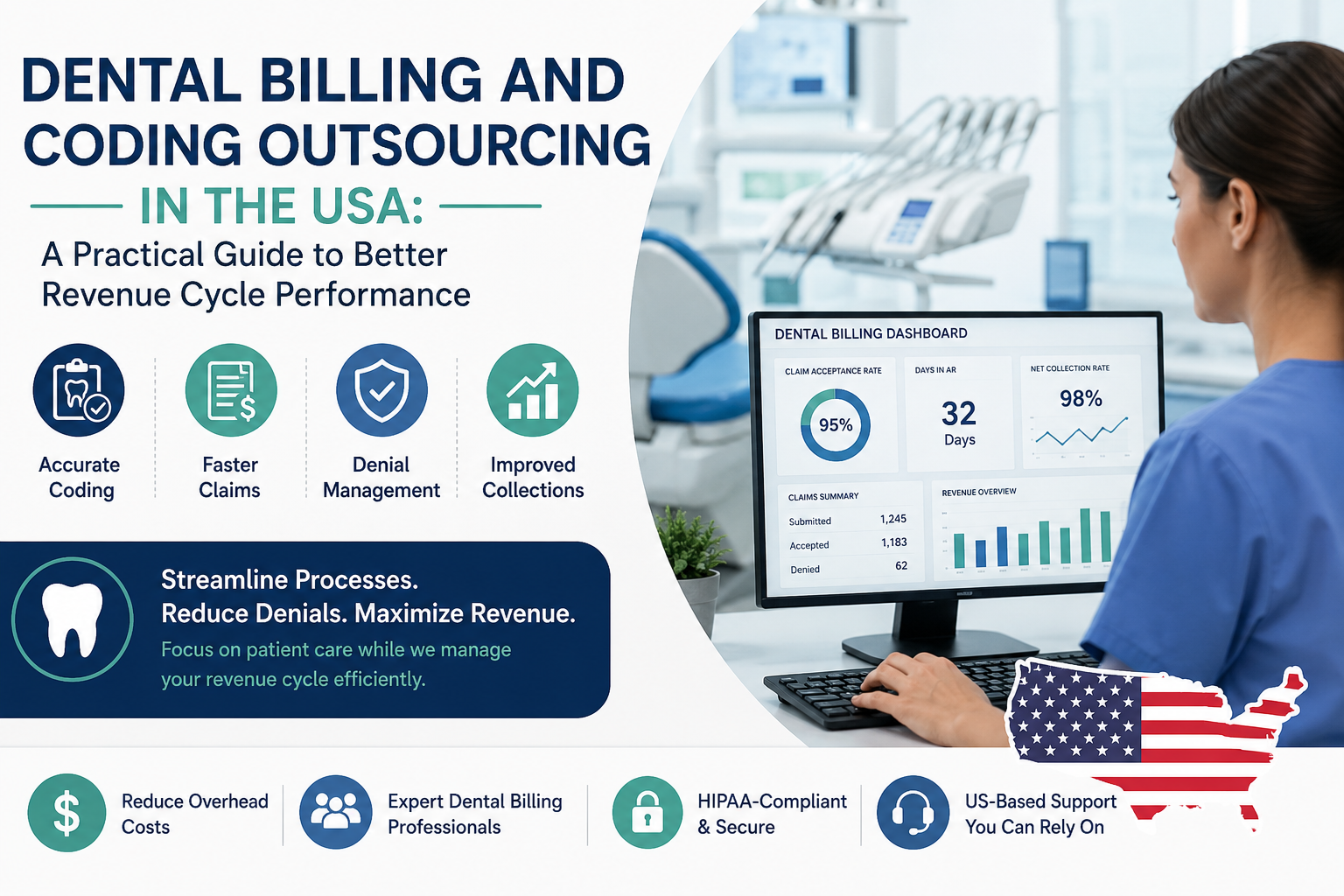
Running a dental practice involves much more than providing quality patient care. Dentists and their teams also have to deal with insurance verification, claim submission, coding accuracy, payment posting, denials, patient balances, and constant payer changes. When these administrative tasks take too much time, revenue can suffer even when a practice has a steady flow of patients.
This is where a dental billing agency can become a practical solution. Instead of managing every billing task internally, a dental practice can work with an experienced billing partner that understands dental claims, payer requirements, coding procedures, and revenue follow-up.
For many practices, the goal is not simply to send claims faster. It is to create a more organized billing process that reduces avoidable errors, improves reimbursement visibility, and allows the dental team to spend more time on patients.
Why Dental Billing Has Become More Complicated
Dental billing may appear straightforward from the outside, but the process involves several moving parts. A claim can be delayed because of an incorrect patient detail, missing documentation, coding mismatch, eligibility issue, or payer-specific requirement.
The challenge becomes greater for practices that work with multiple insurance companies. Each payer may have different policies, claim requirements, reimbursement rules, and timelines.
Common administrative challenges include:
- Verifying insurance eligibility before appointments
- Understanding dental benefits and coverage limitations
- Selecting appropriate procedure codes
- Submitting clean claims
- Tracking outstanding claims
- Correcting rejected claims
- Following up on unpaid accounts
- Posting insurance and patient payments accurately
- Managing claim denials and underpayments
- Keeping patient balances organized
When these activities are handled inconsistently, small errors can accumulate into significant revenue leakage.
What Does a Dental Billing Agency Do?
A dental billing agency provides outsourced billing and administrative support for dental practices. The exact scope varies between providers, but a comprehensive partner may manage activities throughout the billing cycle.
A typical workflow can include patient information review, insurance verification, claim preparation, electronic submission, payment posting, denial management, accounts receivable follow-up, and reporting.
The important distinction is that outsourcing does not mean giving up control of the practice's financial operations. A good billing partner should provide visibility through reports, communication, and clearly defined processes.
For example, consider a dental practice that submits 500 insurance claims each month. If a portion of those claims requires corrections because of eligibility or coding problems, staff members must spend additional hours identifying the issue and resubmitting the claim. A structured billing process can identify these problems earlier and reduce unnecessary rework.
Dental Billing Companies vs. In-House Billing
Many practices initially manage billing internally because it gives them direct control. However, maintaining an effective in-house billing department requires trained employees, software, quality checks, ongoing education, and sufficient staffing.
Dental billing companies can provide specialized knowledge without requiring a practice to build the entire function internally.
In-house billing may involve:
- Salaries and employee benefits
- Training and continuing education
- Billing software expenses
- Staff turnover
- Workflow management
- Vacation and absence coverage
- Monitoring payer changes
Outsourced billing can provide:
- Dedicated billing expertise
- Standardized claim workflows
- Regular accounts receivable follow-up
- Denial tracking
- Payment reconciliation
- Performance reporting
- Scalable administrative support
This does not mean outsourcing is automatically better for every practice. The decision should depend on claim volume, staffing capacity, financial goals, technology, and the complexity of the practice's payer mix.
What to Look for in Dental Billing Companies in USA
Choosing among dental billing companies in USA requires more than comparing service prices. A low-cost provider may not be valuable if claims remain unresolved or communication is poor.
Dental practices should evaluate several areas before selecting a partner.
1. Dental Billing Experience
Dental billing has its own procedures, terminology, coding requirements, and payer considerations. A company should demonstrate practical experience with dental practices rather than relying only on general healthcare billing knowledge.
2. Claim Management Process
Ask how claims are reviewed before submission. A strong process should identify common errors before claims reach the payer.
Important areas include:
- Patient information
- Insurance details
- Procedure coding
- Supporting documentation
- Authorization requirements
- Claim status
3. Denial Management
A denial is not necessarily the end of a claim. The billing team should determine why the claim was denied, identify the appropriate correction or appeal route, and track the claim until resolution.
A practice should ask whether the provider separates simple claim corrections from more complex appeals and whether denial trends are reported regularly.
4. Accounts Receivable Follow-Up
A claim sitting unpaid for months can create a serious cash-flow problem. Dental billing providers should have a defined process for monitoring outstanding balances and prioritizing older accounts.
Rather than simply generating an aging report, an effective team should investigate why balances remain unpaid.
Understanding Dental Billing RCM
Dental billing RCM refers to the financial workflow that begins when a patient receives a service and continues through claim submission, payer processing, payment, and final account reconciliation.
The process can be viewed as a sequence:
Patient Registration → Eligibility Verification → Treatment Documentation → Coding → Claim Submission → Payer Processing → Payment Posting → Denial Management → A/R Follow-Up → Account Resolution
A weakness at any stage can affect the final reimbursement.
For instance, if eligibility is not verified before treatment, the practice may discover after the appointment that the patient's coverage has changed. Similarly, inaccurate coding can cause a claim to be rejected or reimbursed incorrectly.
This is why dental billing RCM should be treated as a connected process rather than a collection of unrelated administrative tasks.
How Better Claim Preparation Can Reduce Delays
One of the simplest ways to improve billing performance is to focus on claim quality before submission.
A billing team can review claims for common issues such as:
- Incorrect subscriber information
- Missing insurance details
- Invalid procedure codes
- Incomplete documentation
- Incorrect provider information
- Duplicate submissions
- Missing attachments when required
Imagine a practice that discovers most of its rejected claims are related to a recurring registration error. Continuing to correct those claims after submission wastes staff time. Identifying the issue during the initial billing review allows the practice to address the source of the problem.
This type of preventive approach is more sustainable than repeatedly fixing the same errors.
The Role of Dental Billing Company Services
Dental billing company services can extend beyond basic claim submission. Depending on the provider, practices may receive support for different parts of the revenue process.
Services may include:
- Insurance verification
- Charge entry
- Dental claim submission
- Payment posting
- A/R management
- Denial analysis
- Claim appeals
- Patient statement support
- Insurance follow-up
- Reporting and reconciliation
Some practices may only need support with accounts receivable, while others may benefit from an end-to-end billing workflow.
The right service model should therefore be based on the practice's actual bottlenecks rather than selecting the largest package available.
Why Reporting Matters
A dental practice should know what is happening to its claims and outstanding revenue.
Useful reporting can help management identify:
- Outstanding A/R
- Aging trends
- Denial patterns
- Payment activity
- Unresolved claims
- Collection performance
- Recurring billing errors
For example, if a practice notices that claims from one payer consistently remain unresolved longer than claims from other insurers, management can investigate the cause instead of treating every unpaid claim the same way.
Good reporting turns billing information into something the practice can act on.
Where Medical Billing and Coding Expertise Fits
Although dental practices have specific billing requirements, some organizations also work across broader healthcare operations. This is where related capabilities can become useful.
Professional medical billing services support the financial side of healthcare claims, while medical coding services focus on accurate coding and documentation practices. Organizations offering medical billing and coding services may also have experience with payer workflows, claim review, denial management, and reimbursement processes.
Similarly, broader revenue cycle management services can cover activities from eligibility and claims through payment posting and accounts receivable follow-up.
For practices or healthcare organizations that require broader administrative support, credentialing services can also be valuable. Credentialing helps ensure provider enrollment and participation information is properly managed with applicable insurance networks.
These services are not substitutes for dental-specific expertise. Instead, they can complement dental billing when a practice or healthcare organization has multiple administrative requirements.
When Should a Dental Practice Consider Outsourcing?
There is no single point at which every practice should outsource billing. However, several warning signs indicate that the current process may need additional support.
A practice may want to evaluate outsourcing when:
- Billing staff are overwhelmed by claim volume
- Claims are frequently rejected
- A/R continues to increase
- Denials are not being followed up consistently
- The practice lacks experienced billing personnel
- Dentists spend too much time discussing administrative problems
- Staff turnover disrupts billing operations
- Management cannot easily identify outstanding revenue
- Insurance follow-up is inconsistent
Outsourcing can also make sense during expansion. A growing practice may acquire additional providers or locations without wanting to immediately build a larger internal billing department.
How to Choose the Right Dental Billing Partner
Before signing an agreement, practices should ask specific operational questions.
How are claims reviewed before submission?
This reveals whether the provider focuses on prevention or simply reacts to denials.
How frequently is A/R followed up?
The answer should include a clear process rather than a general promise.
What reports will the practice receive?
Ask for examples of the reports and how often they are delivered.
How are denials categorized?
A useful system should identify recurring denial causes so the practice can address underlying problems.
Who will communicate with the practice?
A designated contact can make communication much easier.
How is data protected?
Dental practices handle sensitive patient and financial information, so appropriate privacy and security practices are essential.
Can the service scale with the practice?
The billing partner should be capable of supporting changes in providers, locations, claim volume, or service lines.
A Practical Example
Consider a multi-provider dental practice where front-office employees handle eligibility, claims, payment posting, and patient calls. During busy periods, claim follow-up gets postponed because staff must prioritize patients at the front desk.
After several weeks, the practice has a growing list of unresolved insurance balances.
An outsourced billing team can separate these responsibilities from front-office operations. Claims can be monitored, unpaid balances can be prioritized, and recurring errors can be reported to management.
The benefit is not simply having someone else perform billing. The larger advantage is creating accountability around the revenue process.
The Bottom Line
A dental billing agency can become a valuable operational partner when a practice needs stronger control over claims, payments, denials, and accounts receivable. However, the best provider is not necessarily the one offering the most services or the lowest price.
Dental practices should look for a partner with relevant experience, transparent reporting, reliable communication, strong claim processes, and a clear approach to unresolved accounts.
Organizations such as 247 Medical Billing Services can also support broader healthcare revenue operations through medical billing services, medical coding services, medical billing and coding services, revenue cycle management services, and credentialing services. For practices evaluating outsourcing, the priority should remain the same: choose a partner that understands the workflow, communicates clearly, and helps create a more consistent path from completed treatment to accurate reimbursement.
Frequently Asked Questions
1. What is a dental billing agency?
A dental billing agency is an outsourced service provider that helps dental practices manage billing-related activities such as insurance verification, claim submission, payment posting, denial management, and accounts receivable follow-up.
2. Are dental billing companies in USA different from general medical billing companies?
Yes. Dental billing involves dental-specific procedures, coding, payer requirements, and benefit structures. A general healthcare billing company may have broader experience, but practices should confirm that the provider has direct dental billing expertise.
3. What does dental billing RCM include?
Dental billing RCM can include eligibility verification, coding, claim submission, payer follow-up, payment posting, denial management, accounts receivable management, and account reconciliation.
4. How can dental billing providers help reduce claim delays?
They can review patient and insurance information, check claims for common errors, submit claims through appropriate channels, monitor claim status, and address rejected or denied claims promptly.
5. Is outsourcing dental billing suitable for small dental practices?
It can be. Small practices may benefit when they have limited administrative staff, increasing claim volume, growing A/R, or difficulty maintaining consistent insurance follow-up. The decision should be based on the practice's workload and financial needs.
6. What should a dental practice ask before choosing a billing company?
Practices should ask about dental billing experience, claim review procedures, denial management, A/R follow-up, reporting, communication, data security, pricing, and how the provider will measure and communicate billing performance.
 English
Join our community to interact with posts!