
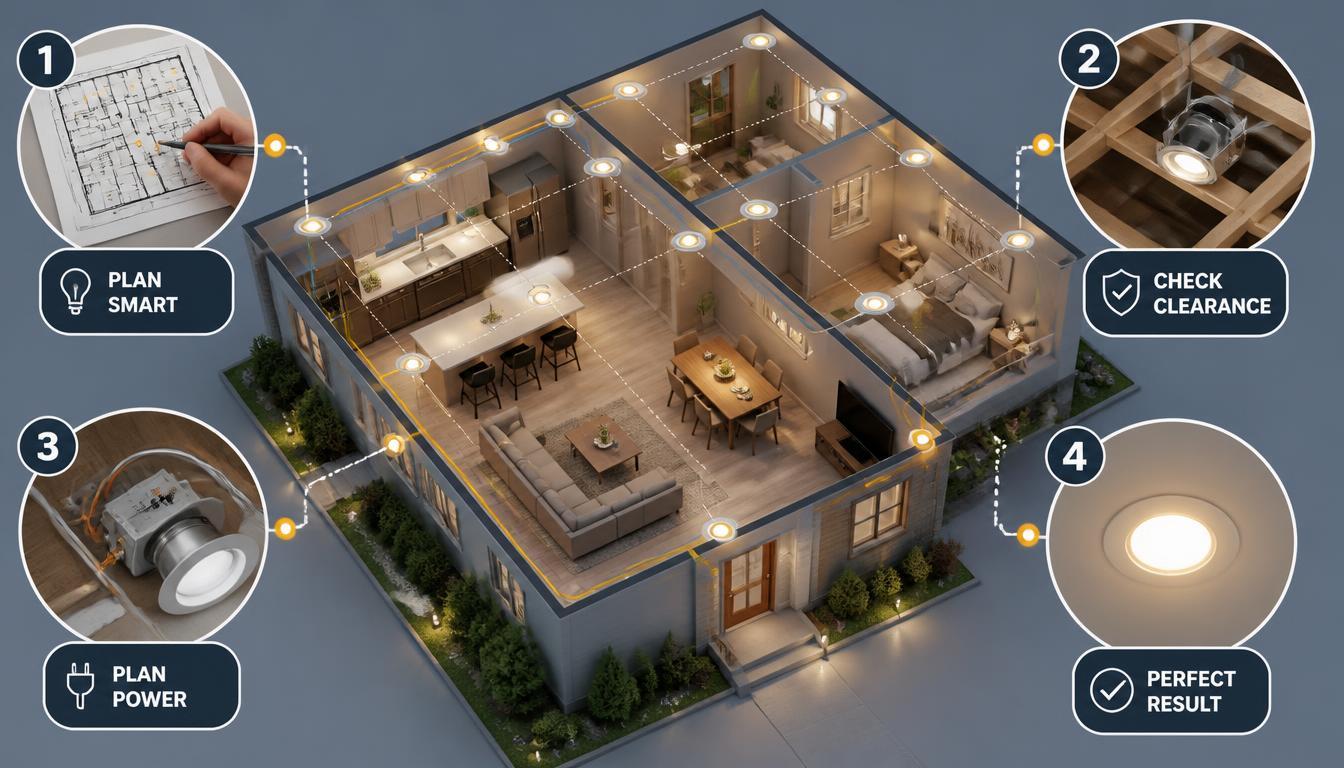
When designing recessed lighting, careful consideration is required. It requires accurate placement to maximize benefit and thoughtful design to achieve visual harmony.
The right lighting scheme involves taking into consideration ceiling type, available electricity, spacing between fixtures and controls, and the room's purpose. Such preparation is essential long before the stage of cutting the holes is reached.
Why Does Professional Planning Matter For Recessed Lighting?
Professional planning is crucial for connecting lighting choices with the room's actual needs. This process considers the ceiling type, furniture, tasks performed in the room, control devices, and the desired visual effect.
A good professional first needs to assess the room in question instead of counting the number of light fixtures to be used.
The result is a recessed lighting installation planned around how the room is actually used. Rather than installing fixtures uniformly throughout the area, the design considers how people will utilize the room.
DOE states that proper lighting design is important for maximizing lighting efficiency. It also notes that downlights work with controls such as occupancy sensors and daylight controls.
What Does Professional Planning Help Prevent?
Lighting layout planning in advance will help you avoid such issues as improper placement, excess light, unwanted shadows, and fixture design conflicts with the interior arrangement.
A professional reviews furniture positions, ceiling height, work areas, and existing electrical conditions. These details influence both fixture placement and the amount of light required.
For example, placing every fixture in a perfect grid may look tidy on paper. Yet that approach may leave a countertop poorly lit or create unnecessary brightness over an empty walkway.
| Planning Factor | Why It Matters | Potential Problem Without Planning |
| Fixture spacing | Supports balanced light | Dark or overly bright areas |
| Ceiling structure | Determines suitable placement | Installation conflicts |
| Furniture layout | Connects light with activities | Poor task visibility |
| Controls | Supports flexible use | Limited lighting control |
This makes ceiling illumination more intentional. The purpose is effective coverage rather than merely a ceiling dotted with fixtures.
What Are The Benefits Of Employing An Expert?
Specialists bring planning expertise and can match the right technology to the design. They also provide a second set of eyes before permanent work begins.
The following are the main advantages:
-
More deliberate fixture placement.
-
Better coordination with existing electrical systems.
-
Greater attention to glare and shadows.
-
Improved compatibility between fixtures and controls.
-
Less risk of costly layout changes later.
A professional approach also helps homeowners compare fixture specifications instead of choosing products based only on appearance.
ENERGY STAR standards mandate that downlights be certified based on performance requirements, such as minimum efficacy and minimum light output.
Are There Any Downsides To Using Professionals?
There will always be some labor and planning costs. Additionally, the homeowner will have less direct control over the installation process.
Yet, professional help can prove its worth in cases where the task involves the renovation of more than one room, new wiring, a complicated ceiling, and lighting controls.
The following are the primary benefits of hiring a professional:
-
Specialist assessment.
-
Coordinated layout.
-
Technical product review.
-
Installation expertise.
The right choice depends on project complexity. ENERGY STAR notes that certain retrofit kits simplify upgrades to existing downlights, while new installations still require suitable fixture selection and installation planning.
How Does Fixture Selection Affect The Final Result?
Fixture performance matters as much as placement. A carefully planned layout loses value if the selected fixtures provide unsuitable output, color, or beam distribution.
The Department of Energy indicates that LED technology provides effective optical control, which allows small fixtures to direct light precisely.
A proper LED downlight should match the room's lighting needs, the conditions of the ceiling, appearance, and control needed. Checking these details before installation avoids costly last-minute substitutions.
CIRC Lighting demonstrates how lighting selection can support both practical performance and interior design goals.
Conclusion
Professional planning makes recessed lighting more effective by connecting placement, fixture performance, ceiling conditions, and room function. Although professional installation involves added cost, careful planning may prevent poor layouts and unnecessary changes.
 English
Join our community to interact with posts!