
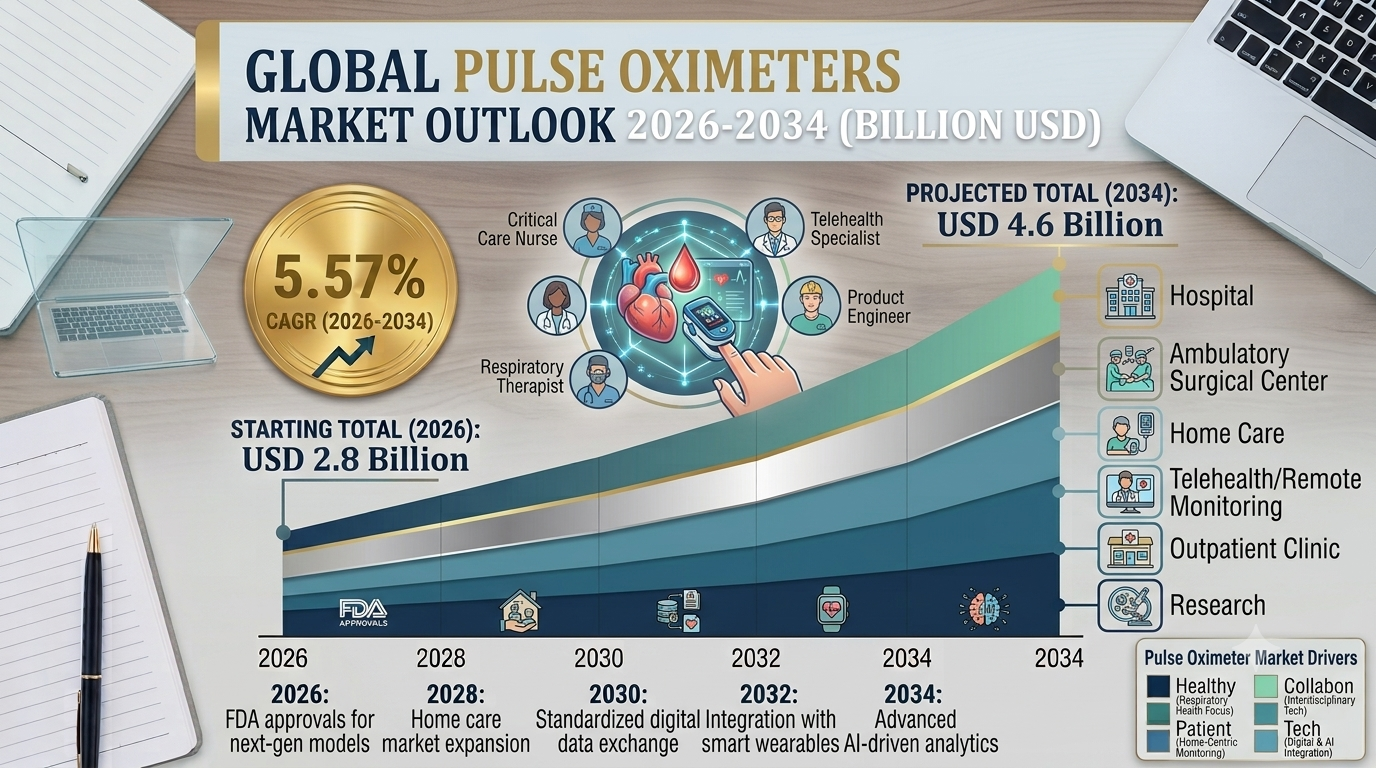
According to IMARC Group, the global pulse oximeters market size reached USD 2.8 Billion in 2025 and is projected to reach USD 4.6 Billion by 2034, growing at a CAGR of 5.57% during 2026–2034. This sustained pulse oximeters market growth is driven by the rising prevalence of chronic respiratory diseases, a growing ageing population, expanding home healthcare adoption, and the continuous introduction of advanced, portable, and connected oximeter variants compatible with Android and Apple platforms for electronic medical record (EMR) integration.
Pulse Oximeters Industry Overview
Pulse oximetry is a non-invasive monitoring technique that measures the percentage of haemoglobin in the blood that is carrying oxygen known as oxygen saturation (SpO2) — using light absorption properties of oxygenated and deoxygenated blood. The technology has evolved dramatically from bulky bedside monitors to sleek fingertip clips, wrist-worn wearables, and handheld portable devices with smartphone connectivity.
Pulse oximeters are now deployed across a broad spectrum of clinical and non-clinical settings. Key applications include:
• Inpatient monitoring in hospitals, ICUs, and emergency departments
• Perioperative and anaesthesia monitoring in operating theatres
• Ambulatory surgery centre post-procedural care
• Chronic disease management for COPD, asthma, heart failure, and sleep apnoea patients
• Home healthcare and remote patient monitoring (RPM) programmes
• Sports and fitness performance monitoring via wearable oximeters
• Neonatal and paediatric intensive care monitoring
These broad clinical and consumer applications, combined with rising health awareness and the integration of pulse oximetry into mainstream wearables, are fuelling sustained Pulse Oximeters Market Growth globally.
Global Pulse Oximeters Market Size & Key Statistics
Below are the key Pulse Oximeters Market statistics drawn from IMARC Group's comprehensive market analysis:
Base Year - 2025
Historical Period - 2020–2025
Forecast Period - 2026–2034
Pulse Oximeters Market Size in 2025 - USD 2.8 Billion
Market Forecast in 2034 - USD 4.6 Billion
Market Growth Rate (2026–2034) - 5.57% CAGR
Largest Region - North America
Leading Type Segment - Fingertip Pulse Oximeters
Leading Sensor Type Segment - Reusable
Leading End-Use Segment - Hospitals and Clinics
Request a Sample Report for Detailed Pulse Oximeters Market Share Evaluation: https://www.imarcgroup.com/pulse-oximeter-market/requestsample
Key Market Drivers & Pulse Oximeters Market Trends in 2026
Several powerful forces are shaping the Pulse Oximeters Market Trends and fuelling steady growth across global healthcare markets:
1. Rising Prevalence of Chronic Respiratory and Cardiovascular Diseases
The global burden of chronic conditions such as COPD, asthma, heart failure, and sleep apnoea continues to escalate. COPD alone affects over 300 million individuals worldwide, requiring continuous SpO2 monitoring to manage disease progression and prevent acute exacerbations. This structural demand for reliable oxygen saturation monitoring is a primary engine of Pulse Oximeters Market Growth across both clinical and home settings.
2. Rapid Expansion of Home Healthcare and Remote Patient Monitoring
The increasing number of individuals who prefer to manage chronic conditions outside clinical settings is a defining Pulse Oximeters Market Trend. Pulse oximeters have become household essentials for patients with respiratory and cardiac conditions. The proliferation of affordable, portable devices with Bluetooth connectivity and smartphone app integration — enabling patients to share real-time SpO2 data with their physicians is reshaping home healthcare delivery globally.
3. Technological Advancements in Device Design and Connectivity
Advanced product variants compatible with Android and Apple operating systems are enabling seamless integration with electronic medical records (EMR). Manufacturers are incorporating built-in memory for data storage, customisable alarms, user-friendly interfaces, and AI-driven algorithms. In July 2024, Masimo introduced the Masimo W1 Sport advanced health-tracking wearable, offering continuous pulse oximetry metrics powered by advanced halo AI technology — illustrating the trajectory of smart oximetry innovation.
4. Growing Focus on Paediatric and Neonatal Care
There is a rising emphasis on launching pulse oximeters specifically designed for neonatal and paediatric care. Devices feature more sensitive, smaller sensors and softer materials to ensure accurate and comfortable monitoring for infants and children. Masimo's Rad-G Pulse Oximeter, with its paediatric-specific mode delivering accurate readings in low-perfusion conditions common in young patients, exemplifies this expanding clinical niche.
5. Favourable Regulatory Frameworks and Standardisation
Regulatory bodies including the ISO and FDA are setting robust standards for device calibration, performance, and clinical validation — fostering consumer trust and market confidence. In July 2024, the World Health Organization launched the Medical Devices Information System (MeDevIS), the first global open-access platform providing comprehensive information on medical devices to support procurement, selection, and usage decisions globally — a development positively influencing Pulse Oximeters Market Analysis and adoption rates.
6. COVID-19 Legacy and Heightened Health Awareness
The pandemic fundamentally shifted public awareness of SpO2 monitoring, driving mass consumer adoption of fingertip pulse oximeters for home COVID-19 monitoring. This COVID-19 legacy has permanently elevated the consumer pulse oximeter category — with many households now treating oximeters as standard health monitoring equipment alongside thermometers and blood pressure monitors.
7. Integration of AI and Machine Learning
AI and machine learning integration by manufacturers holds significant potential for enhancing functionality and interpretability of pulse oximeters, enabling more comprehensive health monitoring and personalised clinical insights. This trend is expected to be a key Pulse Oximeters Market Trend over the forecast period, with AI-enabled SpO2 monitoring increasingly embedded in mainstream wearables and hospital monitoring platforms.
Key Market Segmentation
By Type
Fingertip Pulse Oximeters – Largest Segment: Fingertip pulse oximeters dominate the market due to their portability, ease of use, and ability to deliver rapid, non-invasive SpO2 and pulse rate measurements. Recent innovations include continuous monitoring with ring-like designs providing real-time data via smartphone apps. Wellue's O2Ring, for instance, incorporates advanced sensors and improved algorithms ensuring accurate readings across different skin tones — a development positively influencing Pulse Oximeters Market Size globally.
Handheld Pulse Oximeters: Handheld devices are preferred in clinical environments requiring spot-check monitoring across multiple patient locations, combining portability with clinical-grade accuracy.
Wrist-worn Pulse Oximeters: Wrist-worn devices are gaining traction in consumer health and fitness tracking, with increasing integration into mainstream smartwatches and fitness bands.
Others: Includes tabletop and bedside monitors deployed in ICU and hospital ward environments for continuous multi-parameter patient monitoring.
By Sensor Type
Reusable – Largest Segment: Reusable pulse oximeters are increasingly important in both clinical and home settings due to their cost-effectiveness and environmental benefits. Masimo's MightySat Rx — offering Bluetooth connectivity, SpO2, pulse rate, and perfusion index tracking — exemplifies the premium reusable segment, elevating overall Pulse Oximeters Market Revenue.
Disposable: Disposable sensors are widely used in hospital inpatient settings — particularly ICUs and operating theatres — where infection control protocols mandate single-patient sensor use.
By End-Use
Hospitals and Clinics – Largest Segment: Hospitals and clinics represent the largest end-use segment, reflecting the critical role of pulse oximetry across emergency rooms, operating theatres, ICUs, and general wards. During surgeries, anaesthesiologists rely on pulse oximeters to ensure patients maintain adequate oxygenation — making hospital adoption a fundamental driver of Pulse Oximeters Market Share globally.
Ambulatory Surgery Centers: ASCs are a fast-growing segment, with pulse oximeters essential for post-procedural recovery monitoring in outpatient surgical settings.
Home Healthcare: Home healthcare is a rapidly expanding end-use category, driven by RPM programmes, chronic disease management, and rising consumer health awareness post-pandemic.
Others: Includes sports and fitness applications, aviation and military settings, and veterinary monitoring.
Regional Pulse Oximeters Market Analysis
North America – Largest
United States & Canada; well-established healthcare infrastructure, widespread SpO2 monitoring adoption, strong FDA regulatory framework, Medtronic 510(k) clearances, high COPD prevalence driving clinical demand
Europe: Germany, France, UK, Italy, Spain, Russia; mature healthcare systems, growing home healthcare adoption, supportive EU MDR framework, strong hospital monitoring infrastructure
Asia Pacific: China, Japan, India, South Korea, Australia, Indonesia; rapidly expanding healthcare sector, rising chronic disease burden, growing consumer oximeter adoption, domestic manufacturers (Contec, Lepu Medical) scaling volume
Latin America: Brazil, Mexico; growing healthcare infrastructure investment, rising awareness of SpO2 monitoring, increasing hospital and home healthcare adoption
Middle East & Africa: UAE, Saudi Arabia, South Africa; healthcare modernisation under Vision 2030, rising chronic disease burden, expanding hospital and clinic infrastructure
North America dominates the global Pulse Oximeters Market Share, driven by widespread prevalence of respiratory diseases, advanced medical technology adoption, strong regulatory oversight, and a high degree of health monitoring awareness. In May 2022, Medtronic Plc received FDA 510(k) clearance for its pulse oximeter sensor with silicone adhesive — reflecting ongoing regulatory pipeline activity underpinning North American market leadership.
Asia Pacific represents the fastest-growing regional market, fuelled by expanding healthcare infrastructure, a growing middle class prioritising health monitoring, rising COPD and cardiovascular disease burden, and the scaling of domestic manufacturers including Contec Medical Systems and Lepu Medical Technology.
Connect for Detailed Pulse Oximeters Market Analysis and Segmentation – Speak to an Analyst: https://www.imarcgroup.com/request?type=report&id=2227&flag=C
Leading Players in the Pulse Oximeters Industry
The global pulse oximeters market features a mix of established medical device multinationals and focused oximetry specialists. Key companies covered in the IMARC Group report include:
- Beijing Choice Electronic Tech Co., Ltd
- Beurer India
- BPL Medical Technologies
- Contec Medical Systems Co., Ltd.
- Dr Trust
- ICU Medical, Inc.
- Lepu Medical Technology (Beijing) Co., Ltd.
- Masimo Corporation
- Nonin
- Proactive Medical Products
- Zacurate
The report includes comprehensive competitive analysis covering market structure, player positioning, top winning strategies, a competitive dashboard, and a company evaluation quadrant.
About Us:
IMARC Group is a leading global market research company providing data-driven insights and expert consulting services to businesses seeking to achieve their strategic objectives. With a multi-disciplinary team of industry experts, IMARC delivers thorough, reliable market intelligence across sectors including Healthcare, Technology, Chemicals, Energy, Food & Beverages, and more.
Contact Us:
IMARC Group
United States: +1-201-971-6302
India: +91-120-433-0800
United Kingdom: +44-753-714-6104
 English
Join our community to interact with posts!