
IMARC Group has recently released a new research study titled "Mexico Vertical Farming Market Size, Share, Trends and Forecast by Component, Structure, Growth Mechanism, Application and Region, 2026-2034", offering a detailed analysis of the market drivers, segmentation, growth opportunities, trends, and competitive landscape to understand the current and future market scenarios.
Mexico Vertical Farming Market Size & Share 2026-2034
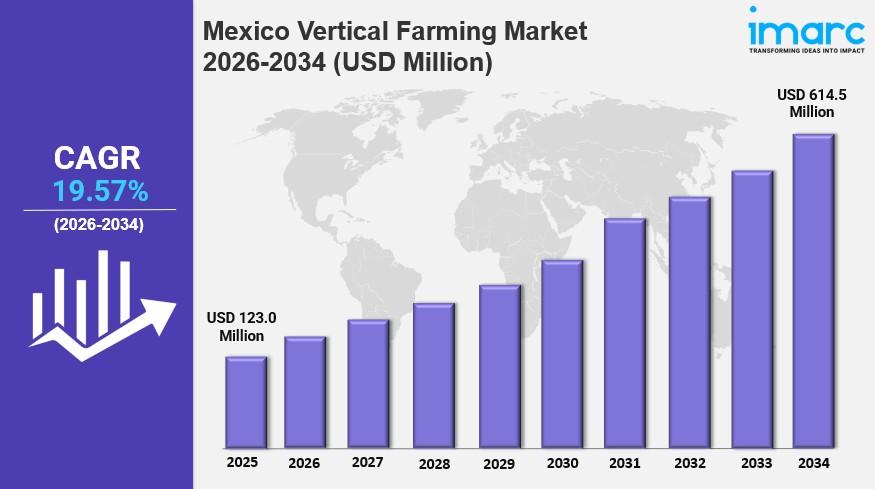
The Mexico vertical farming market size reached USD 123.0 Million in 2025. Looking forward, IMARC Group expects the market to reach USD 614.5 Million by 2034, exhibiting a growth rate of CAGR of 19.57% during 2026-2034. The vertical farming market in Mexico is fueled by urban growth, water scarcity, and a rising demand for fresh, locally sourced food, strengthening the Mexico vertical farming market outlook.
Different technological developments, governmental programs, sustainability issues, and increasing food prices also play a role in the expansion of this pioneering agricultural industry.
Key Market Statistics at a Glance
● Base Year: 2025
● Historical Years: 2020-2025
● Forecast Period: 2026-2034
● Market Size (2025): USD 123.0 Million
● Projected Market Size (2034): USD 614.5 Million
● Growth Rate: CAGR of 19.57% (2026-2034)
Explore Opportunities in the Mexico Vertical Farming Market: Download the IMARC Sample Report: https://www.imarcgroup.com/mexico-vertical-farming-market/requestsample
Key Growth Drivers and Trends in the Mexico Vertical Farming Market
Growth in the Mexico vertical farming market is being driven by growing investment in vertical farming technology, as Mexico's population is projected to reach 150 million by 2050, with 80% likely living in urban centers, requiring increased food production. The use of vertically stacked layers helps maximize space and water use, making it more suitable for urban areas with limited land expanse.
One of the leading Mexico vertical farming market trends is the greater adoption of hydroponic and aeroponic technologies, which alleviate pressure on land and decrease water usage, a crucial factor given the water shortage in certain areas of Mexico. Companies like Magic Sun have launched products such as hydroponic greenhouse grown tomatoes, while there is a rising trend toward smart farming technologies encompassing sensors, data analytics, and automation to enhance crop yields.
Another key factor supporting Mexico vertical farming market growth is government support for sustainable agriculture initiatives, as the Mexican government provides subsidies, grants, and technical support to help farmers transition to vertical farming systems and technology. In 2023, the Mexican Ministry of Agriculture and Rural Development initiated several programs aimed at assisting farmers in shifting towards more sustainable agricultural practices, while domestic and international organizations continue to support pilot initiatives and educational programs across the sector.
Speak to an Analyst: https://www.imarcgroup.com/request?type=report&id=28682&flag=C
Mexico Vertical Farming Industry Segmentation Insights
Breakup by Component
- Irrigation Component: Delivers precise water and nutrients to crops, improving resource efficiency and supporting consistent plant growth.
- Lighting: Provides controlled light intensity and wavelengths, enabling optimal photosynthesis and year-round crop production.
- Sensors: Monitor temperature, humidity, nutrients, light, and other conditions to optimize crop growth and resource utilization.
- Climate Control: Regulates temperature, humidity, airflow, and environmental conditions, ensuring optimal growing conditions and crop productivity.
- Building Material: Includes glass and plastic greenhouses that provide structural protection and controlled environments for vertical farming operations.
- Others: Includes supporting equipment and technologies that enhance vertical farm efficiency, productivity, monitoring, and operational management.
Breakup by Structure
- Building-based Vertical Farms: Utilize existing or purpose-built buildings for controlled, multi-layer crop cultivation and efficient urban food production.
- Container-based Vertical Farms: Use modified shipping containers with controlled environments, enabling modular, portable, and scalable farming operations.
Breakup by Growth Mechanism
- Hydroponics: Grows plants without soil using nutrient-rich water, improving water efficiency and enabling controlled crop production.
- Aeroponics: Cultivates plants with roots suspended in air and regularly misted with nutrient solutions for efficient growth.
- Aquaponics: Combines fish farming and hydroponic cultivation, recycling nutrient-rich water to support sustainable crop production.
Breakup by Application
- Indoor: Enables controlled year-round cultivation within buildings, reducing weather dependence and optimizing environmental conditions.
- Outdoor: Integrates vertical farming systems into open environments while utilizing available sunlight and natural growing conditions.
Breakup by Region
- Northern Mexico: Supports vertical farming through water scarcity concerns, urbanization, technological adoption, and demand for resource-efficient agriculture.
- Central Mexico: Benefits from dense urban populations, strong food demand, technological development, and proximity to major consumption centers.
- Southern Mexico: Offers agricultural potential and growing interest in sustainable farming technologies to improve regional food production.
- Others: Includes regions with emerging vertical farming adoption driven by urbanization, resource constraints, and sustainable agriculture initiatives.
Key Challenges and Growth Opportunities in the Mexico Vertical Farming Market
The Mexico vertical farming market faces challenges including high initial capital investment for setting up vertical farming infrastructure, significant energy consumption associated with artificial lighting and climate control systems, and the need for specialized technical expertise to operate and maintain advanced hydroponic and aeroponic systems.
Despite these challenges, the market offers considerable growth opportunities driven by continued government support for sustainable agriculture, rising consumer demand for fresh and locally grown produce, and growing adoption of smart farming technologies such as sensors, data analytics, and automation. Continued investment in vertical farming infrastructure and precision agriculture techniques is expected to create substantial opportunities for long-term growth in the Mexico vertical farming market.
Competitive Landscape
The Mexico vertical farming market is being shaped by a mix of domestic and international companies investing in vertical farming technology, sustainable agriculture platforms, and digital agriculture tools. In December 2024, Bayer launched a digital agriculture platform called FieldView in Mexico, designed to provide farmers with data-driven tools to optimize crop management, improve efficiency, and support decision-making throughout the crop growing cycle.
In November 2024, La Salle Bajío University in Mexico collaborated with Verde Compacto to launch a vertical hydroponic farm to foster education in sustainable agriculture. This farm, equipped with advanced vertical hydroponic technology, spans 30 square meters and maximizes productivity while requiring only a fraction of the water needed in traditional farms.
Author
IMARC Group
IMARC Group is a leading global market research company providing data-driven insights and expert consulting services to businesses seeking to achieve their strategic objectives. With a multidisciplinary team of industry experts, IMARC delivers reliable market intelligence across sectors including Chemicals and Materials, Healthcare, Technology, Agriculture, and Retail.
Contact Us:
IMARC Group
Email: sales@imarcgroup.com
United States: +1-201-971-6302
 English
Join our community to interact with posts!