
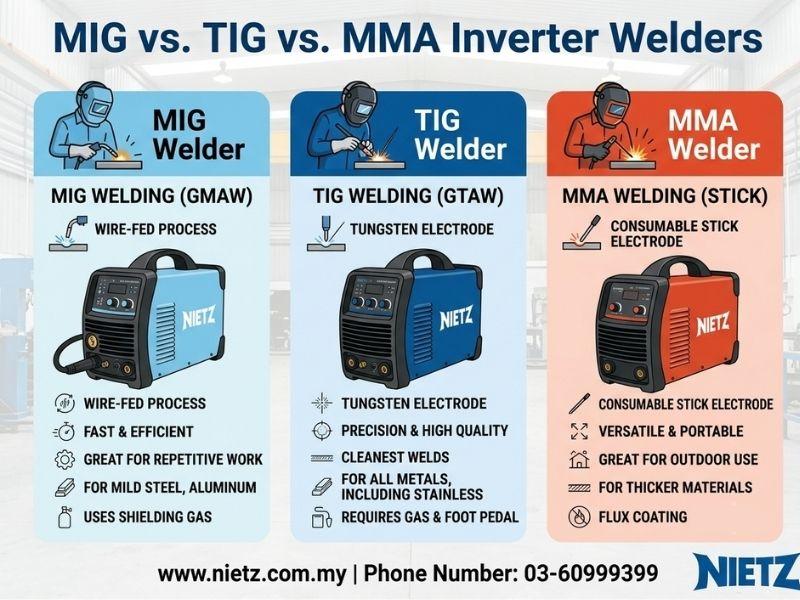
Having the wrong welder in the shop isn't just a production slowdown; it wastes welding supplies, leads to rework, and drives skilled welders crazy. MIG welding is characterized by rapid deposition and high deposition rate, suitable for production of mild steel. TIG is used for precision work on thin and exotic metals. MMA (stick) operations are suitable for outdoor, heavy-duty and site work. ROI profile for each process will vary depending on the type of material, throughput, and operator skills.
Knowing these three processes before you buy a welding machine is crucial to avoiding wasting money on suboptimal equipment for your application, especially when you are buying from a trusted welding machine supplier in Malaysia.
What's the Core Difference Between MIG, TIG, and MMA Welding?
MIG (Metal Inert Gas) welding is a process that uses a continuously fed wire electrode and an inert gas to weld. This form of TIG uses a non-consumable tungsten electrode and a separate filler, thus providing the operator with total manual control. Manual Metal Arc (MMA) or stick welding is performed by melting a flux coated electrode into the weld pool.No gas is used in the Manual Metal Arc (MMA) or stick welding process.
Each process is engineered for different performance demands. Picking based on price alone is one of the most common mistakes workshop owners make.
MIG Welding: Built for Speed and Volume
When Does MIG Make Sense?
For high volume fabrication shops using mild steel, stainless steel and aluminium products, MIG is the process of choice. With continuous wire feed, less downtime between passes and operators can achieve productive level quicker than TIG or MMA.
Welding using MIG welding has a high ratio of speed to quality and is widely used in Malaysian manufacturing and fabrication industries, especially in automotive component making and structural steel shops.
MIG Strengths and Limitations
-
Speed: Deposition rates of 2–8 kg/hr, depending on wire diameter and parameters
-
Ease of use: Faster operator learning curve compared to TIG
-
Clean output: Minimal post-weld cleanup on thinner materials
-
Limitation: Requires clean, scale-free base metal for best results
-
Limitation: Shielding gas setup makes it less practical for outdoor or site work
MIG is most profitable when your shop runs repetitive welds on prepared material in a controlled environment. If your team welds the same joint geometry dozens of times per shift, MIG will outperform both TIG and MMA on throughput.
TIG Welding: Precision Over Production Rate
Where TIG Delivers Real Value
When weld appearance, metallurgical integrity, or tight tolerances are essential, TIG is the right heat transfer method to use. It's common in sectors such as food processing equipment, pharmaceutical piping, aerospace parts and decorative architectural metalwork, where weld quality is assessed or exposed.
TIG can weld wider variety of metals than MIG or MMA: carbon steel, stainless, aluminium, copper, titanium, exotic alloys. TIG is the only process available for maintenance work on thin-gauge stainless pipework or heat exchanger units.
TIG Strengths and Limitations
-
Precision: Ideal for wall thicknesses from 0.5mm upward
-
Versatility: Handles the broadest range of metals and alloys
-
Weld quality: Produces the cleanest, strongest welds with lowest distortion
-
Limitation: Slow deposition - not suited for large structural welds
-
Limitation: Requires significantly higher operator skill and longer training time
A skilled TIG welder commands a higher wage. Factor this into your total cost-per-weld calculation when evaluating machine investment, not just the machine price tag.
MMA (Stick) Welding: The Tough Site Performer
Why MMA Still Holds Ground in Industrial Work
MMA is frequently underestimated in modern workshops, but it remains the most field-adaptable process available. No gas cylinder, no wire feeder, no sensitivity to wind or contaminants. For construction sites, pipeline maintenance, and heavy structural repair work in Malaysia's infrastructure and oil and gas sectors, MMA is often the only practical option.
Modern inverter-based MMA machines are significantly lighter and more energy-efficient than traditional transformer welders - some units weigh under 5kg while delivering 160–200A output, which is more than sufficient for most site repair tasks.
MMA Strengths and Limitations
-
Portability: Works anywhere with a power source, no gas setup required
-
Material tolerance: Welds through rust, paint, and mill scale better than MIG
-
Range: Suitable for steel, cast iron, and some stainless grades
-
Limitation: Slower than MIG, with more slag to clean between passes
-
Limitation: Not suitable for thin materials under 2mm
Side-by-Side Comparison: MIG vs. TIG vs. MMA
| Feature | MIG | TIG | MMA (Stick)
|
|---|---|---|---|
| Welding Speed | Fast | Slow | Moderate |
| Operator Skill Required | Medium | High | Medium |
| Metal Compatibility | Mild steel, SS, aluminium | All metals including exotics | Steel, cast iron, some SS |
| Outdoor / Site Use | Poor | Poor | Excellent |
| Weld Appearance | Good | Excellent | Moderate |
| Consumable Cost | Medium | Low (rod) / Medium (gas) | Low |
| Best Application | Production fabrication | Precision / critical welds | Site repair / heavy structure |
How to Choose the Right Inverter Welder for Your Workshop
The best approach isn't always to pick one process - it's to match process to application. Many fabrication workshops in Malaysia operate with a combination: MIG machines on the production floor, a TIG setup for quality-critical or custom work, and MMA inverters for on-site maintenance teams.
When evaluating an inverter welding machine, look beyond the amperage rating. Consider duty cycle (the percentage of time it can weld continuously), input voltage requirements (240V single phase vs. 415V three phase), and whether the machine supports multi-process operation.
Questions to Ask Before Buying
-
What metals and thicknesses does your shop weld most frequently?
-
Is the welding done in a fixed workshop or on-site?
-
What is your operator's current skill level, and do you have budget for training?
-
What production volume do you need to sustain per shift?
-
Does your application require certified weld procedures or quality documentation?
Answering these five questions will narrow your selection faster than any specification sheet.
Inverter Technology: Why It Matters for Industrial Buyers
Inverter-based welding machines have largely replaced transformer-based units in workshops across Malaysia - and for good reason. They're lighter, more energy-efficient, and offer better arc stability across all three processes. The energy savings alone are meaningful: inverter machines typically consume 30–50% less power than equivalent transformer units, which has a real impact on monthly electricity costs at scale.
The mig tig mma comparison becomes more relevant when you factor in inverter multi-process units, which allow a single machine to switch between processes - valuable for smaller workshops that can't justify three separate machines but still handle varied work types.
Finding the Right Industrial Welder Supplier in Malaysia
Equipment quality matters, but so does supplier support. For workshops running production schedules, machine downtime is costly. When evaluating an industrial welder supplier, check for local service availability, spare parts stock, and technical support response time - not just the upfront machine price.
Inverter welding machines are offered by Nietz in Malaysia for fabrication, maintenance and industrial jobs. If you're looking for a high duty MIG set or a precision TIG unit for critical welds your team requires, it helps to have a supplier who knows your production environment so you can make your selection quicker, and your investment more defensible.
Frequently Asked Questions
Q1: Which is better for a beginner welder - MIG or MMA?
For the novice, MIG is easier in terms of wire feeding and the more forgiving arc control. MMA demands more skill to control the angle and speed of the electrode, but is still a good place to begin for welders who must be mobile rather than precise.
Q2: Can one inverter machine handle MIG, TIG, and MMA?
Yes. Multi-process inverter welders are available and increasingly common in Malaysian workshops. They're ideal for smaller operations that handle varied work types. However, dedicated single-process machines typically offer better performance and duty cycle for high-volume production environments.
Q3: What thickness of metal is TIG welding best suited for?
TIG is most effective on metals from 0.5mm to around 10mm, though skilled operators can weld thicker materials with multiple passes. It's the preferred process for thin-gauge stainless steel, aluminium, and any application where weld aesthetics or structural integrity are closely inspected.
Q4: Is MMA welding suitable for stainless steel?
MMA can weld stainless steel using the correct stainless electrodes, such as E308L or E316L grades. However, for critical or hygienic applications - like food processing or pharmaceutical pipework - TIG is strongly preferred due to its cleaner weld profile and lower risk of contamination.
Q5: How do I compare inverter welding machines before buying?
Focus on duty cycle rating, input voltage compatibility, amperage range, and after-sales service from your supplier. A machine rated at 60% duty cycle at maximum amperage is significantly more practical for production use than one rated at 20%, even if the listed amperage output appears similar.
Q6: What is the main advantage of inverter welding machines over transformer-based ones?
Inverter welding machines are lighter, more energy-efficient, and produce a more stable arc - especially at lower amperages. They typically consume 30–50% less electricity than transformer units, which makes them a better long-term investment for workshops with continuous welding operations.
 English
Join our community to interact with posts!