
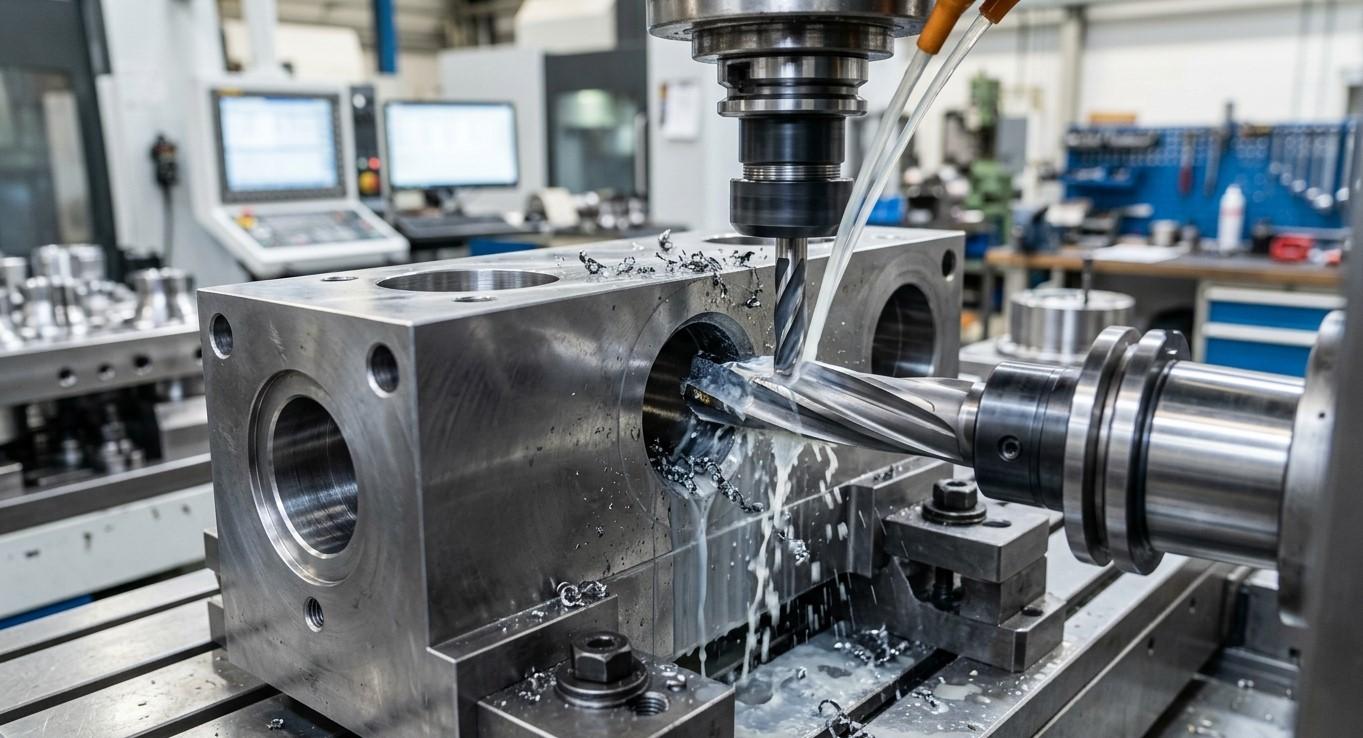
Producing accurate holes is an essential requirement in many manufacturing and engineering applications. Drilling can create a hole, but when a tighter dimensional tolerance, improved roundness, better surface finish, or greater consistency is required, reaming is often used as a finishing operation. Industrial reaming provides a controlled way to bring a previously machined hole closer to its required final dimensions.
Choosing the correct reamer, machining method, cutting parameters, tool holder, and inspection process is essential for achieving reliable results. Reaming is particularly important in precision manufacturing, CNC machining, automotive production, fabrication, and general engineering.
As an experienced Industrial Tools Supplier in Dubai, Khokhawala Trading LLC provides industrial tooling and machining solutions for businesses that require dependable tools for precision applications. Understanding proper reaming techniques can help workshops improve hole quality, reduce tool wear, and achieve more consistent production results.
What Is Industrial Reaming?
Reaming is a precision machining process used to improve the dimensional accuracy and surface finish of an existing hole.
Unlike drilling, which is primarily used to create a hole, reaming normally removes a relatively small amount of material from an already drilled, bored, or otherwise prepared hole.
A reamer contains multiple cutting edges arranged around its circumference. As the tool enters the existing hole, its cutting edges remove a controlled amount of material and produce a more accurate internal surface.
Reaming can improve:
-
Hole diameter accuracy
-
Roundness
-
Cylindricity
-
Surface finish
-
Dimensional consistency
-
Fit between mating components
The amount of material removed during reaming should be controlled carefully. Reamers are generally finishing tools rather than heavy material-removal tools.
Why Reaming Is Important for Precision Holes
Many industrial components require holes that must accommodate shafts, pins, bearings, bushings, fasteners, or other components.
A drilled hole may have:
-
Slight dimensional variation
-
Surface irregularities
-
Taper
-
Runout
-
Poor surface finish
-
Minor deviations from the required diameter
Reaming can help correct certain dimensional and surface-quality issues when the starting hole is suitable for the process.
The result can be a more consistent hole that meets the required engineering specification.
Different Types of Industrial Reamers
Selecting the correct reamer is one of the most important parts of a successful reaming process.
Hand Reamers
Hand reamers are designed for manual applications. They typically include a longer lead section that helps guide the tool into an existing hole.
They are commonly used for:
-
Maintenance work
-
Repair operations
-
Low-volume applications
-
Manual fitting
-
General engineering
Hand reaming requires controlled alignment and steady operation.
Machine Reamers
Machine reamers are designed for use with drilling machines, milling machines, lathes, and CNC machining centers.
They are suitable for production environments where consistent tool movement and controlled cutting conditions are required.
Straight-Flute Reamers
Straight-flute reamers have cutting edges running parallel to the tool axis.
They can be useful for many general-purpose reaming applications, particularly where chip evacuation is manageable.
Spiral-Flute Reamers
Spiral-flute reamers have angled cutting edges that can improve chip movement and cutting smoothness in certain applications.
They may be particularly useful when machining materials where chip evacuation is a concern.
Adjustable Reamers
Adjustable reamers allow the effective cutting diameter to be adjusted within a specified range.
They can be useful for maintenance and applications where a degree of size adjustment is required.
However, adjustment must be performed carefully to maintain the desired geometry and cutting performance.
Carbide Reamers
Carbide reamers offer high hardness and wear resistance and can be useful in demanding production environments.
They may be suitable for specific materials, high-volume production, and applications requiring consistent performance.
Common Industrial Reaming Techniques
The technique used during reaming has a direct impact on hole quality.
1. Prepare the Hole Correctly
Reaming should normally begin with an appropriately sized existing hole.
The pre-drilled hole should leave enough material for the reamer to remove without requiring excessive cutting.
If too much material remains, the reamer may experience excessive cutting forces, heat, and wear.
If too little material remains, the reamer may rub instead of cutting effectively.
The correct allowance depends on factors such as hole diameter, material, reamer design, and manufacturer recommendations.
2. Maintain Proper Alignment
Alignment is essential during reaming.
If the reamer enters the hole at an angle, it can produce:
-
Oversized holes
-
Taper
-
Poor roundness
-
Uneven tool wear
-
Poor surface finish
Machine reaming should therefore use a rigid and properly aligned setup.
Hand reaming requires particular care because the operator must maintain alignment throughout the process.
3. Control Cutting Speed
Reaming generally uses lower cutting speeds than many drilling operations.
The correct speed depends on:
-
Workpiece material
-
Reamer material
-
Reamer diameter
-
Tool coating
-
Machine capability
-
Coolant or lubrication
Excessive speed can increase heat and tool wear, while an excessively low speed may affect productivity and cutting performance.
Tool manufacturer recommendations should be used as the starting point for selecting appropriate cutting conditions.
4. Use the Correct Feed Rate
Feed is another critical factor.
If feed is too low, the reamer may rub rather than cut properly. If feed is too high, cutting forces can increase and surface finish may deteriorate.
The appropriate feed depends on the reamer diameter, workpiece material, tool geometry, and desired hole quality.
5. Use Suitable Coolant or Lubrication
Proper lubrication can reduce friction and help remove heat from the cutting zone.
Coolant can also assist with chip evacuation.
The appropriate coolant depends on the material and reaming operation. Some applications may require cutting oil, while others may use water-based coolant or another suitable cutting fluid.
Coolant delivery should reach the cutting zone effectively rather than simply flooding the general machining area.
6. Avoid Stopping Inside the Hole
In many reaming applications, the tool should be fed smoothly through the hole without unnecessary interruption.
Stopping or reversing the reamer while its cutting edges are engaged can potentially affect the hole surface and tool condition.
The exact procedure should follow the reamer manufacturer's recommendations and the requirements of the machining operation.
Reaming Different Workpiece Materials
Material selection plays a major role in reaming performance.
Aluminum
Aluminum can produce built-up edge if the tool geometry, speed, or lubrication is unsuitable.
Sharp industrial cutting tools and appropriate lubrication can help produce cleaner results.
Mild Steel
Mild steel is commonly reamed using suitable HSS or carbide tools. Proper cutting speed, feed, and coolant selection can help maintain hole quality.
Stainless Steel
Stainless steel can generate significant heat and may work harden when cutting conditions are unsuitable.
Sharp tooling, controlled parameters, good rigidity, and effective coolant delivery are particularly important.
Cast Iron
Cast iron is abrasive and can generate fine particles during machining. Tool material and wear resistance should therefore be considered carefully.
Hardened Materials
Hard materials may require specialized carbide or advanced cutting tools and carefully controlled machining conditions.
Importance of Tool Holding During Reaming
Tool holding has a significant influence on reaming accuracy.
The tool holder should provide:
-
Good concentricity
-
Secure clamping
-
Adequate rigidity
-
Minimal runout
-
Proper compatibility with the machine
Excessive runout can cause the reamer's cutting edges to remove material unevenly. This can result in an oversized or irregular hole.
Suitable CNC tool holders and properly maintained spindle interfaces can therefore contribute significantly to precision reaming.
Reaming on CNC Machines
CNC machining centers provide controlled movement and repeatability, making them suitable for production reaming.
A typical CNC reaming process may include:
-
Spot drilling or hole preparation
-
Drilling to the required preliminary diameter
-
Cleaning or chip evacuation
-
Installing the appropriate reamer
-
Establishing the correct tool offset
-
Setting cutting speed and feed
-
Applying appropriate coolant
-
Feeding the reamer through the hole
-
Retracting the tool correctly
-
Inspecting the finished hole
CNC programming should account for the tool geometry, hole depth, machine configuration, and manufacturer's recommendations.
Reaming Blind and Through Holes
Hole depth and geometry also influence reamer selection.
Through Holes
Through holes generally provide better chip evacuation because chips and coolant have an exit path.
The reamer can pass completely through the workpiece when the setup permits.
Blind Holes
Blind holes require more attention to tool length, chip evacuation, bottom clearance, and tool geometry.
The reamer should not be allowed to contact the bottom of the hole unless the tool is specifically designed for that application.
Common Reaming Problems and Solutions
Oversized Holes
Oversized holes can result from excessive runout, incorrect tool size, excessive cutting speed, poor alignment, or unsuitable tool conditions.
Check the tool, holder, machine alignment, and cutting parameters.
Poor Surface Finish
Poor finish can be caused by worn cutting edges, incorrect feed, inadequate lubrication, vibration, or improper reamer selection.
Tapered Holes
Taper can indicate alignment problems, tool deflection, unstable workholding, or uneven tool wear.
Chatter
Chatter may result from poor rigidity, excessive tool overhang, unsuitable cutting parameters, or workpiece movement.
Reducing overhang and improving tool and workpiece rigidity can help.
Premature Tool Wear
Excessive speed, insufficient lubrication, abrasive materials, poor tool holding, or incorrect reaming allowance can accelerate wear.
Role of Precision Measuring Tools
Inspection is essential when producing precision holes.
Useful precision measuring tools may include:
-
Bore gauges
-
Plug gauges
-
Internal micrometers
-
Dial indicators
-
Calipers
-
Coordinate measuring equipment
The appropriate inspection method depends on the required tolerance and component specification.
For critical holes, measurement should be performed using equipment suitable for the specified tolerance rather than relying only on general-purpose instruments.
Reaming vs Drilling
Drilling and reaming serve different purposes.
Drilling is primarily used to create a hole and remove larger quantities of material.
Reaming is generally a finishing process that removes a smaller, controlled amount of material to improve hole accuracy and surface finish.
A common machining sequence is therefore:
Spotting → Drilling → Reaming → Inspection
Depending on the required geometry and tolerance, boring or other processes may be used instead of or before reaming.
Best Practices for Industrial Reaming
For reliable results, workshops should:
-
Select the correct reamer for the material and hole specification.
-
Prepare the starting hole to the appropriate size.
-
Maintain proper tool alignment.
-
Use a rigid workholding setup.
-
Minimize tool holder runout.
-
Follow recommended cutting speeds and feeds.
-
Use suitable coolant or lubrication.
-
Avoid excessive tool overhang.
-
Inspect tools for wear before use.
-
Measure finished holes with appropriate inspection equipment.
-
Replace worn or damaged reamers before they affect production quality.
-
Maintain clean tool holders and machine interfaces.
Benefits of Proper Reaming Techniques
A well-controlled reaming process can provide:
-
Improved hole dimensional accuracy
-
Better surface finish
-
Greater consistency
-
Reduced tool wear
-
Better component fit
-
Lower rejection rates
-
Improved production efficiency
-
More predictable machining results
-
Longer tool life
-
Better overall CNC machining performance
These advantages make reaming an important finishing process for precision manufacturing.
Final Thoughts
Industrial reaming is an effective technique for producing accurate, consistent, and smooth holes when the process is properly controlled. Selecting the correct reamer, preparing the hole correctly, maintaining alignment, controlling cutting parameters, using suitable coolant, and ensuring reliable tool holding are all essential for achieving good results.
Reaming should also be treated as part of a complete machining process. High-quality industrial cutting tools, carbide cutting tools, CNC machining tools, suitable CNC tool holders, and reliable machining accessories can all contribute to better hole quality. Final inspection using appropriate precision measuring tools helps verify that the finished hole meets the required specification.
For manufacturers and engineering businesses seeking reliable industrial tooling solutions, Khokhawala Trading LLC provides a wide range of professional tools and machining products. As an established Industrial Tools Supplier in Dubai, the company supports CNC machining, manufacturing, fabrication, engineering, and industrial maintenance requirements.
By applying the right reaming technique and combining suitable tooling with accurate measurement and proper machine setup, manufacturers can produce precision holes more consistently while improving tool performance, production efficiency, and overall machining quality.
 English
Join our community to interact with posts!