
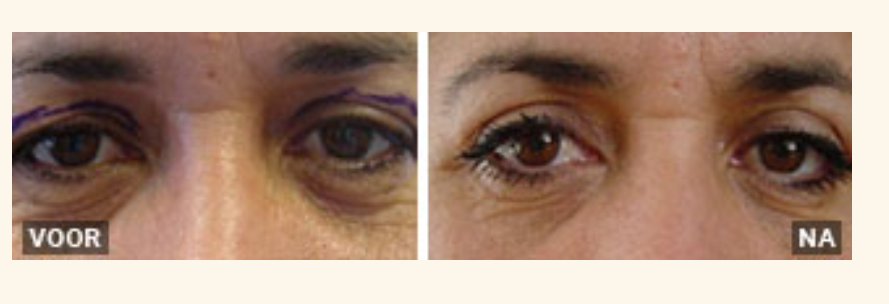
At 48, Karin felt energetic, but her face often suggested otherwise. Bags beneath her eyes and changes around her eyelids gave her a tired appearance even when she felt perfectly well. In a patient experience published by a Dutch cosmetic clinic, she explained that she sometimes wore fake glasses simply to make the area less noticeable.
Eventually, she chose eyelid surgery. She was happy with the result, but her experience raises an important question for other women: is your tired-looking under-eye area caused by the same problem?
Quite often, it is not.
One woman may have actual bags caused by prominent fat or loose skin. Another may have a deep tear trough that creates a shadow. Someone else may have darker pigment beneath otherwise smooth lower eyelids. Many women have two or three of these problems at the same time.
They can all make the face look tired, but they should not automatically be treated in the same way.
For women over 35 considering treatment in the Netherlands in 2026, the sensible place to start is not with a procedure. It is with understanding what is actually happening beneath the eyes.
Under-Eye Bags and Dark Circles Are Not the Same Problem
People often use "bags" and "dark circles" to describe the same tired-looking area. From a treatment point of view, that can be misleading.
A true under-eye bag usually creates a raised area beneath the lower eyelid. Fat around the eye can become more noticeable as supporting tissues change with age. Skin may also become looser, making the bulge more obvious.
Dark circles describe darkness rather than a physical bag, and that darkness can have several causes.
A systematic review published in Dermatologic Surgery that included 39 studies divided periorbital dark circles into pigmentary, vascular, structural and mixed causes.
Pigmentary circles involve darker colouring of the skin itself. Vascular circles can appear when blood vessels are more visible through thin skin. Structural circles develop when facial shape creates shadows. Mixed dark circles involve more than one cause.
A tear trough is a common structural example. This groove runs from the inner corner beneath the eye toward the cheek. When light falls across it, the hollow creates a shadow.
From a distance, that shadow can easily look like a dark circle.
That is why the first question should not be, "Which treatment should I book?"
It should be, "What is actually causing what I see?"
Why the Under-Eye Area Often Changes After 35
There is no birthday when under-eye bags suddenly appear.
Genetics can make dark circles or tear troughs noticeable in the 20s. Other women reach their 40s or 50s without developing significant bags.
Still, ageing gradually changes the structures around the eyes.
Skin can become thinner and less firm. Facial fat and other soft tissues change over time. The transition between the lower eyelid and upper cheek may become less smooth. A hollow that was hardly noticeable several years ago can become deep enough to cast a visible shadow.
A comprehensive medical review of periorbital hyperpigmentation identified several possible causes of under-eye darkness. These include genetics, excess pigmentation, allergies, dermatitis, swelling, visible blood vessels, skin laxity and shadows associated with an age-related tear trough.
This explains why age alone cannot tell you which treatment you need.
You can spend hours of research comparing eye creams, fillers, lasers and surgery. That research will not help much until you understand whether your main problem is a raised bag, a hollow, darker pigment, temporary swelling or a combination of these.
Look at the Pattern, Not Just the Darkness
You cannot diagnose yourself properly with a bathroom mirror, but you can notice patterns that help you ask better questions during a consultation.
Start by looking at the area in soft, even daylight.
If you see a raised pocket beneath the lower eyelid that remains visible throughout the day, prominent fat or loose skin may be contributing.
If there is a depression instead of a bulge, especially near the inner corner of the eye, a tear trough may be creating the shadow.
Colour can offer another clue. Brown or grey-brown darkness can involve pigmentation. Blue, reddish or purple tones may be influenced by thin skin and visible underlying vessels.
Then think about timing.
Puffiness that is much stronger after waking and improves later is different from a permanent structural bag. Allergies and fluid-related swelling can also change how the under-eye area looks from one day to another.
These clues are only a starting point. Mixed causes are common, especially as facial tissues change with age.
When a Permanent Bag May Point Toward Lower-Eyelid Surgery
When the main concern is a persistent bag caused by prominent fat or excess skin, lower blepharoplasty may be one treatment to discuss with an appropriately qualified doctor.
In the Netherlands, the procedure is commonly called an onderooglidcorrectie.
It is not simply a matter of tightening everything beneath the eye. Depending on the person's anatomy, surgery may involve addressing excess skin, prominent fat or repositioning tissue to create a smoother transition between the lower eyelid and cheek.
Research supports choosing treatment according to the underlying problem. The 39-study systematic review found that blepharoplasty was most appropriate when excessive skin laxity contributed to the dark or tired appearance. Volume-based treatments were more suitable when volume loss was the main issue.
For someone researching wallen verwijderen, that distinction matters. Before deciding on surgery, it makes sense to establish whether there is actually excess tissue to correct or whether a hollow is creating much of the tired appearance.
Eyelid correction is already a familiar procedure in the Netherlands. In 2025, the Nederlandse Vereniging voor Plastische Chirurgie (NVPC) stated that thousands of eyelid corrections are performed in the Netherlands each year.
Popularity, however, does not tell you whether the procedure is right for your face.
Real Recovery Is More Than a Before-and-After Photo
Karin's experience is useful because it shows what polished before-and-after photographs usually leave out.
She was pleased with her result and felt that she looked less tired. She also liked that other people generally could not immediately tell she had undergone cosmetic treatment.
Recovery still took time.
Karin reported that it took about four weeks before she felt reasonably presentable. Swelling beneath her eyes took roughly three months to disappear fully.
That is one person's experience, not a standard recovery timetable. Healing differs between patients.
It does show why a final photograph tells only part of the story. A picture taken several months after surgery cannot show how the first week felt or how long swelling remained noticeable.
If lower-eyelid surgery is being considered, ask about bruising, swelling, scars, aftercare and realistic social or work downtime as well as the expected final result.
A Tear Trough Needs a Different Conversation
Now imagine there is no obvious bag.
Instead, you see a hollow between the lower eyelid and upper cheek. Under overhead lighting, it creates a strong shadow. With soft light directly in front of your face, some of that darkness seems to disappear.
That suggests facial structure may be contributing.
For carefully selected patients, a doctor may discuss restoring volume with hyaluronic acid filler or fat transfer.
Research has found that soft-tissue fillers and autologous fat grafting can be useful when volume loss is responsible for the dark appearance.
That does not make filler a general treatment for dark circles.
If the area is already puffy, adding volume may not make sense. If brown pigmentation is the main issue, filler will not remove the pigment. Loose skin also remains a separate problem.
A good assessment should therefore look at the whole transition from the lower eyelid into the cheek rather than simply targeting the darkest-looking line.
Tear-Trough Filler Is Still a Medical Procedure
Fillers have become common enough to sound almost routine. Treatment close to the eyes still deserves careful thought.
A systematic review of delayed complications after tear-trough fillers examined 28 published articles containing 52 individual complication cases. Of these patients, 98% were women, and their average age was 48.3 years.
Among these documented complication cases, 42.3% involved swelling, 25% involved lumps or nodules, 17.3% involved a xanthelasma-like reaction, and 7.7% involved filler migration. Hyaluronic acid was involved in 71.2% of the reported cases.
These figures need context.
They do not mean that 42.3% of everyone who receives tear-trough filler develops delayed swelling. Researchers specifically examined published cases where delayed complications had already occurred.
The research instead shows the types of problems that have been documented. It also explains why experience with under-eye anatomy matters when choosing someone to perform the treatment.
When the Darkness Comes From Pigmentation
Some women have fairly smooth lower eyelids with no major bag or deep hollow, yet the skin still appears noticeably brown or grey-brown.
That points toward a different problem.
Research suggests that topical treatments and chemical peels may help certain pigment-based dark circles. Some laser treatments have also shown mild to moderate benefits for selected pigmentary and vascular causes. However, researchers have repeatedly noted that stronger clinical evidence is still needed.
Sun exposure deserves attention here too. Ultraviolet exposure can contribute to skin pigmentation, which is one reason sensible sun protection forms part of long-term care when pigment is involved. Sunscreen will not remove a structural bag or fill a tear trough, but protecting the skin from further UV exposure is still useful.
Skin tone also matters when considering pigment treatments.
A 2024 systematic review examining periorbital hyperpigmentation in Fitzpatrick skin types IV to VI specifically looked at treatment evidence for darker skin tones. This is important because the risk of unwanted pigment changes and the response to certain procedures can differ between skin types.
For a diverse population such as the Netherlands, a treatment plan should account for the individual's skin rather than assuming the same approach works equally well for everyone.
Puffiness That Comes and Goes May Not Be a Permanent Bag
Not every puffy under-eye area needs cosmetic treatment.
Perhaps the swelling is strongest when you wake up and improves later. Maybe it becomes more noticeable during allergy season.
That pattern is different from a fixed structural bag.
Medical research on periorbital darkness includes swelling and allergy-related inflammation among the possible contributors to a tired-looking under-eye area.
This is important because removing tissue or adding filler does not address every cause of puffiness.
There is also a point where cosmetic advice should stop. Sudden swelling, significant pain, redness, changes in vision or a new problem affecting mainly one eye deserves medical assessment rather than being treated as a cosmetic issue.
What If You Have More Than One Under-Eye Problem?
Real faces rarely fit perfectly into one category.
You might have a small fat bag with a tear trough directly beneath it. The raised area catches light while the hollow creates a shadow. Together, they can make the bag appear larger and the dark circle deeper.
Another woman may have loose skin plus pigmentation. Improving the loose tissue could make the contour smoother without completely changing the colour.
Someone else may have a tear trough, thin skin and visible blood vessels.
These mixed causes are well recognised in research on dark circles.
They also explain why copying another person's treatment can be disappointing. Two women can both complain that they "look tired" while having completely different anatomy.
Before treatment, ask what part of the problem is expected to improve.
Then ask an equally important question: what is likely to remain?
Knowing the limits of a treatment before having it can prevent unrealistic expectations afterward.
Which Treatment Matches Which Under-Eye Problem?
The easiest way to understand the options is to start with the problem rather than the procedure.
A persistent raised bag may justify discussing lower-eyelid surgery if excess skin or prominent fat is responsible.
A deep tear trough or hollow may lead to a discussion about volume correction when volume loss is the main cause.
Brown or grey-brown darkness may need a pigment-focused assessment rather than surgery.
Blue or purple darkness can involve thin skin and visible vessels, which may require a different approach.
Puffiness that changes during the day deserves assessment for temporary causes before assuming permanent structural treatment is necessary.
A mixture of several problems may mean that one treatment can improve part of the appearance but not everything.
This cause-first approach is far more useful than trying to decide whether surgery, filler or a skin treatment is "best." They are designed to solve different problems.
What Should Happen Before You Choose a Treatment?
A useful consultation should leave you understanding your own under-eye area better. It should not simply leave you with the price of a procedure.
Ask the practitioner to explain what they see.
Is there true fat protrusion? Is the lower-eyelid skin loose? Is a tear trough creating the shadow? Is actual pigmentation responsible for part of the darkness? Are visible vessels contributing? Are several causes present together?
Then ask why the recommended treatment fits those findings.
You should also understand what the treatment cannot reasonably correct.
If volume correction may smooth a hollow but leave brown pigmentation behind, that should be clear beforehand. If surgery can reduce a bag but will not completely change naturally darker skin, you should know that too.
A realistic treatment plan explains its limits as clearly as its potential benefits.
Choosing a Qualified Practitioner Matters in the Netherlands
The Dutch cosmetic market has grown considerably.
Figures reported by the Inspectie Gezondheidszorg en Jeugd (IGJ) show that filler treatments in the Netherlands increased by 81% between 2019 and 2022, rising from approximately 162,000 to 294,000 treatments. The IGJ has said that newer national figures are expected later in 2026.
More treatments mean more choice, but they also make provider selection increasingly important.
The IGJ received 175 reports concerning Botox and filler treatments in 2025. In 117 of those reports, or 67%, the person making the report said, or IGJ investigation indicated, that treatment had been performed by someone who was not authorised to carry it out.
That does not mean 67% of cosmetic treatments in the Netherlands are performed by unauthorised practitioners. The figure applies specifically to the reports received by the IGJ.
The Dutch government advises people considering cosmetic procedures to check the BIG-register. It also makes an important distinction. Being legally authorised does not automatically prove that someone has sufficient experience with a particular cosmetic procedure.
Ask how often the practitioner treats the under-eye area. Ask about relevant training and experience. Ask how complications are recognised and managed.
Most importantly, expect an explanation of why a treatment fits your anatomy.
If every under-eye concern seems to lead to exactly the same recommendation, getting a second opinion is reasonable.
The Right Under-Eye Treatment Starts With Understanding the Cause
For women over 35, choosing an under-eye treatment in 2026 should not begin with whatever procedure is currently popular online.
It should begin with your own face.
A permanent raised bag caused by excess skin or prominent fat is different from a tear trough. A tear trough is different from brown pigmentation. Pigmentation is different from temporary morning puffiness. Many women have several of these at the same time.
So instead of starting with, "What is the best treatment for under-eye bags or dark circles?" ask a more useful question:
"What is actually making my under-eye area look tired?"
Once you know the answer, it becomes much easier to understand whether the sensible next conversation is about lower-eyelid surgery, volume correction, pigment treatment, temporary puffiness or simply leaving the area alone.
The goal is not to choose the biggest treatment or the newest one. It is to choose an approach that actually matches the problem you have.
 English
Join our community to interact with posts!