
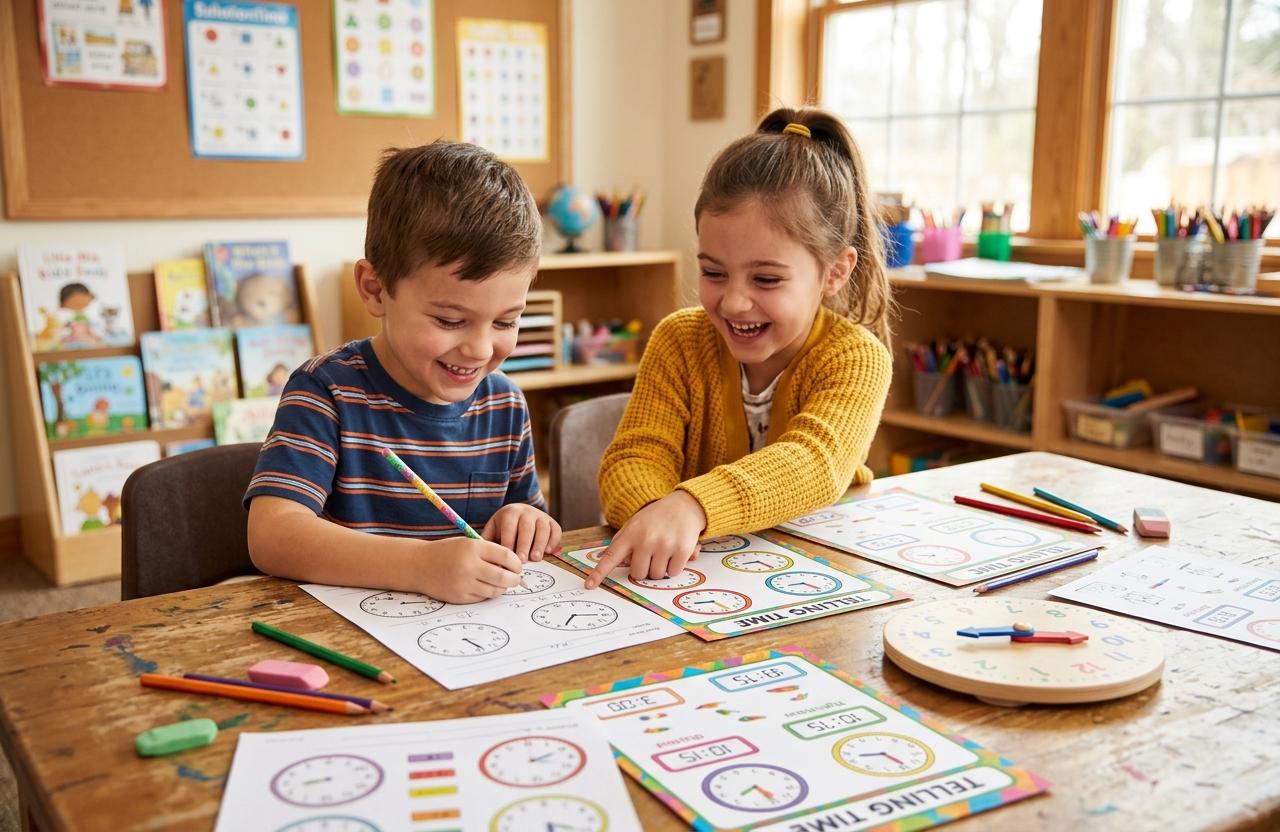
Teaching children how to tell time is an important part of early learning. Understanding clocks helps kids develop number recognition, counting skills, sequencing, and an awareness of daily routines. However, learning to read an analog clock can sometimes be challenging for young learners. This is where worksheets can make the learning process easier, more engaging, and more structured.
How to Teach Kids About Telling Time With Worksheets is a useful approach because worksheets give children opportunities to practice the same concepts repeatedly while gradually building confidence. With carefully designed activities, parents and teachers can introduce clock concepts in a simple and enjoyable way.
Why Is Learning to Tell Time Important for Kids?
Telling time is more than simply reading numbers from a clock. It helps children understand how their day is organized. They begin to recognize when it is time to wake up, eat breakfast, attend school, play, study, and go to bed.
Learning time also supports mathematical development. Children practice counting by fives, recognizing numbers, comparing quantities, and understanding sequences. These skills can support their progress in other areas of mathematics.
Worksheets provide a convenient way to reinforce these concepts. Instead of learning only through verbal explanations, children can see clocks, answer questions, draw hands, and complete different time-based activities.
How Can Worksheets Introduce Basic Clock Concepts?
Before asking children to read specific times, begin with the basic parts of a clock. Explain that an analog clock normally has twelve numbers and two main hands.
The shorter hand represents the hour, while the longer hand represents the minutes. Some worksheets can introduce these parts separately so children do not become overwhelmed.
For example, a worksheet might show several clocks and ask children to circle the hour hand. Another activity could ask them to identify the minute hand. These simple exercises help children become familiar with the structure of a clock before they begin reading time.
Start With O Clock Times
One of the easiest ways to begin teaching time is with o clock times. These are times such as 1:00, 4:00, 7:00, and 10:00.
At this stage, explain that when the minute hand points to twelve, the time is exactly on the hour. The hour hand then points directly toward the appropriate number.
A worksheet can include several blank clocks where children write the correct time. You can also provide digital times and ask children to draw the clock hands.
For example:
Digital time: 5:00
Task: Draw the hour and minute hands on the analog clock.
Repeating these exercises helps children connect digital and analog representations of time.
How Can You Teach Half Hours With Worksheets?
Once children understand o clock times, introduce half-hour times. Explain that half past an hour means thirty minutes have passed.
For example, 3:30 is half past three. The minute hand points to the six, while the hour hand is positioned between three and four.
Worksheets can make this concept easier through visual practice. Children can match phrases such as “half past six” with the correct clock or complete clocks showing different half-hour times.
Matching activities are especially useful because they encourage children to think about time rather than simply memorize answers.
Introduce Quarter Hours Gradually
Quarter-hour concepts can be introduced after children become comfortable with hours and half hours. Explain that a quarter of an hour equals fifteen minutes.
Children can learn phrases such as quarter past and quarter to. For example, 4:15 is quarter past four, while 4:45 is quarter to five.
At first, use simple worksheets with clear clock faces. Ask children to identify whether each clock shows an hour, half hour, quarter past, or quarter to.
Visual worksheets are particularly helpful because children can see how the minute hand changes position around the clock.
Use Time Matching Activities
Matching exercises can turn worksheet practice into a more interactive learning experience. A worksheet might have clocks on one side and written or digital times on the other.
Children must connect each clock to its correct time.
For example:
- 2:00 matches two o clock
- 6:30 matches half past six
- 9:15 matches quarter past nine
- 11:45 matches quarter to twelve
These activities help children recognize different ways of expressing the same time.
Connect Worksheets With Daily Routines
Children often learn faster when lessons relate to things they already understand. Use worksheets that connect time with everyday activities.
For example, a worksheet could show:
7:00 – Wake up
8:00 – Go to school
12:00 – Have lunch
4:00 – Play
8:00 – Go to bed
Ask children to match activities with clocks or arrange daily events in chronological order.
This approach helps children understand that telling time has a practical purpose. They are not simply completing mathematics exercises; they are learning how time works in their everyday lives.
Make Worksheets Age Appropriate
Not every worksheet is suitable for every child. Younger learners usually benefit from large clock faces, fewer questions, and simple instructions. Older children can work with more detailed activities involving five-minute intervals, elapsed time, and word problems.
When choosing worksheets, consider the child's current ability. If an activity is too difficult, the child may become frustrated. If it is too easy, they may lose interest.
A good progression is to move from identifying clock parts to reading o clock times, then half hours, quarter hours, five-minute intervals, and eventually more complex time problems.
Add Five Minute Intervals
After children understand the basic concepts, introduce five-minute intervals. Teach them that the numbers around an analog clock can represent groups of five minutes.
For example:
- 1 = 5 minutes
- 2 = 10 minutes
- 3 = 15 minutes
- 4 = 20 minutes
- 6 = 30 minutes
- 9 = 45 minutes
- 12 = 60 minutes
Worksheets can ask children to identify times such as 2:25, 5:40, or 8:55. These exercises strengthen both counting and clock-reading skills.
Use Time Word Problems
Once children can read clocks, worksheets can introduce simple word problems.
For example:
“Sam starts homework at 4:00 and finishes at 5:00. How long does he study?”
Another question could ask:
“Lunch begins at 12:30. What time will it be one hour later?”
These activities encourage children to apply their knowledge rather than simply identify clock hands.
Keep Practice Short and Consistent
Children do not need to complete large numbers of questions every day. Short and regular practice sessions can be more effective.
A parent or teacher might use one worksheet for ten to fifteen minutes and then discuss the answers. Repetition over several days can help reinforce concepts without making learning feel tiring.
Encouragement is also important. When children make mistakes, explain the answer and let them try again. This creates a positive learning environment and helps them develop confidence.
Conclusion
Learning to tell time is an important childhood skill that combines mathematics with everyday life. How to Teach Kids About Telling Time With Worksheets becomes much easier when learning is broken into manageable steps.
Start with clock parts and o clock times before introducing half hours, quarter hours, five-minute intervals, and elapsed time. Use matching activities, daily routines, and simple word problems to keep lessons meaningful.
With age-appropriate worksheets and consistent practice, children can gradually become more confident in reading analog clocks and understanding how time fits into their daily lives.
 English
Join our community to interact with posts!