
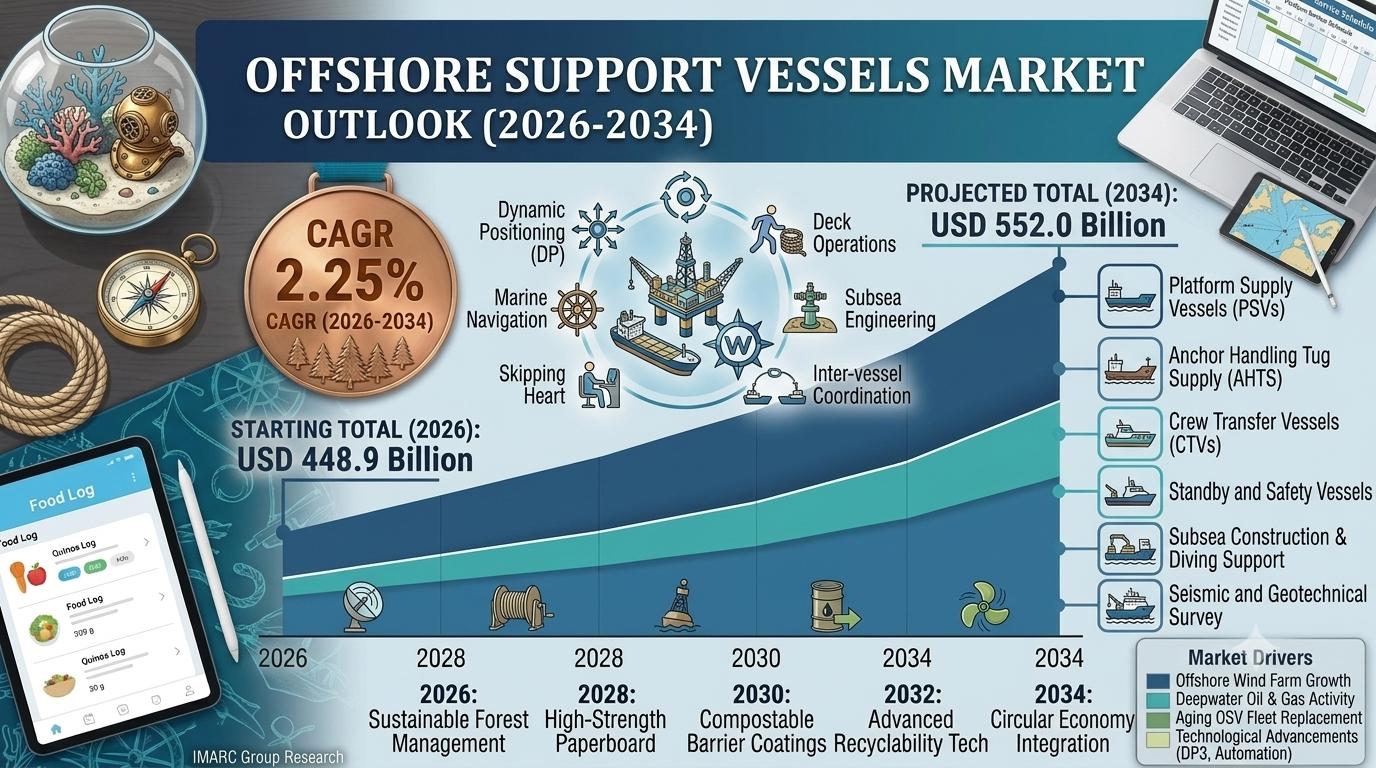
According to IMARC Group, the global offshore support vessels market size reached USD 47.7 Billion in 2025 and is projected to reach USD 62.3 Billion by 2034, expanding at a CAGR of 3.00% during 2026–2034. This steady offshore support vessels market growth reflects rising offshore exploration and production activity, the surge in offshore wind energy projects driven by renewable energy commitments, and the ongoing modernization of aging OSV fleets with fuel-efficient, technologically advanced vessels.
Offshore Support Vessels Industry Overview
Offshore Support Vessels (OSVs) are specialized ships engineered to support offshore oil and gas exploration, production, and renewable energy operations. They provide critical services such as transporting equipment, personnel, and supplies to offshore installations, along with anchor handling, towing, subsea construction support, and technical and logistical assistance in challenging marine conditions where conventional vessels cannot operate efficiently.
Offshore support vessels are deployed across a broad continuum of use cases:
- Oil and gas exploration & production: Supporting drilling rigs, production platforms, and floating production units with personnel, equipment, and supply transport
- Offshore wind energy: Transporting turbine components, assisting installation and foundational work, and providing ongoing maintenance and repair services
- Anchor handling and towing: Positioning, relocating, and retrieving offshore drilling rigs and mooring systems
- Inspection, survey, and subsea operations: Bathymetric surveys, ROV deployment, pipeline evaluation, and geotechnical studies
- Crew and logistics management: Floating accommodation, cargo handling, and supply chain coordination for offshore personnel and materials
Global Offshore Support Vessels Market Size & Key Statistics
Below are the key offshore support vessels market statistics drawn from IMARC Group's comprehensive market analysis:
| Report Attribute | Key Statistics |
| Base Year | 2025 |
| Historical Period | 2020–2025 |
| Forecast Period | 2026–2034 |
| Offshore Support Vessels Market Size in 2025 | USD 47.7 Billion |
| Market Forecast in 2034 | USD 62.3 Billion |
| Market Growth Rate (2026–2034) | 3.00% CAGR |
| Largest Region | Asia Pacific (over 25% share) |
| Leading Type Segment | Anchor Handling Towing Supply Vessel |
| Leading Water Depth Segment | Shallow Water |
| Leading Fuel Segment | Fuel Oil |
| Leading Application | Oil and Gas Applications |
Request for a Sample Report for Detailed Offshore Support Vessels Market Share Evaluation: https://www.imarcgroup.com/offshore-support-vessels-market/requestsample
Key Market Drivers & Offshore Support Vessels Market Trends in 2026
Several powerful forces are shaping offshore support vessels market trends and fuelling sustained growth expectations across global offshore energy and logistics markets:
1. Rising Offshore Exploration and Production Activities
Offshore exploration and production activities are accelerating to meet growing global energy demand, as dwindling onshore reserves push operators toward previously untapped offshore resources. Industry estimates suggest the global OSV fleet could grow by 15% by 2027 as exploration intensifies. For instance, in July 2024, India's oil minister highlighted the potential for a USD 100 Billion investment in the country's offshore exploration, with only 10% of its sedimentary basin explored so far. OSVs remain essential for transporting personnel, equipment, and supplies to offshore platforms and supporting seismic surveys, drilling, and subsea construction.
2. Expansion of Offshore Wind Energy Projects
The growing number of offshore wind initiatives, propelled by rising preference for renewable energy, is reshaping fleet demand. By 2023, four fixed-bottom offshore wind projects had received approval along the U.S. Atlantic Coast, with two already operational. OSVs are essential for transporting turbine components from onshore assembly sites, assisting installation and foundational work, and providing ongoing maintenance and repair — making this one of the most consistent Offshore Support Vessels Market Trends through 2034.
3. Modernization and Upgradation of Aging Fleets
A significant share of the operating OSV fleet is aging, with the U.S. Coast Guard reporting that more than 30% of OSVs in the U.S. fleet are over 25 years old. Operators are increasingly investing in new, technologically advanced vessels that offer better fuel efficiency, lower emissions, and enhanced safety — helping fleet owners meet tightening environmental regulations while remaining competitive.
4. Technological Advancements in Vessel Design
Dynamic positioning systems, hybrid propulsion, and fuel-efficient vessel designs are improving operational reliability and reducing costs across the sector. These innovations are attracting fresh investment and supporting compliance with increasingly stringent safety and environmental standards governing offshore operations worldwide.
5. Regulatory Emphasis on Safety and Environmental Compliance
Regulatory bodies across major offshore markets — including the U.S. and the European Union — are tightening safety and emissions standards for marine vessels. This is driving sustained investment in cleaner-burning engines, hybrid and electric propulsion, and digital navigation systems, further reinforcing long-term Offshore Support Vessels Market Growth.
6. Expanding Oilfield Services and Logistics Demand
Rising global trade and offshore construction activity are increasing demand for streamlined logistics, inventory tracking, and cargo coordination. The adoption of IoT and automation technologies within logistics and cargo management services is enhancing accuracy and reducing delays, reinforcing OSV relevance across the broader offshore supply chain.
Key Market Segmentation
By Type
- Anchor Handling Towing Supply Vessel
- Platform Supply Vessel
- Fast Supply Intervention Vessel
- Multi-Purpose Service Vessel
- Others
Anchor handling towing supply vessel — Largest Segment: Leading the market with around 32.3% share in 2025, these robust and adaptable vessels are equipped with powerful winches, towing pins, and stern rollers that enable precise handling of heavy anchor chains and mooring lines. They play a vital role in installing, relocating, and retrieving offshore drilling rigs, and in providing static positioning support during critical offshore operations.
By Water Depth
- Shallow Water
- Deepwater
Shallow water — Largest Segment: Shallow water OSVs hold around 60.8% market share in 2025. Their compact dimensions, shallow draft, and maneuverability allow them to access coastal regions and continental shelves with limited infrastructure, supporting exploration, drilling, well servicing, and subsea construction while transporting personnel, equipment, and supplies between onshore bases and offshore facilities.
By Fuel
- Fuel Oil
- LNG
Fuel oil — Largest Segment: Fuel oil leads with around 74.5% share in 2025. As a reliable, widely available petroleum product, it powers the internal combustion engines on most OSVs, making fuel oil-powered vessels well-suited for long voyages and demanding offshore operations.
By Service Type
- Technical Services
- Inspection & Survey
- Crew Management
- Logistics & Cargo Management
- Anchor Handling & Seismic Support
- Others
Technical services OSVs support the installation, upkeep, and repair of offshore infrastructure, including platforms, subsea equipment, and pipelines, while also assisting construction and diving operations. Inspection and survey vessels carry out bathymetric surveys, environmental assessments, and pipeline evaluations using ROVs and specialized instrumentation. Crew management OSVs provide floating accommodation and logistical support for offshore personnel, while logistics and cargo management services ensure efficient transportation, inventory tracking, and supply chain coordination. Anchor handling and seismic support vessels remain vital for exploration and marine construction, deploying and managing anchors for rigs and platforms.
By Application
- Oil and Gas Applications
- Offshore Applications
Oil and gas applications — Largest Segment: Holding around 78.9% share in 2025, OSVs serving oil and gas operations support the entire lifecycle of offshore projects — from seismic surveys and exploration team transport in the early stages, to transporting personnel, equipment, and supplies to drilling rigs, production platforms, and floating production units during production.
Regional Offshore Support Vessels Market Analysis
| Region | Key Highlights |
| Asia Pacific — Largest | China, Japan, India, South Korea, Australia, Indonesia; extensive offshore reserves, rising renewable energy investment, growing demand for port support and logistics services, over 25% global market share in 2025 |
| North America | United States & Canada; expanding Gulf of Mexico drilling activity, U.S. DOE target of 30 GW offshore wind by 2030, hybrid-powered vessels and dynamic positioning adoption |
| Europe | Germany, France, UK, Italy, Spain, Russia; record 3.8 GW of offshore wind installations in 2023, EU green shipping regulations, fuel-efficient and low-emission vessel innovation |
| Latin America | Brazil, Mexico; expanding offshore oil block auctions, deep-water exploration in the Pelotas Basin, growing exploration-driven OSV demand |
| Middle East & Africa | UAE, Saudi Arabia, Angola, Nigeria; UAE targeting 3 GW offshore wind capacity by 2030, Africa contributing around 60% of regional offshore oil production |
Asia Pacific leads the global Offshore Support Vessels Market Share, underpinned by extensive offshore reserves, rising renewable energy interest, and increasing exploration and production activity driven by surging regional energy demand.
North America follows closely, with the United States accounting for 88.90% of the regional market in 2025, driven by Gulf of Mexico drilling — where more than 570 oil rigs were estimated to be operating in 2023 — and growing offshore wind investment under federal renewable energy targets.
Connect for Detailed Offshore Support Vessels Market Share Segmentation Analysis — Speak to an Analyst: https://www.imarcgroup.com/request?type=report&id=2126&flag=C
Leading Players in the Global Offshore Support Vessels Industry
The global offshore support vessels market features a mix of diversified marine services operators and specialized OSV fleet owners. Key companies covered in the IMARC Group report include:
- Bourbon
- Cyan Offshore Pty Ltd.
- DOF Group ASA
- Grupo CBO
- Havila Shipping ASA
- Hornbeck Offshore
- Nam Cheong Limited
- Ostensjo Rederi
- Pacific Radiance Ltd.
- Sea 1 Offshore
- SEACOR Marine
- Solstad
- Tidewater Inc.
- Vroon
Latest Offshore Support Vessels Market Industry Developments
December 2024 — Geoquip Marine
Geoquip Marine added a new vessel following the conversion of Geoquip Silvretta into a geotechnical services platform from a supply vessel. The conversion includes installation of the GMTR150 drilling rig, supporting major energy projects along the north European shore from spring 2025.
November 2024 — Bourbon Logistics
Bourbon Logistics was awarded a fully integrated logistics contract in Namibia by an oil and gas operator for a six-month exploration campaign, covering freight forwarding, logistics base services, and marine services, with 96% of the roughly 50 staff employed locally.
September 2024 — Maersk Supply Service
Maersk Supply Service secured a contract with Cenovus Energy for a new Field Support Vessel. Built by Crist S.A. in Poland and delivered in 2027, the 110-meter, DP3 ice-classed vessel will support operations at the White Rose Field offshore Canada.
August 2024 — Havila Shipping ASA
Havila Shipping ASA was awarded a contract by Peterson Den Helder for its platform supply vessel, Havila Borg, covering two wells over 200 days with options for eight additional wells.
Offshore Support Vessels Market Report Scope
| Report Features | Details |
| Base Year | 2025 |
| Historical Period | 2020–2025 |
| Forecast Period | 2026–2034 |
| Units | Billion USD |
| Types Covered | Anchor Handling Towing Supply Vessel, Platform Supply Vessel, Fast Supply Intervention Vessel, Multi-Purpose Service Vessel, Others |
| Water Depths Covered | Shallow Water, Deepwater |
| Fuels Covered | Fuel Oil, LNG |
| Service Types Covered | Technical Services, Inspection & Survey, Crew Management, Logistics & Cargo Management, Anchor Handling & Seismic Support, Others |
| Applications Covered | Oil and Gas Applications, Offshore Applications |
| Regions Covered | Asia Pacific, Europe, North America, Latin America, Middle East and Africa |
| Companies Covered | Bourbon, Cyan Offshore Pty Ltd., DOF Group ASA, Grupo CBO, Havila Shipping ASA, Hornbeck Offshore, Nam Cheong Limited, Ostensjo Rederi, Pacific Radiance Ltd., Sea 1 Offshore, SEACOR Marine, Solstad, Tidewater Inc., Vroon, etc. |
About Us
IMARC Group is a leading global market research company providing data-driven insights and expert consulting services to businesses seeking to achieve their strategic objectives. With a multi-disciplinary team of industry experts, IMARC delivers thorough, reliable market intelligence across sectors including Energy and Mining, Transportation and Logistics, Healthcare, Technology, Chemicals, and more.
Contact Us
IMARC Group
United States: +1-201-971-6302
India: +91-120-433-0800
United Kingdom: +44-753-714-6104
 English
Join our community to interact with posts!