
Paying 500 employees in one country is a process. Paying 500 employees across Germany, the UAE, South Africa, the UK, and Poland is a puzzle. Each country has its own tax rules, social contributions, filing calendars, currencies, and labor laws. One late filing or one wrong deduction can mean penalties and unhappy employees.
That is why the Multi-Country Payroll platform for EMEA has become a priority for HR, finance, and IT leaders. As companies hire across borders and expand into new markets, payroll is no longer an admin task. It is a test of compliance, accuracy, and trust.
Download Sample Report Here: https://qksgroup.com/download-sample-form/spark-matrix-multi-country-payroll-platform-for-emea-market-q4-2025-10246
Market Overview: One Platform, Many Rulebooks
QKS Group defines a Multi-Country Payroll (MCP) platform as an integrated solution that centralizes, automates, and manages payroll operations across multiple countries while ensuring compliance with local regulations. It brings scattered payroll processes into one environment and improves visibility into workforce costs.
EMEA is a particularly demanding region. It combines mature European regulatory frameworks, fast-growing Middle Eastern markets, and diverse African labor environments. No two countries work quite the same way.
Core capabilities typically include:
• Compliance management for local tax and labor rules
• Currency conversion and multi-currency payments
• Tax handling and statutory reporting
• Integration with HR and finance systems
• Consolidated reporting and analytics
• A consistent payslip and self-service experience for employees
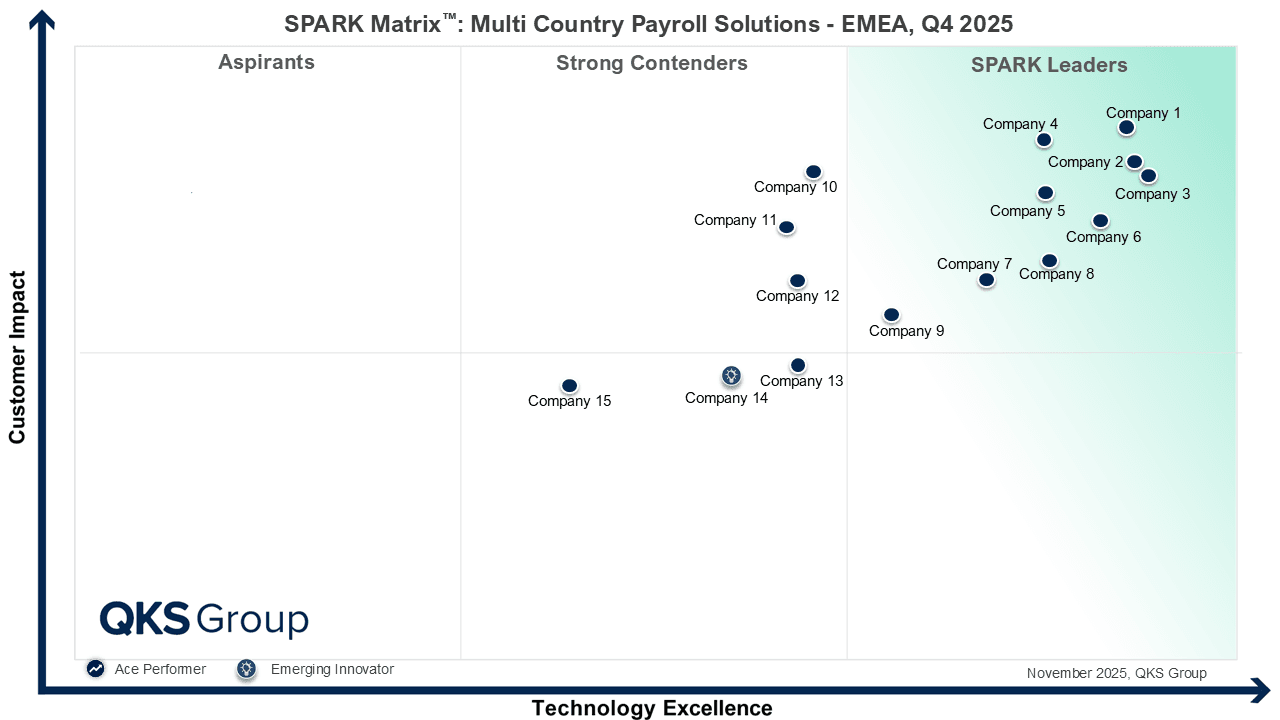
QKS Group's SPARK Matrix evaluates vendors including activpayroll, ADP, Cloudpay,
Deel, Mercans, Neeyamo, Papaya Global, Ramco Systems, Remote, Safeguard Global, SD Worx, Sopra HR, Strada, UKG, and Zalaris. The list shows the range of approaches in this market, from global payroll specialists to HCM suites and employer-of-record providers.
Key Challenges Businesses Face
Running payroll across EMEA exposes problems that single-country operations rarely see:
• Regulatory churn. Tax rates, social security rules, and reporting formats change often and differ by country.
• Fragmented providers. Many enterprises juggle separate local vendors, each with its own process and data format.
• Limited visibility. Without consolidated data, finance teams struggle to see total workforce cost.
• Manual reconciliation. Spreadsheets and email-based approvals slow every payroll cycle.
• Data privacy. GDPR and regional data protection laws govern how employee data moves across borders.
• Currency and payment complexity. Exchange rates and local payment methods add delays and cost.
• Inconsistent employee experience. Late or incorrect payslips damage trust quickly.
Key Trends and Innovations
Compliance automation. Platforms increasingly track regulatory updates and apply them to payroll rules, reducing the risk of missed changes.
Unified global data models. A single source of payroll data supports consistent reporting and faster consolidation across countries.
AI and anomaly detection. Machine learning flags unusual pay variances, duplicate entries, and potential errors before payroll is finalized.
Deeper HR and finance integration. Connections to HCM, ERP, and general ledger systems remove manual data transfers.
Employee self-service and mobile access. Workers view payslips, update details, and raise queries on their own, which reduces helpdesk load.
Flexible delivery models. Enterprises choose between software-led, in-country partner, and hybrid approaches depending on their footprint.
Real-time and on-demand pay. Interest is growing in faster pay cycles and flexible disbursement options.
Benefits and Business Impact
A strong MCP platform delivers value well beyond the payroll team:
• Lower compliance risk. Built-in local rules reduce penalties and audit exposure.
• Operational efficiency. Standardized processes cut manual effort and shorten payroll cycles.
• Cost visibility. Consolidated reporting helps finance leaders understand and forecast workforce costs.
• Accuracy. Automated validations reduce errors and rework.
• Scalability. New countries can be added faster, which supports expansion plans.
• Stronger security. Centralized controls protect sensitive employee data.
• Better employee experience. Timely, accurate pay builds trust and retention.
Real-World Use Cases
Expanding into new markets. A technology firm opens offices in the Gulf and East Africa. Instead of hiring local payroll vendors one by one, it adds the new countries to its existing platform.
Replacing vendor sprawl. A manufacturer with 12 local payroll providers consolidates onto one platform. Payroll data now flows into a single dashboard, and month-end close gets faster.
Managing distributed teams. A SaaS company with remote employees across Europe and the Middle East uses an MCP platform to handle local contributions and payments consistently.
Mergers and acquisitions. After an acquisition, the buyer brings the acquired company's payroll into a common framework without disrupting employees.
Audit readiness. A multinational uses centralized records and approval trails to respond quickly to regulator and auditor requests.
Check SPARK Plus Study Here: https://qksgroup.com/sparkplus?marketid=324&market-name=multi-country-payroll-%28mcp%29
How to Choose the Right Solution
Start with your country footprint and growth plans. Then assess vendors against these criteria:
1. Country coverage. Check depth in the specific EMEA countries you operate in, not just a long country list.
2. Compliance expertise. Ask how regulatory changes are tracked, tested, and delivered.
3. Delivery model. Understand what is handled directly and what relies on local partners.
4. Integration. Confirm connectors with your HCM, ERP, and finance systems.
5. Data security and privacy. Verify GDPR alignment, data residency options, and access controls.
6. Analytics and reporting. Look for consolidated, real-time views of cost and headcount.
7. User experience. Evaluate both the administrator interface and the employee portal.
8. Vendor stability and support. Review service levels, references, and implementation approach.
An independent benchmark makes shortlisting easier. QKS Group's SPARK Matrix compares vendors on capability, differentiation, and market position, giving buyers a structured starting point.
Future Outlook (2025–2028)
Over the next few years, payroll will become more automated, more connected, and more strategic. Expect AI to handle more validation and exception management, and compliance updates to move closer to real time.
Pay transparency rules and expanding data protection requirements in EMEA will raise the bar for reporting and governance. Enterprises will also lean toward platforms that blend payroll with workforce analytics, mobility, and payments. Vendors that offer reliable local expertise within a single global experience will be best placed to lead.
Click Here For More Information: https://qksgroup.com/market-research/sparkmatrix-multi-country-payroll-platform-for-emea-market-q4-2025-10246
Conclusion
Payroll is one of the few processes every employee notices. In a region as varied as EMEA, getting it right takes more than good intentions. A modern Multi-Country Payroll platform brings compliance, accuracy, and visibility under one roof, and frees HR and finance teams to focus on people instead of paperwork.
For CXOs and HR leaders, the next step is to map your payroll landscape, identify gaps, and compare vendors through an independent lens such as QKS Group's SPARK Matrix.
 English
Join our community to interact with posts!