
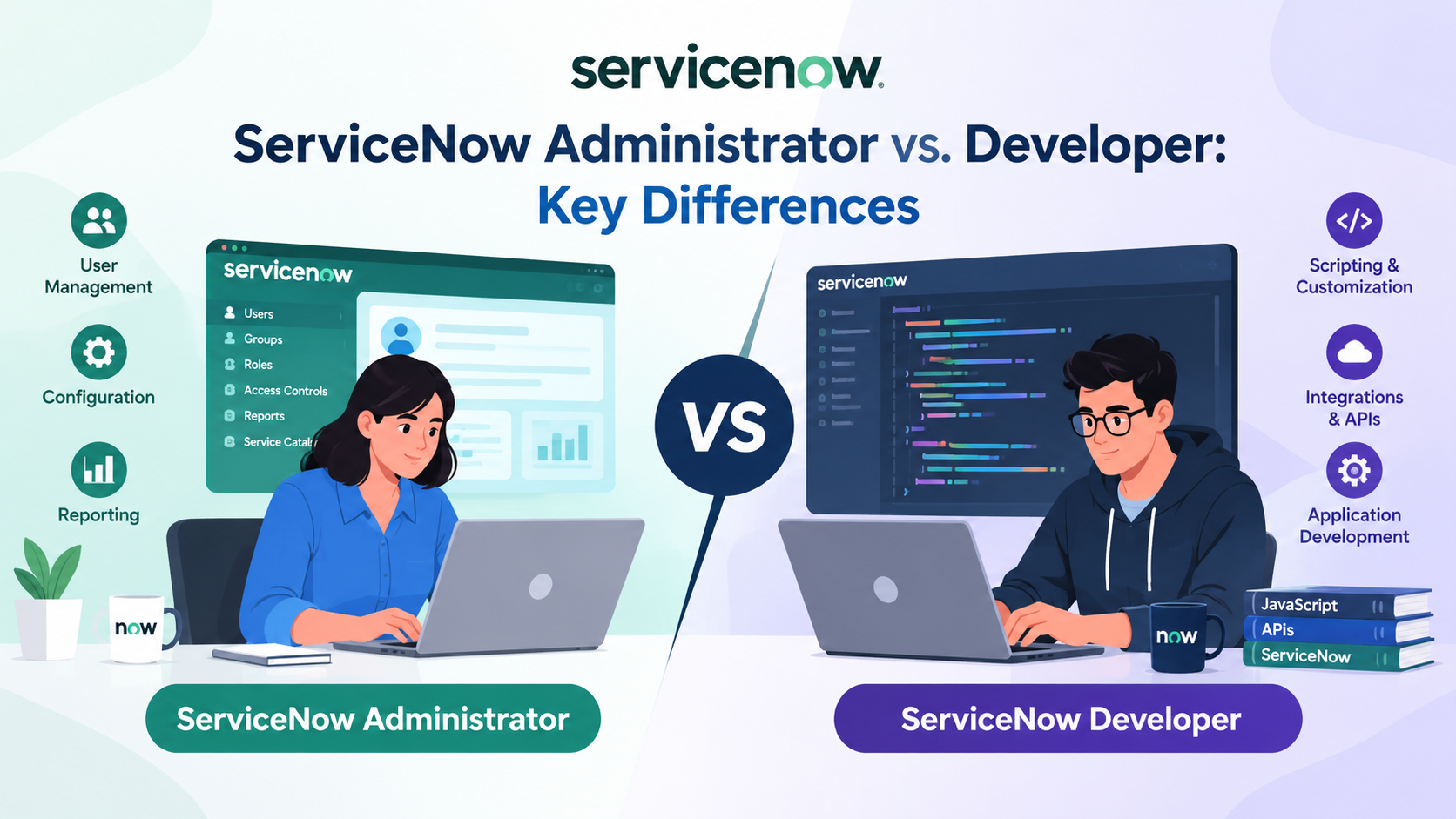
ServiceNow has become an important platform for organizations looking to automate workflows, improve IT service management, and streamline business operations. As demand for ServiceNow professionals grows, two popular career paths attract aspiring IT professionals: ServiceNow Administrator and ServiceNow Developer.
Although both roles work with the same platform, their responsibilities, technical skills, and career opportunities differ. Understanding these differences can help you choose the right career path.
What Is a ServiceNow Administrator?
A ServiceNow Administrator manages and maintains the platform to ensure it operates efficiently. Administrators focus on configuring the system, managing users, maintaining data, and supporting business processes.
Their primary responsibility is to keep the ServiceNow environment secure, organized, and aligned with business requirements.
Key responsibilities of a ServiceNow Administrator include:
-
Managing users, groups, and roles.
-
Configuring forms, lists, fields, and tables.
-
Creating reports and dashboards.
-
Managing access controls and permissions.
-
Maintaining service catalogs and workflows.
-
Troubleshooting platform issues and supporting end users.
Administrators typically work with platform configuration tools and require a good understanding of ServiceNow modules, particularly IT Service Management (ITSM).
Those beginning their journey can explore ServiceNow training to build foundational knowledge and prepare for administrator-related responsibilities.
What Is a ServiceNow Developer?
A ServiceNow Developer builds and customizes applications, scripts, and automated solutions on the platform. Developers use technical skills to implement business requirements that go beyond standard configuration.
They collaborate with administrators, business analysts, and other IT teams to develop solutions that improve operational efficiency.
Key responsibilities of a ServiceNow Developer include:
-
Writing JavaScript for platform customization.
-
Developing Business Rules, Client Scripts, and Script Includes.
-
Creating and customizing Service Portal components.
-
Building automated workflows using Flow Designer.
-
Integrating ServiceNow with external applications and APIs.
-
Developing custom applications and troubleshooting code.
Developers need a deeper understanding of JavaScript, ServiceNow scripting APIs, application development, and integrations.
Professionals who want to strengthen their technical knowledge can explore the S2-Labs for learning resources related to ServiceNow development and other enterprise technologies.
ServiceNow Administrator vs. Developer: Key Differences
Although these professionals often collaborate, their daily responsibilities differ.
| Area | ServiceNow Administrator | ServiceNow Developer |
|---|---|---|
| Primary focus | Platform management and configuration | Application development and customization |
| Coding skills | Basic scripting may be useful | JavaScript and scripting are important |
| Main tasks | User management, forms, reports, access controls | Scripts, integrations, custom applications |
| Tools | Configuration tools, reports, service catalogs | Script Editors, APIs, Flow Designer |
| Main objective | Maintain a stable and efficient platform | Build solutions for complex requirements |
| Suitable for | Beginners interested in platform administration | Professionals interested in programming |
In practice, the responsibilities can overlap. Administrators may write scripts, while developers also configure forms, workflows, and access controls.
Skills Required for Each Role
Skills for ServiceNow Administrators
Administrators should understand the ServiceNow interface, tables, forms, lists, roles, access controls, and reporting. Knowledge of ITSM processes, including incident, problem, and change management, is also valuable.
Strong communication and troubleshooting skills help administrators understand user requirements and resolve platform issues effectively.
Skills for ServiceNow Developers
Developers need a solid understanding of JavaScript, client-side and server-side scripting, Business Rules, Script Includes, GlideRecord, and REST APIs. Familiarity with application development, debugging, and platform security is equally important.
Hands-on practice is particularly useful because real projects help learners understand how to translate business requirements into working solutions.
Which Career Path Should You Choose?
The right choice depends on your interests, experience, and long-term goals.
Choose ServiceNow Administration if you prefer system configuration, user support, reporting, and managing business processes. It can be a suitable starting point for freshers and professionals transitioning into IT service management.
Choose ServiceNow Development if you enjoy programming, solving technical problems, creating applications, and integrating different systems. This path is especially suitable for people interested in software development and automation.
If you are unsure, start by learning the platform fundamentals before progressing into scripting and application development. This approach gives you a clearer understanding of both roles.
Conclusion
ServiceNow Administrators and Developers play complementary roles in building and maintaining an effective ServiceNow environment. Administrators focus on platform configuration, user management, and system maintenance, while developers build custom applications, scripts, and integrations.
Both paths offer opportunities to develop valuable IT skills. By understanding your strengths and gaining practical experience, you can choose a career direction that matches your interests.
To begin your learning journey, visit S2-Labs and explore relevant ServiceNow learning resources to develop your knowledge and prepare for future career opportunities.
 English
Join our community to interact with posts!