
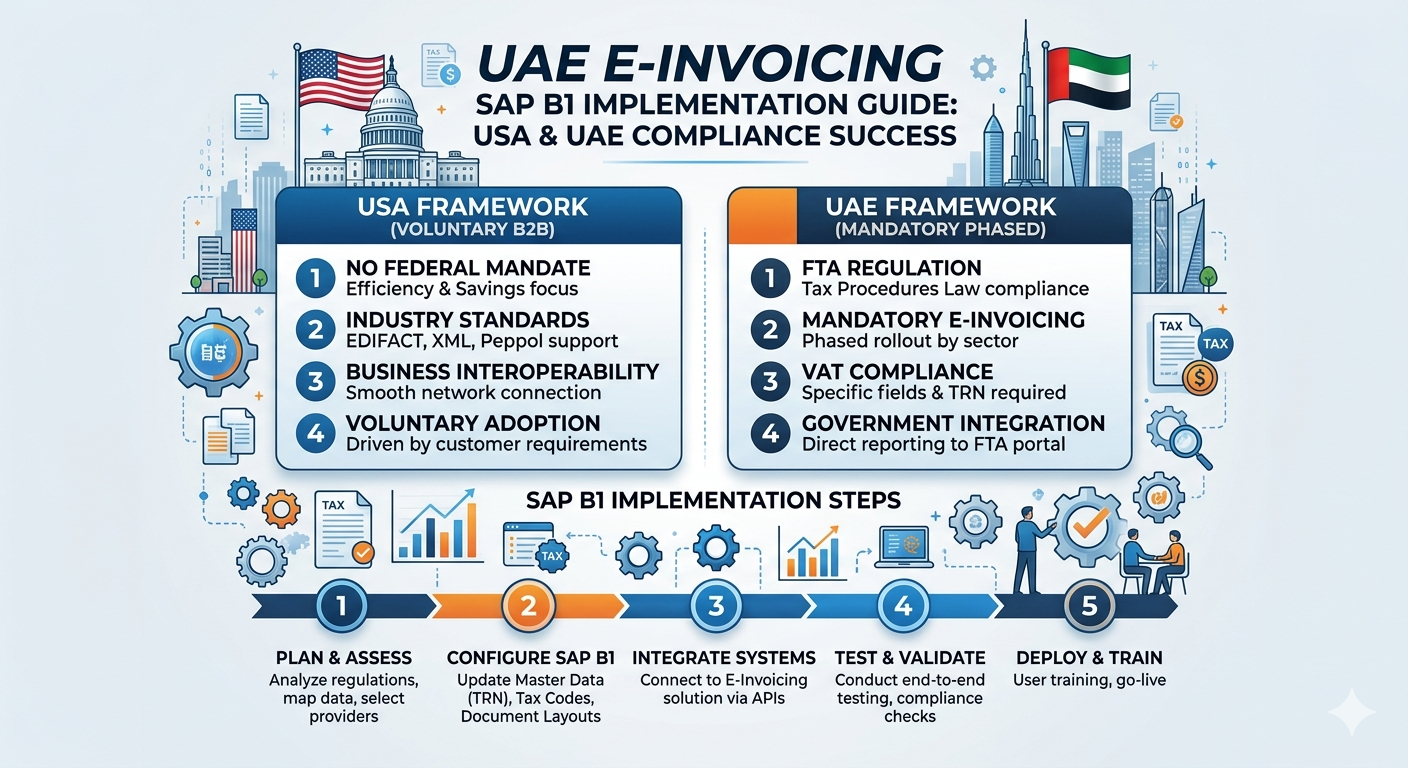
Businesses operating in the UAE are preparing for a major shift in digital tax reporting. Governments worldwide are adopting electronic invoicing systems to increase transparency, prevent tax fraud, and streamline financial reporting. In the UAE, the upcoming framework for electronic invoicing will significantly impact companies using ERP systems such as SAP Business One.
For organizations relying on SAP Business One for accounting and financial management, understanding uae einvoice for sap b1 is essential to ensure compliance, automation, and smooth invoice processing. Implementing an efficient e-invoicing structure helps businesses transmit invoices electronically, validate tax data, and integrate seamlessly with government reporting frameworks.
This guide explains how e-invoicing works with SAP Business One, why it matters for companies in the UAE, and how organizations can prepare their systems for compliance while maintaining operational efficiency.
Understanding the UAE E-Invoicing Framework
Electronic invoicing refers to the digital creation, transmission, and storage of invoices in a structured format that can be automatically processed by tax authorities and business systems.
The UAE government is introducing a digital invoicing ecosystem aligned with global standards to support tax transparency and reduce manual documentation. Companies will be required to issue invoices in a standardized format that can be validated electronically.
Key objectives of the system include:
• Improving tax reporting accuracy
• Reducing invoice fraud and errors
• Automating business transactions
• Enhancing government compliance monitoring
• Simplifying financial record keeping for businesses
Organizations that use ERP platforms such as SAP Business One must adapt their systems to support structured invoice formats and automated submission mechanisms.
Why SAP Business One Users Must Prepare for E-Invoicing
SAP Business One is widely used by small and medium enterprises to manage accounting, inventory, sales, and financial reporting. When e-invoicing regulations become mandatory, businesses must ensure that their ERP systems can generate compliant invoices and transmit them digitally.
Companies implementing uae e-invoicing sap b1 capabilities will benefit from automation and improved data accuracy. Instead of manually generating invoices or maintaining separate systems, businesses can integrate invoicing directly into their ERP workflows.
Benefits include:
• Faster invoice generation and validation
• Reduced manual errors in tax reporting
• Real-time financial data synchronization
• Improved compliance with regulatory requirements
• Seamless integration with accounting and tax modules
Organizations that begin preparing early will avoid disruptions once the mandate becomes active.
How E-Invoicing Works with SAP Business One
Integrating e-invoicing with SAP Business One involves creating structured invoice data, validating tax information, and transmitting invoices through an approved digital channel.
In a typical process, the ERP system generates an invoice that contains all required fields such as supplier information, customer details, tax values, and item descriptions. This invoice is then converted into a standardized electronic format compatible with regulatory systems.
With uae einvoicing sap b1 integration, the process usually follows these steps:
-
Invoice creation in SAP Business One
-
Data validation according to regulatory standards
-
Conversion into structured e-invoice format
-
Digital submission through the approved network
-
Confirmation and archival for compliance
This automated workflow helps businesses maintain accurate financial records while ensuring regulatory compliance.
Core Components of a UAE E-Invoice
Electronic invoices contain structured data elements that allow automated processing by systems and authorities. These fields are standardized to ensure consistency and transparency.
Typical invoice components include:
• Supplier identification details
• Buyer information
• Invoice number and date
• Product or service descriptions
• Quantity and pricing details
• VAT calculations
• Total payable amount
• Digital authentication or validation codes
When implementing uae e-invoice sap b1 systems, companies must ensure that these data fields are properly configured within their ERP environment.
Key Features of SAP Business One E-Invoicing Integration
Organizations implementing digital invoicing solutions within SAP Business One can benefit from several advanced capabilities.
Automated Invoice Generation
ERP automation allows invoices to be generated automatically from sales orders or delivery documents. This reduces manual entry and improves accuracy.
Structured Data Formatting
Invoices must be converted into digital formats compatible with regulatory frameworks. Implementing uae einvoice sap b1 integration ensures that data is structured according to government requirements.
Real-Time Validation
Validation tools help identify missing fields, incorrect tax calculations, or formatting errors before invoices are submitted.
Digital Archiving
Electronic invoices must be stored securely for regulatory audits and financial reporting purposes.
Seamless ERP Integration
Businesses using uae e-invoicing for sap b1 can maintain their existing accounting processes while enabling digital compliance features.
Benefits of E-Invoicing for Businesses in the UAE
Adopting digital invoicing solutions offers more than just regulatory compliance. It also improves operational efficiency and financial transparency.
Improved Financial Accuracy
Automation reduces manual errors and ensures that invoice data is consistent across systems.
Faster Payment Cycles
Electronic invoices are processed quickly, helping businesses receive payments faster.
Reduced Administrative Work
Manual documentation, printing, and filing processes are minimized with digital workflows.
Better Tax Compliance
Using uae einvoicing for sap b1 systems helps companies meet government tax reporting requirements accurately.
Stronger Audit Trails
Electronic records provide clear documentation for audits and regulatory reviews.
Implementation Steps for SAP Business One E-Invoicing
Organizations preparing for digital invoicing must follow a structured implementation approach.
Assess Current ERP Configuration
Businesses should evaluate their existing SAP Business One environment to identify required changes or integrations.
Identify Compliance Requirements
Understanding regulatory standards is essential for successful implementation.
Integrate Middleware or E-Invoicing Platforms
Companies often use integration tools to connect SAP Business One with government reporting systems.
Configure Invoice Data Fields
Proper configuration ensures that invoice data matches regulatory specifications.
Testing and Validation
Before deployment, organizations should test their uae sap b1 e-invoicing systems to ensure accurate data transmission.
Technical Considerations for SAP B1 E-Invoicing
Implementing e-invoicing in ERP systems requires technical planning and system configuration.
Important considerations include:
• Data mapping between ERP and e-invoice formats
• API integrations with invoicing platforms
• Secure data transmission protocols
• Compliance with digital signature requirements
• Long-term data storage and archival
Businesses implementing uae sap b1 einvoicing solutions should work with experienced integration specialists to ensure reliable system performance.
Challenges Businesses May Face During Implementation
Transitioning to electronic invoicing may present several challenges for organizations.
System Integration Complexity
ERP systems often require customization to support structured invoice formats.
Staff Training Requirements
Employees must understand new workflows and digital invoicing processes.
Data Accuracy Issues
Incorrect data mapping can cause invoice validation failures.
Regulatory Updates
Government frameworks may evolve, requiring system adjustments.
Organizations implementing uae sap b1 e-invoice solutions should stay updated with regulatory guidelines to avoid compliance issues.
Best Practices for SAP Business One E-Invoicing Compliance
To ensure a smooth transition to electronic invoicing, businesses should follow several best practices.
• Start implementation planning early
• Ensure accurate tax configuration in ERP systems
• Maintain clear documentation of invoice workflows
• Test integrations thoroughly before deployment
• Train accounting and finance teams on new processes
Companies adopting uae sap b1 einvoice frameworks can improve both compliance and operational efficiency.
Preparing for the Future of Digital Tax Systems
Electronic invoicing is part of a broader transformation toward digital tax ecosystems. Governments are moving toward real-time financial reporting and automated tax monitoring.
Businesses that adapt early will gain several advantages:
• Stronger regulatory compliance
• Improved financial transparency
• Faster transaction processing
• Reduced operational costs
• Better integration with global digital tax systems
Organizations implementing uae e-invoice for sap b1 systems today will be better prepared for future regulatory developments.
Frequently Asked Questions
What is UAE e-invoicing for SAP Business One?
It refers to integrating electronic invoicing functionality within SAP Business One so that invoices can be generated, validated, and transmitted in compliance with UAE regulatory standards.
Why is e-invoicing important for UAE businesses?
Electronic invoicing improves tax transparency, reduces fraud, and helps governments monitor financial transactions more effectively.
Can SAP Business One support e-invoicing?
Yes. SAP Business One can integrate with e-invoicing platforms or middleware solutions that convert ERP invoice data into compliant electronic formats.
When should businesses prepare for e-invoicing?
Companies should begin preparing as early as possible to ensure their ERP systems are ready before the regulatory mandate becomes active.
What benefits does e-invoicing provide?
It improves invoice accuracy, reduces manual work, speeds up payment cycles, and enhances regulatory compliance.
Conclusion
The transition toward electronic invoicing is transforming the way businesses manage financial transactions and tax reporting. Companies using SAP Business One must ensure their ERP systems are ready to generate compliant digital invoices and integrate with regulatory frameworks.
Implementing e-invoicing solutions helps organizations automate invoice processing, maintain accurate tax records, and streamline financial operations. Businesses that proactively adopt digital invoicing technology will not only meet regulatory requirements but also gain operational efficiency and long-term scalability.
As the UAE continues to develop its digital tax infrastructure, companies investing in reliable SAP Business One e-invoicing systems will be better positioned to adapt to future regulatory changes and maintain seamless business operations.
 English
Join our community to interact with posts!