
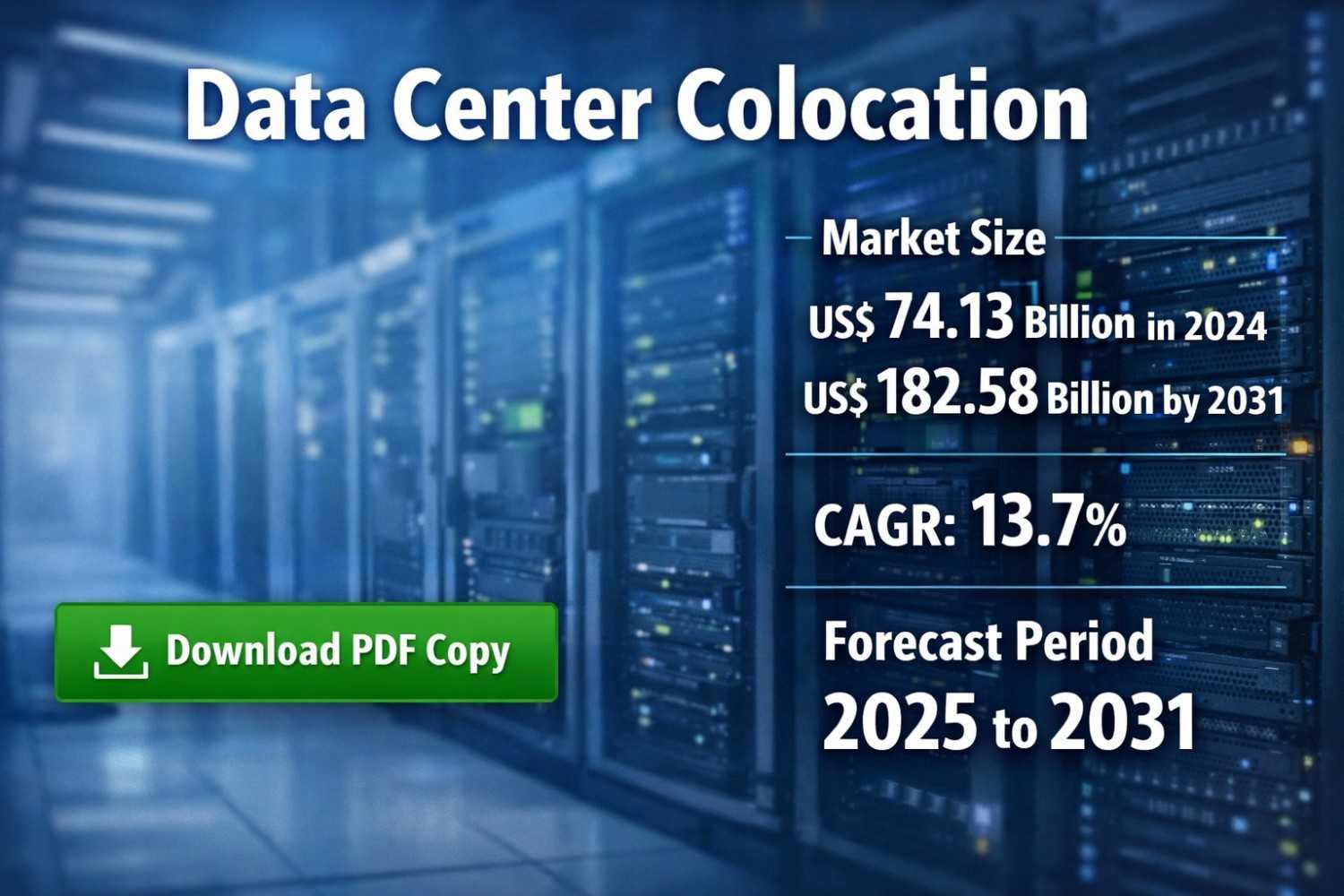
The data center colocation market has evolved into the central nervous system of the digital economy. As organizations prioritize digital agility over the heavy capital investment of maintaining private facilities, colocation has become the go-to solution for scalable infrastructure. By 2031, the global market is projected to witness substantial growth, fueled by the rising demand for high density computing and the rapid decentralization of data processing.
Market Report Segmentation Analysis
To understand the trajectory of the data center colocation market segments by 2031, a detailed look at its core segments is essential. The industry is primarily categorized by solution type, tier classification, enterprise size, and industry vertical.
By Solution Type: Retail vs. Wholesale
The market is divided into retail and wholesale colocation services. Retail colocation, which involves leasing smaller amounts of space and power, traditionally dominated the market share. However, by 2031, the wholesale segment is expected to show the fastest growth rate. This is largely due to hyperscalers and massive cloud service providers seeking multi megawatt halls to house their expanding infrastructure. Wholesale suites offer the privacy and control large enterprises require while maintaining the cost benefits of a shared facility.
By Tier Classification: Ensuring Uptime
Tier levels determine the reliability and redundancy of a data center. Tier 3 facilities currently hold the largest market share because they offer a balanced mix of 99.982% uptime and cost efficiency. However, the demand for Tier 4 facilities is rising sharply. By 2031, mission critical sectors like finance and healthcare will increasingly gravitate toward Tier 4 to ensure zero downtime and complete fault tolerance for their high stakes operations.
By Enterprise Size: The Shift in Scale
While large enterprises remain the primary revenue contributors, small and medium enterprises (SMEs) are the fastest growing demographic. SMEs are increasingly abandoning on-premise server rooms in favor of retail colocation to access professional security and connectivity that would otherwise be unaffordable. By 2031, the "Colocation as a Service" model will likely become the standard for businesses of all sizes.
By Industry Vertical: Leading the Charge
The IT and Telecom sector continues to lead the market, followed closely by BFSI (Banking, Financial Services, and Insurance). The 2031 outlook suggests a significant surge in the healthcare and retail verticals. Healthcare providers require secure colocation for massive genomic datasets and telemedicine, while retailers need localized edge colocation to support real time inventory management and personalized customer experiences.
Strategic Drivers and Regional Insights
The shift toward edge computing is a major catalyst for segmentation changes. As 5G becomes ubiquitous, colocation providers are moving away from centralized "Tier 1" hubs like Northern Virginia or London and into "Tier 2" and "Tier 3" cities to reduce latency.
From a regional perspective, North America maintains its position as the largest market, but the Asia Pacific region is forecast to be the fastest growing through 2031. Rapid urbanization and government led digital initiatives in countries like India, China, and Indonesia are driving a massive need for localized data residency and compliant colocation hubs.
Download Sample PDF Report@ https://www.theinsightpartners.com/sample/TIPTE100000210
Top Market Players
The competitive landscape is dominated by a few global giants and a growing number of specialized regional providers. These companies are aggressively investing in "liquid cooling" and renewable energy to meet the power demands of 2031.
- Equinix, Inc.
- Digital Realty Trust, Inc.
- NTT Global Data Centers
- CyrusOne
- Coresite (American Tower Corporation)
- KDDI Corporation
- Iron Mountain Inc.
- China Telecom Corporation Limited
- Global Switch
- Telehouse
Future Outlook
As we look toward 2031, the data center colocation market will be defined by "Intelligence and Sustainability." Artificial Intelligence will not just be a workload within the data center; it will manage the data center itself, optimizing power usage and predicting equipment failure before it occurs. The industry will also transition toward a circular economy model, where waste heat from servers is repurposed for local heating grids.
The rise of "Sovereign Clouds" will force colocation providers to build more facilities within national borders to comply with strict data privacy laws. By the end of the decade, the distinction between colocation and cloud will continue to blur, as providers offer more managed services, turning the physical data center into a flexible, software defined environment.
Frequently Asked Questions
What is the main difference between Tier 3 and Tier 4 colocation?
Tier 3 facilities are "concurrently maintainable," meaning they have multiple paths for power and cooling, but only one is active at a time. They guarantee 99.982% uptime. Tier 4 facilities are "fault tolerant," featuring fully redundant and isolated systems. Even a serious technical failure or a power outage will not impact the servers, guaranteeing 99.995% uptime.
Why is the wholesale colocation segment growing so quickly?
The growth is driven by "Hyperscalers" like social media platforms and global cloud providers. These companies need massive amounts of space and power (often exceeding 1 megawatt) to support AI and big data analytics. Wholesale colocation allows them to secure this capacity quickly without the multi year lead times required to build their own proprietary facilities.
How does colocation support environmental sustainability?
Modern colocation providers have a higher "Power Usage Effectiveness" (PUE) than typical enterprise data centers. Because they operate at scale, they can invest in advanced cooling technologies and sign large scale Power Purchase Agreements (PPAs) for renewable energy like wind and solar, which helps their clients meet carbon reduction goals.
The Insight Partners provides comprehensive syndicated and tailored market research services in the healthcare, technology, and industrial domains. Renowned for delivering strategic intelligence and practical insights, the firm empowers businesses to remain competitive in ever-evolving global markets.
• Email: sales@theinsightpartners.com
• Website: theinsightpartners.com
• Phone: +1-646-491-9876
 English
Join our community to interact with posts!