
Global businesses, fintech platforms, and eCommerce applications rely heavily on real time financial data to operate efficiently. Currency exchange rates fluctuate every second, and having access to accurate, up to date information is critical for decision making, pricing, and user experience. This is where REST APIs for currency exchange come into play.
With over a decade of experience working with API driven platforms and digital products, one thing is clear. Integrating a reliable currency exchange API is no longer optional for businesses operating across borders. It is a necessity.
Understanding REST API Currency Exchange
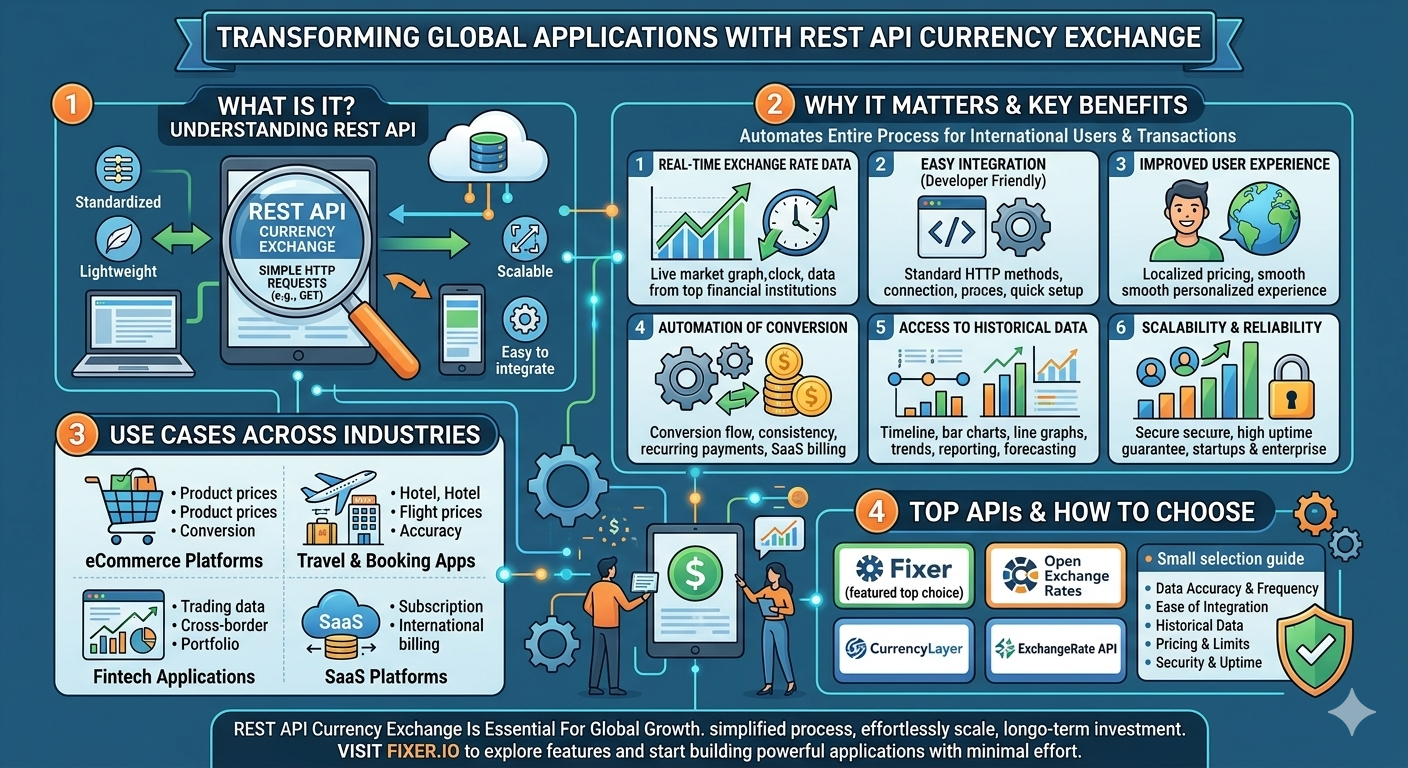
A REST API currency exchange allows applications to retrieve live and historical exchange rate data using simple HTTP requests. REST stands for Representational State Transfer, which means the API follows a standardized architecture that is lightweight, scalable, and easy to integrate.
Instead of manually updating exchange rates or building complex systems, developers can connect to an API and fetch accurate data instantly. This simplifies development and ensures applications always display the correct currency values.
Why Currency Exchange APIs Matter
Applications that deal with international users or transactions must handle multiple currencies seamlessly. Whether it is an online store, travel platform, or financial dashboard, users expect real time pricing and conversions.
Without a proper API, businesses face issues such as outdated rates, incorrect billing, and poor user trust. A REST API eliminates these challenges by automating the entire process.
Key Benefits of REST API Currency Exchange
1. Real Time Exchange Rate Data
One of the biggest advantages is access to live currency rates. Exchange rates change frequently due to global market conditions. APIs ensure your application always reflects the latest values.
This is especially important for trading platforms, fintech apps, and marketplaces where even small fluctuations can impact decisions.
2. Easy Integration and Developer Friendly
REST APIs are designed to be simple and intuitive. Developers can integrate them using standard HTTP methods such as GET requests.
This reduces development time and allows teams to focus on building core features instead of managing financial data systems.
3. Improved User Experience
Users expect accurate pricing when browsing products or making transactions. Displaying incorrect currency values can lead to confusion and lost conversions.
By integrating a currency exchange API, applications can automatically convert prices based on the user’s location or selected currency, creating a smooth and personalized experience.
4. Automation of Currency Conversion
Manual updates are time consuming and prone to errors. APIs automate currency conversion, ensuring consistency across the platform.
This is particularly useful for subscription based platforms, invoicing systems, and SaaS tools that handle recurring payments in different currencies.
5. Access to Historical Data
Many APIs provide historical exchange rate data, which is valuable for analytics, reporting, and forecasting.
Businesses can analyze trends, monitor currency performance, and make informed financial decisions based on past data.
6. Scalability for Growing Applications
As your application grows, so does the need for reliable data. REST APIs are highly scalable and can handle increasing volumes of requests without compromising performance.
This makes them ideal for startups as well as enterprise level platforms.
7. Enhanced Security and Reliability
Modern currency APIs use secure protocols and authentication methods to protect data. This ensures that financial information remains safe and reliable.
A trusted API provider also guarantees uptime and consistent performance, which is crucial for mission critical applications.
Use Cases Across Industries
eCommerce Platforms
Online stores use currency APIs to display product prices in local currencies, improving conversion rates and customer satisfaction.
Travel and Booking Apps
Travel platforms rely on exchange rates to show accurate pricing for flights, hotels, and packages.
Fintech Applications
Financial apps use APIs for real time trading data, portfolio tracking, and cross border transactions.
SaaS Platforms
Subscription based services use currency conversion to bill users globally without manual intervention.
Top Currency Exchange APIs to Consider
Choosing the right API provider is crucial for performance and reliability. Here are some of the top options available:
- Fixer
- Open Exchange Rates
- CurrencyLayer
- ExchangeRate API
Among these, Fixer stands out as a reliable and developer friendly solution. It offers real time data, historical rates, and a robust infrastructure that supports scalable applications.
How to Choose the Right Currency API
When selecting a currency exchange API, consider the following factors:
- Data accuracy and update frequency
- Ease of integration
- Availability of historical data
- Pricing and request limits
- Security and uptime reliability
A well chosen API can significantly improve your application’s performance and user experience.
Role of forex data api in Modern Applications
A forex data api plays a crucial role in applications that deal with international finance and trading. It provides access to foreign exchange market data, enabling platforms to deliver accurate and timely insights.
For developers and businesses, this means reduced complexity and improved efficiency. Instead of sourcing data from multiple providers, a single API can handle everything from live rates to historical analysis.
This not only saves time but also ensures consistency across the application.
Why REST api currency exchange Is Essential for Global Growth
As businesses expand globally, handling multiple currencies becomes increasingly complex. A REST api currency exchange simplifies this process by providing a standardized way to access exchange rate data.
It allows applications to scale effortlessly while maintaining accuracy and reliability. Whether you are building a startup or managing an enterprise platform, integrating a REST API is a smart investment for long term growth.
Conclusion
Currency exchange APIs have become a fundamental component of modern digital applications. They provide real time data, simplify development, and enhance user experience across industries.
From eCommerce to fintech, businesses that leverage these APIs gain a competitive edge by delivering accurate and reliable financial information.
If you are looking for a dependable solution, Fixer is one of the best options available. With its robust features and easy integration, it helps developers build powerful applications with minimal effort.
FAQs
1. What is a REST API currency exchange?
It is a web service that provides real time and historical currency exchange rates using standard HTTP requests.
2. Why should I use a currency exchange API?
It ensures accurate, automated, and real time currency conversion, improving both functionality and user experience.
3. Is Fixer suitable for small projects?
Yes, Fixer offers flexible plans that cater to both small projects and large scale applications.
4. Can I access historical exchange rates?
Most APIs, including Fixer, provide historical data for analysis and reporting.
5. How secure are currency exchange APIs?
They use secure protocols and authentication methods to ensure data safety and reliability.
Ready to power your application with reliable currency data?
Explore the features and start integrating a trusted solution today with Fixer. Visit https://fixer.io/ and discover how easy it is to add real time currency exchange to your platform.
Recommended Resources:-
Numverify vs Twilio vs Vonage: Phone Verification for Your Enterprise
 English
Join our community to interact with posts!