
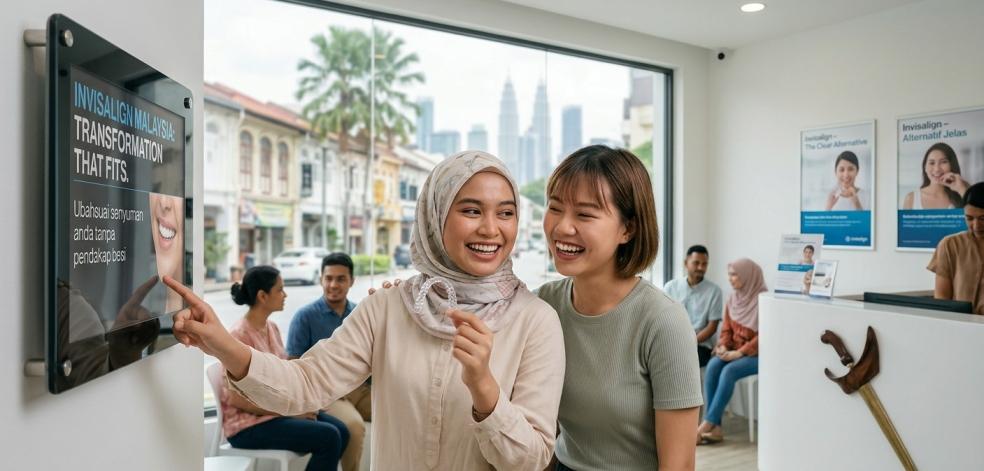
Straightening your teeth has never been more discreet—or more debated. Invisalign braces have quietly transformed orthodontic treatment in Malaysia, offering an alternative to traditional metal braces that many patients find far easier to live with. But with a higher price tag and a commitment to wearing aligners for up to 22 hours a day, the question on every prospective patient's lips is simple: is it actually worth it?
This post breaks down everything you need to know—from how the treatment works and what real Malaysian patients have experienced, to how much it costs and what to look for in a provider.
How Does Invisalign Work?
Invisalign uses a series of custom-made, clear plastic aligners to gradually shift your teeth into position. Unlike traditional metal braces, which use brackets and wires fixed to your teeth, Invisalign aligners are removable and virtually invisible when worn.
The treatment process typically follows three stages:
- Initial consultation: Your orthodontist assesses your teeth and determines whether Invisalign is suitable for your case.
- 3D mapping: A digital scan of your mouth is taken to create a precise treatment plan, showing the projected movement of your teeth from start to finish.
- Custom aligners: A series of aligners is produced, each worn for one to two weeks before switching to the next set.
The result is a treatment that fits around your life rather than disrupting it. You can remove your aligners to eat, drink, and brush your teeth—something traditional braces simply do not allow.
Real Malaysian Results: What Patients Are Saying
Across Malaysia, orthodontic clinics are reporting growing demand for Invisalign, particularly among working adults who want to avoid the aesthetic impact of metal braces. The cases treated range from mild crowding and spacing issues to more moderate bite corrections.
Patient experiences tend to highlight three consistent themes: improved confidence, better oral hygiene during treatment, and satisfaction with the final result.
One patient from Kuala Lumpur, treated for moderate crowding over 14 months, noted that she was able to attend client meetings and social events throughout her treatment without feeling self-conscious. Another patient from Penang shared that switching to Invisalign after an initial consultation for traditional braces made the process feel far less daunting.
Before-and-after results for mild to moderate cases are generally strong. More complex cases—such as significant bite misalignment—may require additional treatment or a combination approach with fixed appliances.
The Cost of Invisalign in Malaysia: What to Expect
Invisalign treatment in Malaysia typically ranges from RM 8,000 to RM 20,000, depending on the complexity of your case, the experience of your provider, and the duration of treatment. Mild cases with shorter treatment timelines sit at the lower end; comprehensive treatments for more complex alignment issues will push costs higher.
For comparison, traditional metal braces in Malaysia generally cost between RM 3,000 and RM 8,000. On the surface, Invisalign is the more expensive option. However, many patients factor in the long-term value: fewer visible appointments, no dietary restrictions, and a more comfortable day-to-day experience.
Most reputable clinics offer instalment payment plans, and some private insurance policies in Malaysia provide partial coverage for orthodontic treatment. It is worth checking your policy before your consultation, as coverage varies significantly between providers.
Pros and Cons: A Balanced View
No treatment is perfect for every patient. Here is an honest breakdown.
The advantages
- Discreet appearance: Aligners are nearly invisible, making them popular with professionals and adults.
- Comfort: Smooth plastic aligners cause less irritation to the gums and cheeks than metal brackets.
- Removability: You can eat and drink freely, and maintain normal oral hygiene throughout treatment.
- Predictable outcomes: The 3D treatment planning process gives patients a clear picture of expected results before they begin.
The drawbacks
- Cost: Invisalign is a significant financial commitment compared to traditional braces.
- Compliance: Results depend on wearing aligners for 20 to 22 hours per day. Patients who frequently remove them will see slower or less effective outcomes.
- Adjustment discomfort: Each new set of aligners applies pressure to your teeth, which can cause temporary soreness for the first day or two.
- Not suitable for all cases: Severely complex orthodontic issues may not be treatable with Invisalign alone.
How to Choose the Right Invisalign Provider in Malaysia
The quality of your outcome is directly tied to the expertise of your orthodontist. Not all dentists are certified Invisalign providers, and experience levels vary widely.
When researching providers, consider the following:
- Certification: Look for an Invisalign-certified provider, ideally with a higher tier status such as Platinum or Diamond, which reflects the volume and complexity of cases they have treated.
- Portfolio: Ask to see before-and-after photos of previous patients with similar cases to yours.
- Consultation quality: A thorough initial consultation should include a full assessment of your dental and jaw structure, not just a quick look and a quote.
Red flags to watch for include providers who skip the 3D scanning process, offer unusually low prices without clear explanation, or are unable to show evidence of previous Invisalign cases.
Maintaining Your Results: Care During and After Treatment
Looking after your aligners during treatment is straightforward but important. Rinse them with lukewarm water each time you remove them, and clean them gently with a soft-bristled toothbrush. Avoid using hot water, as it can warp the plastic.
Once your treatment is complete, your orthodontist will fit you with a retainer. This is non-negotiable. Without a retainer, teeth naturally shift back towards their original position over time—a process that can undo months of treatment. Most patients wear their retainer nightly on a long-term basis.
Regular dental check-ups throughout and after treatment are equally important, both to monitor progress and to maintain overall oral health.
Making the Decision: Is Invisalign Worth It for You?
For most patients with mild to moderate orthodontic concerns, Invisalign delivers excellent results with considerably less disruption to daily life than traditional braces. The discretion, comfort, and flexibility it offers are genuine advantages—not marketing language.
That said, Invisalign is not the right choice for everyone. It demands consistent compliance, involves a meaningful financial investment, and may not be appropriate for highly complex cases. The most informed decision you can make is to book a consultation with a certified orthodontist, discuss your specific needs, and request a detailed treatment plan before committing.
The technology is proven. The results speak for themselves. Whether it is worth it ultimately comes down to your goals, your lifestyle, and your budget.
 English
Join our community to interact with posts!