
Every minute of unexpected equipment downtime can cost manufacturers, utilities, energy providers, and transportation companies thousands—or even millions—of dollars. As organizations accelerate digital transformation initiatives, managing physical assets has become far more than a maintenance function. It has become a strategic business priority.
Enterprise Asset Management (EAM) is emerging as the foundation of intelligent industrial operations, enabling organizations to optimize asset performance, extend equipment life, reduce operational costs, and improve workforce productivity. Powered by Artificial Intelligence (AI), Industrial Internet of Things (IIoT), digital twins, predictive analytics, and cloud technologies, modern EAM platforms are transforming how enterprises manage critical assets throughout their lifecycle.
QKS Group's latest market research explores the evolving global Enterprise Asset Management landscape, highlighting emerging technology trends, competitive dynamics, and the future outlook for organizations investing in next-generation asset management platforms.
The Evolution of Enterprise Asset Management
Traditional maintenance systems primarily focused on scheduling preventive maintenance and recording service history. While effective for basic maintenance operations, these systems often lacked the intelligence required to anticipate failures or optimize asset utilization.
Today, Enterprise Asset Management has evolved into a comprehensive digital platform that manages every stage of the asset lifecycle—from planning and procurement to operation, maintenance, refurbishment, and retirement.
Modern EAM solutions consolidate operational, maintenance, and financial information into a unified platform, allowing organizations to make data-driven decisions that improve reliability, compliance, and operational efficiency.
Rather than reacting to equipment failures, organizations are increasingly adopting predictive and prescriptive maintenance strategies powered by real-time operational intelligence.
Industry 4.0 Is Transforming Asset Management
Industry 4.0 technologies continue to reshape enterprise asset strategies across manufacturing, utilities, transportation, mining, oil and gas, healthcare, and smart infrastructure.
Several technologies are accelerating this transformation:
- Industrial IoT sensors continuously monitor equipment conditions.
- Artificial Intelligence identifies failure patterns before breakdowns occur.
- Machine Learning improves maintenance recommendations over time.
- Digital Twins simulate asset behavior under different operating conditions.
- Cloud platforms enable centralized visibility across geographically distributed assets.
- Mobile applications empower field technicians with real-time information.
These innovations allow maintenance teams to shift from calendar-based servicing toward condition-based and predictive maintenance models that reduce downtime while maximizing asset availability.
The Rise of Connected Industrial Ecosystems
One of the biggest shifts in today's market is the convergence of EAM with other enterprise platforms.
Modern organizations no longer manage maintenance in isolation. Instead, they connect maintenance operations with production planning, financial management, supply chain operations, and reliability engineering.
This integration typically includes:
- Asset Performance Management (APM)
- Manufacturing Execution Systems (MES)
- Enterprise Resource Planning (ERP)
- Industrial IoT platforms
- SCADA systems
- Digital engineering platforms
This convergence creates a continuous flow of operational intelligence across the enterprise.
For example, production schedules generated within MES can automatically influence maintenance planning inside EAM. Inventory data from ERP ensures replacement parts are available before maintenance begins, while APM continuously monitors equipment health and recommends optimal maintenance windows.
The result is a connected industrial ecosystem where every decision is driven by real-time operational data.
AI and Predictive Intelligence Are Reshaping Maintenance
Artificial Intelligence has become one of the most significant innovations within the EAM market.
Rather than simply storing maintenance records, modern EAM platforms analyze enormous volumes of operational data to identify patterns that indicate equipment degradation.
AI-powered capabilities now include:
- Predictive failure detection
- Intelligent maintenance scheduling
- Root cause analysis
- Automated work order generation
- Asset health scoring
- Remaining useful life estimation
These capabilities help maintenance teams prioritize high-risk assets, reduce unnecessary maintenance activities, and improve overall operational efficiency.
As AI models continue learning from historical maintenance data, their recommendations become increasingly accurate over time.
Digital Twins Are Unlocking Smarter Decisions
Digital twin technology is rapidly becoming a strategic capability within Enterprise Asset Management.
A digital twin creates a virtual representation of a physical asset using operational data collected from IoT sensors.
Organizations can use these digital models to:
- Simulate equipment behavior
- Predict component failures
- Evaluate maintenance scenarios
- Optimize operating conditions
- Improve asset reliability
Instead of waiting for failures to occur, organizations can proactively identify risks and resolve issues before they impact production.
Business Benefits of Modern Enterprise Asset Management
Organizations investing in advanced Enterprise Asset Management platforms are realizing measurable business value across multiple functions.
Key benefits include:
- Increased asset reliability
- Reduced unplanned downtime
- Lower maintenance costs
- Extended equipment lifespan
- Improved workforce productivity
- Better regulatory compliance
- Higher inventory optimization
- Enhanced capital planning
- Improved operational visibility
- Faster decision-making through AI-powered insights
These improvements directly contribute to higher operational efficiency and stronger return on investment.
Future Outlook for the Enterprise Asset Management Market
The future of Enterprise Asset Management will be driven by intelligent automation, connected assets, and autonomous decision-making.
Over the coming years, organizations can expect increased adoption of:
- Generative AI for maintenance assistance
- Autonomous maintenance workflows
- Edge AI for real-time equipment monitoring
- Sustainability-focused asset optimization
- Digital thread integration
- Predictive asset lifecycle management
- Hyperautomation across maintenance operations
As industrial organizations continue modernizing operations, EAM platforms will become central to enterprise-wide digital transformation initiatives.
Rather than serving as standalone maintenance applications, future EAM solutions will function as intelligent operational platforms that connect people, processes, and assets across the entire enterprise.
Conclusion
The evolution of Enterprise Asset Management reflects a broader transformation occurring across industrial operations. By combining AI, Industrial IoT, predictive analytics, digital twins, and integrated enterprise applications, organizations are moving beyond reactive maintenance toward intelligent, data-driven asset optimization.
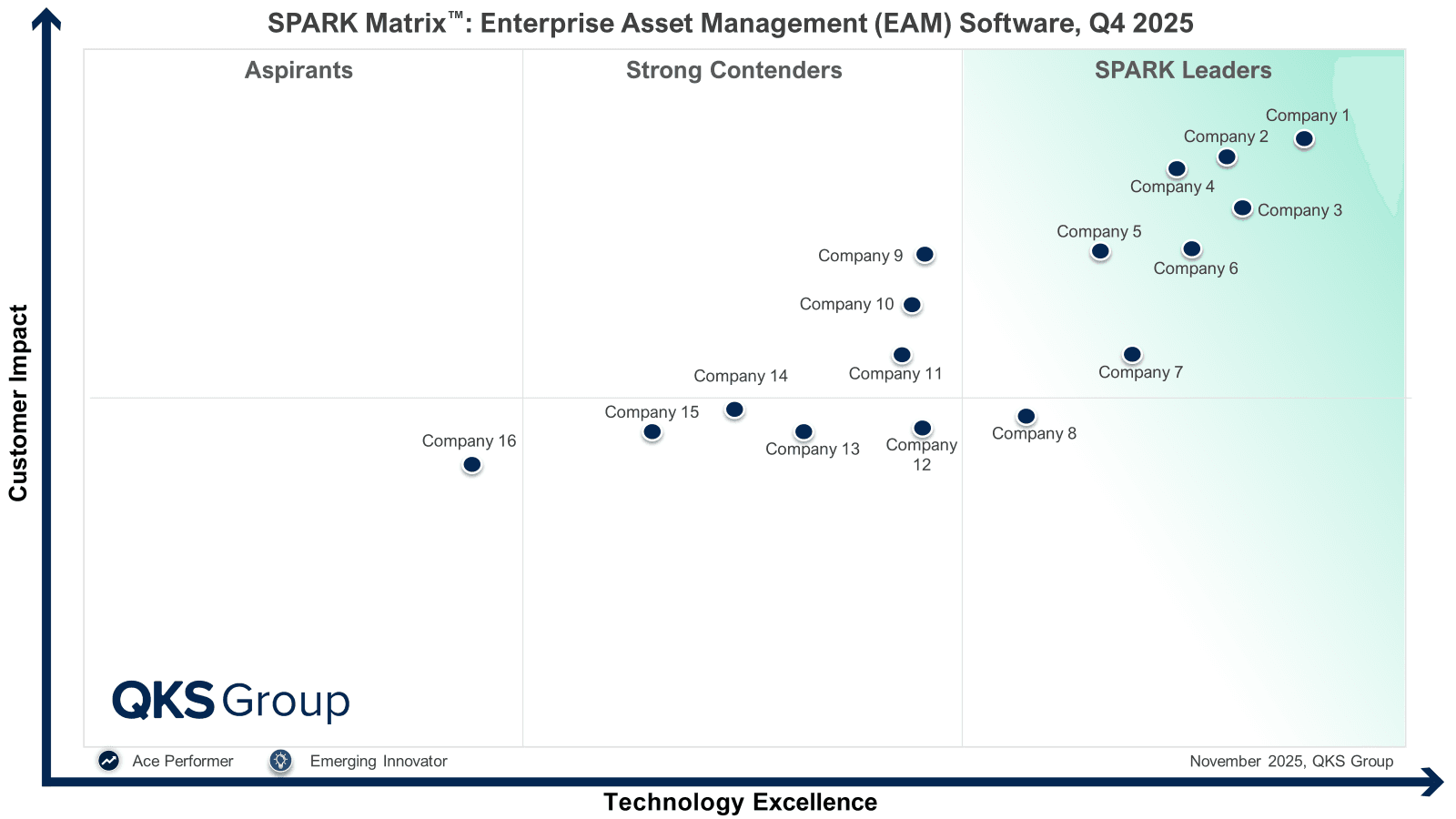
QKS Group's SPARK Matrix™: Enterprise Asset Management provides technology buyers with valuable market intelligence, competitive benchmarking, and vendor evaluations to support informed investment decisions. As enterprises embrace connected industrial ecosystems, selecting the right EAM platform will play a critical role in improving operational resilience, maximizing asset performance, and driving long-term business success.
 English
Join our community to interact with posts!