
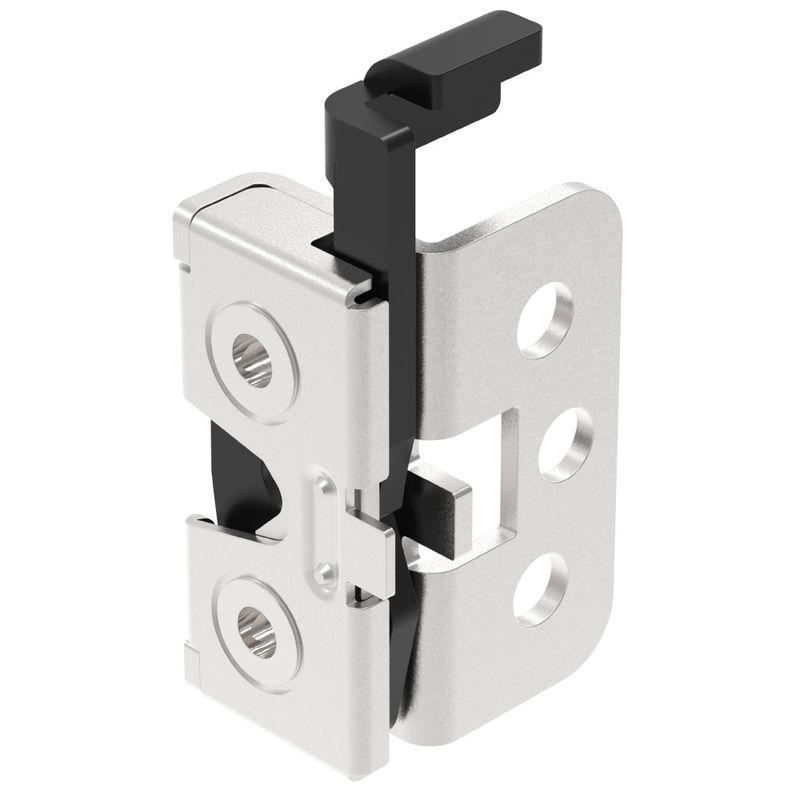
Industrial hinges are easy to overlook because they are usually hidden between doors, panels, covers, and machine frames. However, their role in industrial equipment is far more important than their size suggests. A hinge does more than connect two parts. It controls movement, supports weight, maintains alignment, and helps protect both machinery and operators. In many applications, the performance of an entire enclosure or access system depends on whether the hinge was selected correctly.To get more news about Industrial Hinges, you can visit forndlock.com official website.
Unlike ordinary household hinges, industrial hinges are designed to work under demanding conditions. They may be exposed to heavy loads, frequent opening cycles, vibration, moisture, dust, chemicals, and sudden impact. A hinge used on a factory machine guard, for example, must remain stable even when the equipment operates continuously. A hinge installed on an outdoor electrical cabinet must resist corrosion and temperature changes. These conditions explain why industrial hinge design requires careful attention to materials, dimensions, mounting methods, and operating environments.
Material selection is one of the first considerations. Stainless steel industrial hinges are widely used because they offer excellent corrosion resistance and a clean appearance. They are particularly suitable for food-processing equipment, medical machinery, marine applications, and outdoor enclosures. Carbon steel hinges are often chosen for heavy-duty machinery because they provide high strength at a reasonable cost. When appearance and moderate corrosion resistance are required, manufacturers may apply zinc plating, powder coating, black oxide, or other protective finishes.
Aluminum hinges provide another option for lightweight equipment. They are commonly found on transportation cases, electronic enclosures, and portable industrial systems. Although aluminum does not normally support the same extreme loads as thick steel, its low weight and natural corrosion resistance make it valuable in applications where mobility is important. In my view, material choice should never be based on price alone. A less expensive hinge that rusts, bends, or wears prematurely can create much higher replacement and maintenance costs.
Industrial hinges are available in many structural styles. Continuous hinges, also known as piano hinges, extend across most or all of a door’s length. This design distributes weight evenly and reduces stress concentration. It is useful for long access panels, toolboxes, control cabinets, and vehicle compartments. Butt hinges are more compact and are often used where a simple, traditional pivot is sufficient.
Concealed hinges are preferred when the hinge should remain protected or invisible from the outside. Besides improving appearance, concealment can reduce tampering and prevent the hinge from catching on nearby objects. Lift-off hinges allow doors or panels to be removed without tools, making them practical for equipment that requires regular inspection or cleaning. Weld-on hinges, on the other hand, provide a permanent and highly durable connection for steel gates, machinery, and heavy enclosures.
Load capacity is another critical factor. Buyers should consider not only the weight of the door but also its width, center of gravity, opening angle, and operating frequency. A wide door can produce considerable leverage even when its total weight appears moderate. If the hinge is too small, the door may sag, causing poor sealing, difficult closing, and damage to locks or latches. Using additional hinges can improve load distribution, but only when they are installed with accurate alignment.
Movement quality also matters. Some industrial hinges are designed for unrestricted rotation, while others include fixed stops, friction control, spring assistance, or damping. Friction hinges can hold a panel at different angles without additional support. Torque hinges provide controlled resistance and are commonly used on screens, covers, and adjustment panels. Soft-close or damped hinges reduce sudden movement, helping prevent noise, impact damage, and finger injuries.
In practical equipment design, hinge selection should be considered together with latches, handles, seals, and door frames. A strong hinge cannot compensate for a weak mounting surface. Similarly, even a well-designed door may perform poorly if its hinge position creates uneven pressure on the gasket. Engineers should evaluate the complete access system rather than treating each hardware component separately.
Installation quality has a direct influence on service life. Mounting holes must be positioned precisely, and fasteners should match the expected load and vibration level. Loose screws can cause movement between the hinge and frame, eventually enlarging the holes or damaging the surrounding material. Welded hinges require careful heat control to avoid distortion. After installation, the door should move smoothly without binding, scraping, or pulling against the latch.
Maintenance requirements vary according to hinge design. Some hinges include self-lubricating bushings, sealed bearings, or polymer components that reduce the need for frequent servicing. Traditional metal hinges may require periodic lubrication, especially in dusty or high-cycle applications. Regular inspections should look for corrosion, cracks, loose fasteners, unusual noise, and changes in door alignment. Early maintenance is usually simple, while ignoring a worn hinge can lead to damaged doors and unexpected downtime.
From my perspective, industrial hinges represent a good example of how thoughtful engineering often appears in small details. They rarely attract attention when they work correctly, but their failure becomes immediately noticeable. Selecting the right hinge improves safety, operating comfort, equipment appearance, and long-term reliability. For manufacturers and equipment designers, investing time in hinge selection is not a minor hardware decision. It is an important part of building machinery that performs consistently in the real world.
 English
Join our community to interact with posts!