
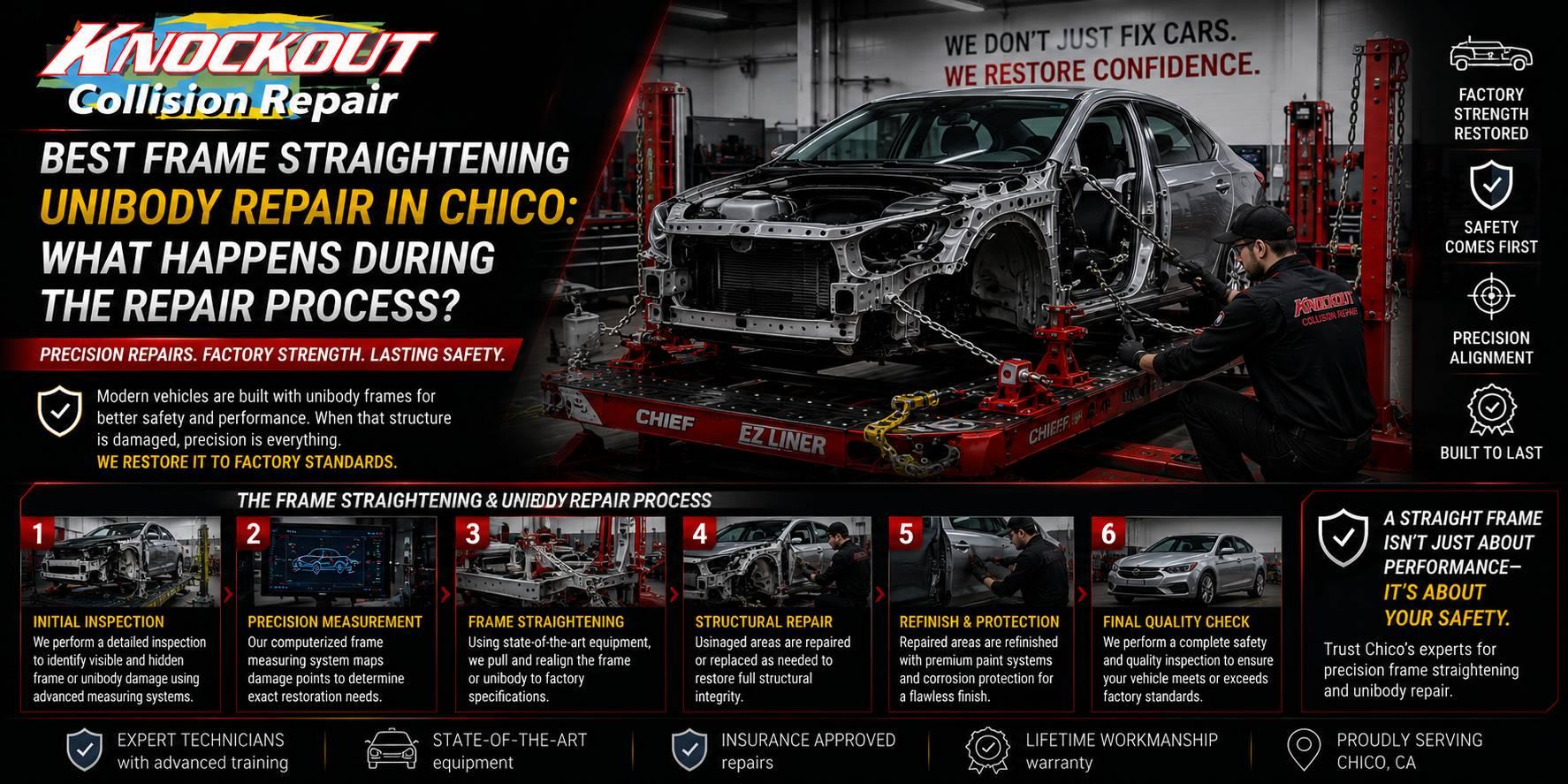
What happens after a crash that bends more than the bumper or fender? A dent is easy to see. A shifted rail, floor section, or suspension mounting point is not. The best frame straightening unibody repair in Chico starts with a structural inspection rather than a quick look at paint and panel gaps. Frame straightening in Chico includes measurement, repair planning, controlled pulling, part replacement when needed, and final checks before the vehicle returns to the road.
Knockout Collision Repair carries out this work with computerized measuring equipment, manufacturer repair procedures, and OEM-part preference. The repair must return the structure, body fit, suspension geometry, and road behavior to the required specifications.
Hidden Damage Can Remain After The Exterior Looks Repairable
A vehicle may still drive after a collision. That does not prove the structure stayed where the manufacturer placed it. The best frame straightening unibody repair in Chico begins by following the impact path through the vehicle. Technicians may remove damaged panels, then inspect rails, aprons, pillars, rocker panels, floor areas, crumple zones, and mounting points.
Small changes can create driving problems later. The car may pull left or right. Tires may wear unevenly. One door may need extra pressure to close. The steering wheel may no longer rest straight.
During frame straightening in Chico, technicians compare those signs with recorded measurements, not appearance alone. This gives the repair plan a factual starting point.
Computerized Measurement Comes Before Pulling
Structural correction starts with factory reference points. Technicians place the vehicle on measuring equipment and compare its present dimensions with manufacturer data. The readings show where the structure moved and how much correction it needs.
The best frame straightening unibody repair in Chico cannot treat every damaged section in the same way. Some areas can be straightened. Others need replacement. High-strength steel, aluminum, bonded panels, and reinforced safety sections respond differently to heat and pulling force.
Frame straightening in Chico often uses several controlled pulls instead of one heavy correction. The technician measures between pulls, adjusts the setup, and checks again. Repeated checks help avoid overpulling a rail or disturbing a section.
The Repair Process Follows A Defined Order
The exact work changes by vehicle and impact location. A proper structural repair usually follows these steps:
-
Remove parts that block access to the damaged structure
-
Record factory control-point measurements
-
Review vehicle-maker procedures before cutting, welding, or pulling
-
Straighten repairable sections with controlled force
-
Replace sections that no longer meet repair requirements
-
Check suspension points, wheel alignment, panel fit, and body gaps
-
Restore corrosion protection and inspect the repaired finish
Knockout Collision Repair also assists with insurance paperwork when required procedures do not appear in the first estimate. Its I-CAR Gold Class recognition and lifetime warranty on eligible repairs add trained oversight and written coverage.
Unibody Construction Changes The Repair Method
A full-frame truck and a unibody passenger car do not absorb collision force in the same way. The best frame straightening unibody repair in Chico must account for this difference before repairs begin.
A traditional frame supports the body on separate rails. A unibody vehicle joins the body and structure into one assembly. Damage to a pillar, rail, floor section, or rocker panel can affect nearby areas that look untouched. A general repair routine cannot address every material, joint, and load path correctly.
Technicians need model-specific sectioning locations, welding methods, adhesives, fasteners, and heat limits. Manufacturer instructions also state when a part may be repaired and when replacement is required. Frame straightening in Chico works properly when those instructions guide the job through final measurement.
OEM parts can support correct fit and material compatibility. When the repair calls for another part type, the owner should know what will be installed and why.
Final Checks Cover More Than Appearance
Structural work does not end when the panels line up and the paint dries. The vehicle still needs a detailed review.
Technicians check door operation, hood and trunk alignment, lamp fit, glass placement, welds, seams, fasteners, and corrosion protection. They also verify suspension geometry and wheel alignment. A road test may expose steering pull, vibration, braking changes, or noise that did not appear while the vehicle remained stationary.
Paint quality still counts, but it cannot correct a shifted mounting point. The finished vehicle should track correctly, close properly, and match the structural dimensions listed for that model.
Structural Repair Should End With Proof
Vehicle owners should ask how a shop measures damage, which manufacturer procedures it follows, what parts it plans to use, and how it checks the completed vehicle. Those questions separate cosmetic work from genuine structural correction.
A good repair job for unibody frame bending in Chico should involve precise measurements, model-specific methods, detailed part selections, and thorough final inspections. The object of frame straightening in Chico is to accomplish a finish in which the structure, suspension points, and body alignment are restored to the necessary position.
 English
Join our community to interact with posts!