
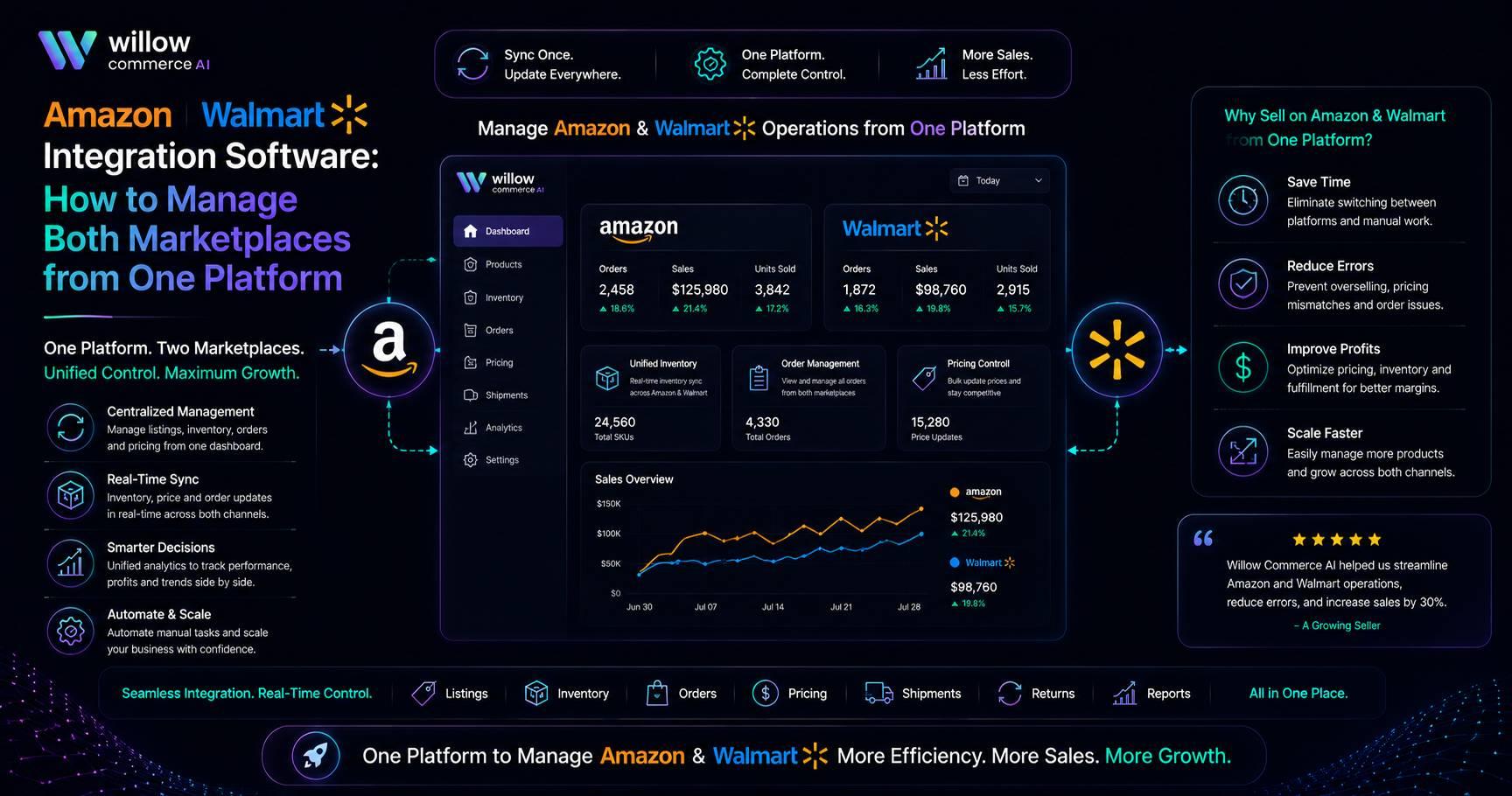
Have Amazon and Walmart started creating two versions of the same job? One team updates prices in Seller Central. Another checks Walmart stock. Orders arrive, product data changes, and the warehouse uses another screen. Then a listing stays active after stock runs out, or tracking reaches one marketplace late.
That is where Amazon Walmart integration software becomes useful. It does more than connect two accounts. A capable platform gives sellers one operating layer for catalog data, inventory, orders, fulfillment, pricing, shipping, and reporting. The advantage comes from removing duplicate work before it causes missed orders or bad data.
One Product Record Should Control Both Marketplaces
Amazon and Walmart ask for different product details. Amazon uses ASINs, FNSKUs, UPCs, browse nodes, and A+ Content. Walmart relies on GTINs, category attributes, item setup rules, and its own content standards. Copying one listing across does not finish the job.
The better model starts with a master catalog. Core data stays in one place, while marketplace-specific fields remain separate where needed. A title can follow Amazon search behavior without forcing the same wording on Walmart. Images, attributes, pack sizes, and identifiers follow the same rule.
Teams that sync Amazon and Walmart listings from a central catalog also get a cleaner correction process. When a field fails, staff fix the source record instead of editing two portals and hoping both updates remain intact. Willow Commerce follows this structure by treating Amazon and Walmart as connected channels within a broader commerce system, rather than isolated storefronts.
Inventory Needs One Source, Not Two Estimates
Inventory trouble rarely starts with a major failure. More often than not, it begins with a small delay. Amazon records a sale. Walmart still displays the previous quantity. A second order lands, and the warehouse no longer has enough stock to ship both.
An Amazon-Walmart inventory sync tool should update available quantity after every sale, return, cancellation, receipt, transfer, and warehouse adjustment. It should also distinguish physical stock from salable stock. Those numbers often differ. Damaged units, inspection holds, reserved units, and safety stock all affect what a marketplace should display.
A sound setup should cover:
-
Shared inventory across both marketplaces
-
Buffer stock by SKU, warehouse, or channel
-
FBA, FBM, WFS, and merchant-fulfilled quantities
-
Multi-location allocation rules
-
Low-stock alerts tied to recent sales
-
Return-to-stock controls after inspection
The warehouse cannot remain outside this process. Willow Commerce connects marketplace availability with receiving, picking, packing, shipping, and location-level stock. That link helps prevent a common problem where the marketplace shows inventory that warehouse staff cannot locate.
Order Routing Should Follow Rules, Not Habit
FBA, FBM, Walmart Fulfillment Services, and in-house fulfillment create more choices than most teams expect. A warehouse may hold the item, yet FBA could deliver it faster. Another order may cost less through the seller’s own facility. Staff often make those calls manually because their systems do not share enough information.
Amazon Walmart integration software can route orders using inventory location, delivery promise, shipping cost, customer distance, and marketplace requirements. It can also send tracking back to the correct channel after shipment. That removes repeated entry, but it should not hide unusual orders.
Routing rules still need exceptions. High-value orders, split shipments, restricted items, and low-stock products may require review. The goal is not to automate every decision. It is to automate routine choices and place difficult cases in front of the right employee.
Pricing And Advertising Need The Same Profit View
Revenue by channel tells only part of the story. Amazon and Walmart charge different fees. Fulfillment, advertising, returns, storage, and shipping change the final margin again. A product can appear successful in one dashboard and still produce weak profit after every cost gets counted.
Sellers need SKU-level reporting that combines Buy Box activity, price rules, Amazon Advertising, Walmart Connect, ACOS, ROAS, return costs, and fulfillment fees. Once those numbers appear together, pricing decisions become less reactive. The team can see whether a lower price wins profitable sales or simply gives away margin.
Repricing also needs limits. A system should react to competition without pushing a product below its floor. It should know the landed cost, current stock position, marketplace fees, and the seller’s margin target. Without that context, automated repricing becomes another source of operational trouble.
Choose The Operating Model Before The Platform
A marketplace tool should fit the way the business runs. Before selection, a seller should map who owns product data, how stock moves, where orders route, which exceptions require review, and how profit gets measured. That review often exposes duplicate work long before software enters the discussion.
The final decision should come down to control, not feature count. A useful platform keeps catalog data consistent, updates inventory fast, routes orders by defined rules, and shows margin at SKU level. It should remain workable when the business adds products, warehouses, staff, or channels. That is the standard a consulting team should use when evaluating Amazon-Walmart integration software.
 English
Join our community to interact with posts!