
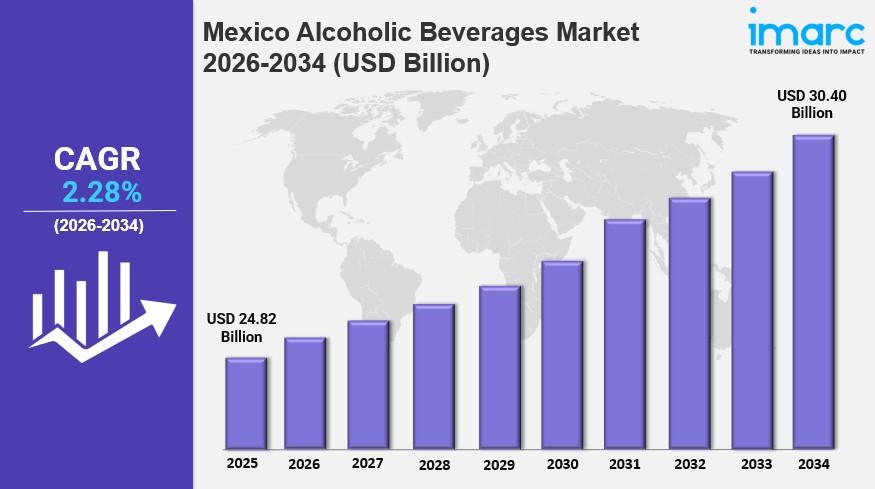
IMARC Group has recently released a new research study titled "Mexico Alcoholic Beverages Market Size, Share, Trends and Forecast by Category, Alcoholic Content, Flavor, Packaging Type, Distribution Channel, and Region, 2026-2034", offering a detailed analysis of the market drivers, segmentation, growth opportunities, trends, and competitive landscape to understand the current and future market scenarios.
Mexico Alcoholic Beverages Market Size & Share 2026-2034
The Mexico alcoholic beverages market size reached USD 24.82 Billion in 2025 and is projected to reach USD 30.40 Billion by 2034, expanding at a CAGR of 2.28% during 2026-2034. The market draws on deep cultural roots in beer, tequila, and mezcal consumption, alongside rising disposable incomes, growing urbanization, and expanding tourism that continue to support steady demand across both premium and mass-market categories.
Momentum in 2026 is further supported by continued premiumization, the rapid rise of ready-to-drink cocktails, and growing digital and e-commerce adoption for alcohol purchases. Together, these dynamics are expected to strengthen the Mexico alcoholic beverages market share throughout the forecast period.
Key Market Statistics at a Glance
-
Base Year: 2025
- Historical Years: 2020-2025
- Forecast Period: 2026-2034
- Market Size (2025): USD 24.82 Billion
- Projected Market Size (2034): USD 30.40 Billion
- Growth Rate: CAGR of 2.28% (2026-2034)
Explore Opportunities in the Mexico Alcoholic Beverages Market: Download the IMARC Sample Report: https://www.imarcgroup.com/mexico-alcoholic-beverages-market/requestsample
Key Growth Drivers and Trends in the Mexico Alcoholic Beverages Market
Growth in the Mexico alcoholic beverages market is being driven by rising demand for premium and artisanal products, as consumers increasingly seek out craft beer, aged mezcal, and heritage tequila brands that emphasize authentic production methods and quality ingredients. Younger, urban consumers with growing disposable incomes are willing to pay more for products that reflect traditional craftsmanship, pushing manufacturers to expand their premium and limited-edition portfolios.
One of the fastest-growing trends is the rise of ready-to-drink cocktails built around traditional Mexican flavors such as tamarind, hibiscus, and agave-based spirits. Mexico's leading tequila-based RTD brand, New Mix, sold more than 11 million nine-liter cases in fiscal 2025, reflecting how strongly convenience-driven, locally flavored pre-mixed beverages are resonating with consumers seeking portable, quality drinks for social occasions.
Digital distribution is also reshaping the market, with alcoholic beverages now ranking among the top online purchase categories in Mexico; industry surveys indicate that roughly three-quarters of consumers have already bought alcohol online, and the vast majority intend to keep doing so. This shift is opening new channels for both established brands and smaller craft producers to reach wider audiences through delivery apps and direct-to-consumer platforms.
Speak to an Analyst: https://www.imarcgroup.com/request?type=report&id=31929&flag=C
Mexico Alcoholic Beverages Industry Segmentation Insights
Breakup by Category:
-
Beer: Represents the leading category, underpinned by deep cultural integration in Mexican social life and strong performance from established domestic brands.
-
Wine: Includes still light wine and sparkling wine, supported by gradually growing consumer interest in wine pairing and premium occasions.
-
Spirits: Covers tequila, mezcal, vodka, whiskey, rum, liqueurs, gin, baijiu, and others, benefiting from strong domestic heritage and rising international demand for Mexican spirits.
Breakup by Alcoholic Content:
-
Medium: Leads the market, favored for delivering balanced drinking experiences suited to extended social occasions.
-
High: Reflects steady demand for traditional spirits such as tequila and mezcal.
-
Low: Growing gradually alongside rising interest in lighter, more moderate options.
Breakup by Flavor:
-
Unflavored: Dominates the market, reflecting strong consumer trust in traditional recipes and classic beer, tequila, and mezcal profiles.
-
Flavored: Continues to expand alongside rising interest in flavored RTDs and experimental spirit blends.
Breakup by Packaging Type:
-
Glass Bottles: Represents the leading packaging format, valued for quality preservation, premium positioning, and strong recycling infrastructure.
-
Tins: Popular for convenience and portability, particularly for beer and RTD products.
-
Plastic Bottles: Used mainly for value-oriented and mass-market offerings.
-
Others: Includes additional packaging formats supporting the market.
Breakup by Distribution Channel:
-
On-Trade: Leads the market, fueled by Mexico's vibrant nightlife, expanding hospitality sector, and strong tourism-driven consumption in bars and restaurants.
-
Supermarkets and Hypermarkets: Provides broad retail access for everyday and occasion-based purchases.
-
Specialist Retailers: Offers curated selections for premium and craft beverage buyers.
-
Online: Growing rapidly as e-commerce and delivery platforms expand alcohol accessibility.
-
Convenience Stores: Serves quick, everyday purchase occasions.
-
Others: Includes additional retail formats supporting distribution.
Breakup by Region:
- Central Mexico: Represents the largest region, driven by urban lifestyles, rising disposable incomes, strong tourism inflows, and well-established distribution infrastructure.
- Northern Mexico: Benefits from proximity to the United States and growing cross-border trade activity.
- Southern Mexico: Reflects steady growth supported by expanding tourism and hospitality development.
- Others: Covers additional regional markets contributing to overall demand.
Key Challenges and Growth Opportunities in the Mexico Alcoholic Beverages Market
The Mexico alcoholic beverages market faces challenges including strict regulatory frameworks governing production, advertising, and distribution, along with excise and special consumption taxes that raise product costs, particularly in price-sensitive segments. Growing public health awareness and responsible-drinking campaigns are also encouraging some consumers to moderate intake, while agave supply constraints and climate variability affecting barley and grape harvests continue to pressure raw-material costs for tequila, mezcal, beer, and wine producers.
Despite these challenges, the market offers considerable opportunities through continued premiumization, growing craft and artisanal production, and expanding ready-to-drink innovation built around traditional Mexican flavors. Tourism industry growth and rising middle-class consumption are expected to sustain on-trade demand, while digital distribution channels and direct-to-consumer platforms open new pathways for both established brands and smaller producers to reach wider audiences across the forecast period.
Competitive Landscape
The Mexico alcoholic beverages market is highly competitive, featuring multinational brewing corporations, traditional Mexican spirits producers, and a growing number of craft beverage manufacturers. Established leaders such as Grupo Modelo and Heineken Mexico rely on extensive distribution networks, brand heritage, and sustained marketing investment to defend their market positions, while smaller craft entrants differentiate through authenticity, regional identity, and artisanal quality. Strategic acquisitions, distribution partnerships, and export expansion continue to shape competitive dynamics as companies pursue both domestic growth and international demand for Mexican spirits.
Recent Developments in the Mexico Alcoholic Beverages Market
-
November 2025: Grupo Modelo partnered with premium chocolatier Turín to launch Negra Modelo Chocolate Turín, a limited-edition holiday lager blending dark malt with semi-bitter cacao notes, targeting festive occasions and gourmet pairings.
- 2025: Heineken announced plans to invest approximately USD 2.7 billion in Mexico through 2028 to expand production capacity and support a broader portfolio of beer and other moderate-alcohol products tailored to local demand.
- 2025: Mexican regulators and industry bodies launched the Agave Responsable Social certification program to strengthen the agave-tequila supply chain, support traditional growers, and promote sustainable cultivation practices.
- January 2025: Tequila exports from Mexico rose by roughly 29% year-on-year, with the United States accounting for the large majority of shipments, underscoring strong international demand for the country's signature spirit.
Author IMARC Group
IMARC Group is a leading global market research company providing data-driven insights and expert consulting services to businesses seeking to achieve their strategic objectives. With a multidisciplinary team of industry experts, IMARC delivers reliable market intelligence across sectors including Chemicals and Materials, Healthcare, Technology, Agriculture, and Retail.
Contact Us:
IMARC Group
Email: sales@imarcgroup.com
United States: +1-201971-6302
 English
Join our community to interact with posts!