
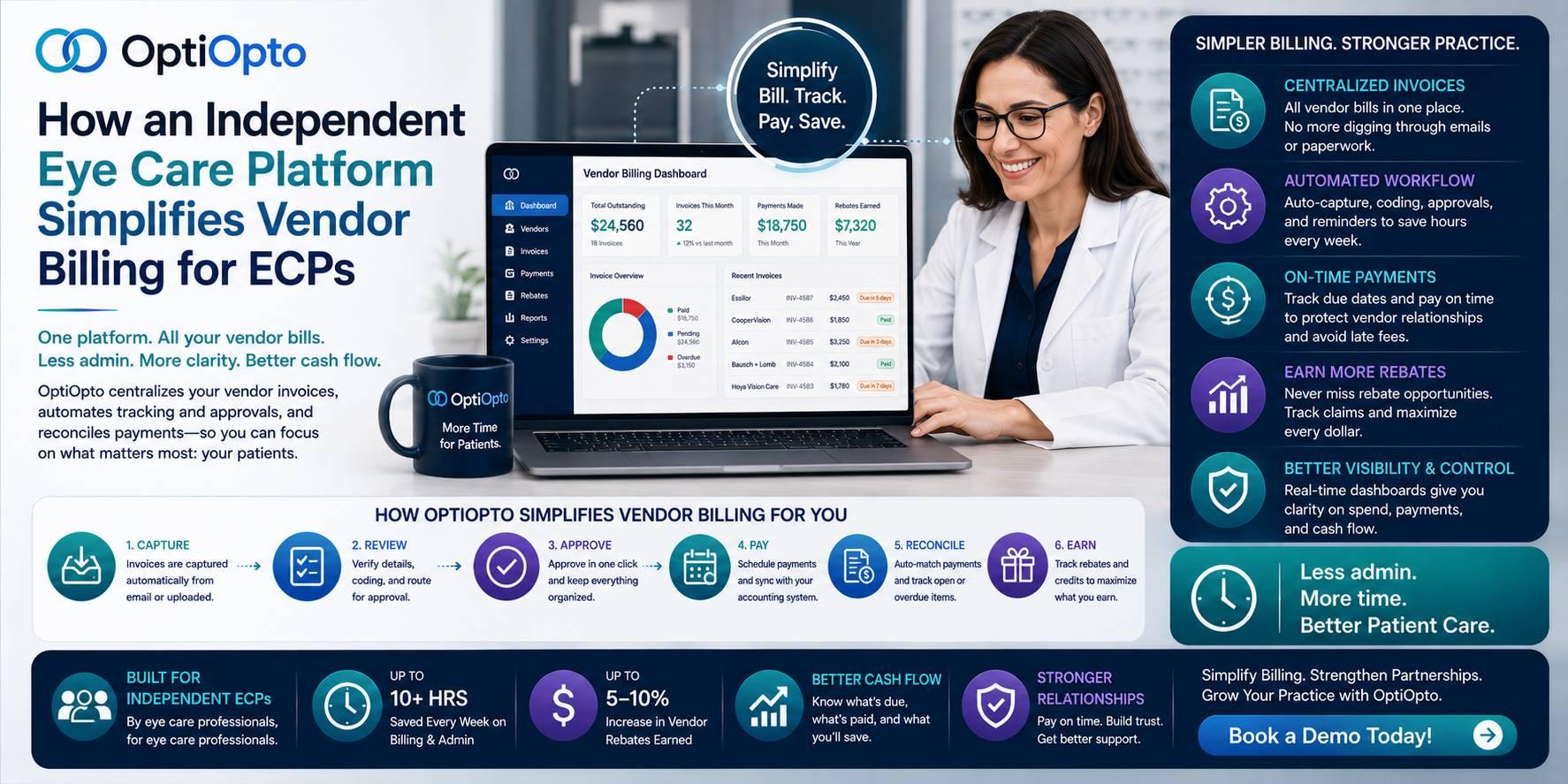
How much staff time disappears each month into vendor invoices, payment checks, missing credits, and rebate follow-ups? For many independent eye care practices, billing does not fail in one dramatic moment. It becomes difficult little by little. One supplier uses a separate portal. Another sends a credit note late. A third applies a different payment date. An independent eye care platform can bring those moving parts into one place, while eyecare business support services help the practice keep control of its vendor relationships and daily decisions.
Why Vendor Billing Creates More Work Than Expected
Independent ECPs rarely deal with one supplier. A single practice may purchase frames, lenses, contact lenses, diagnostic equipment, office supplies, and lab services from several companies. Each account comes with its own invoice format, due date, credit terms, login details, and support contact.
That is where the trouble starts.
Staff members must compare purchase orders with deliveries, check whether suppliers applied credits, confirm contract pricing, and follow up when figures do not match. None of these tasks looks difficult on its own. Together, they take up a large part of the back-office workload.
An independent eye care platform reduces this fragmentation by creating a clearer billing route. Eyecare business support services cover vendor communication, payment review, and account follow-up. The practice still chooses its suppliers. It simply handles the paperwork through a more organized process.
How Consolidated Billing Changes Monthly Account Review
Consolidated billing works best when it does more than place several charges on one statement. The real benefit comes from giving the practice one view of purchases, credits, rebates, balances, and due dates.
OptiOpto follows this model through a central portal, a monthly statement, and one payment process for participating vendors. This setup can reduce the need to log into several systems or search through old email chains when a charge looks wrong.
An independent eye care platform also makes account review easier for managers. They can see which vendor created the charge, whether a credit remains open, and where a payment issue needs attention. Eyecare business support services can then support the follow-up, rather than leaving practice staff to chase every vendor alone.
That change does more than speed up billing. It leaves the practice with a cleaner record of what it bought, received, and still owes.
What A Reliable Vendor Billing System Should Include
A billing system should fit the practice rather than force the practice to rebuild its operations around new software. It should also work beside existing EMR, POS, or practice management systems.
ECPs should look for the following features:
-
One statement covering participating vendor purchases
-
Clear access to invoices, credits, and payment records
-
Rebate tracking that staff can review without extra spreadsheets
-
Support for billing errors and vendor disputes
-
Purchasing records organized by supplier and category
-
Freedom to keep preferred vendors without exclusivity rules
These functions reduce confusion, but they also create accountability. When every charge has a clear source, staff can spot duplicate billing, missing credits, or incorrect terms before the issue remains open for several months.
Why Vendor Choice Must Stay With The Practice
A simpler billing process should not come at the cost of independence. Practice owners still need the freedom to choose suppliers based on product quality, patient demand, service standards, delivery performance, and commercial terms.
A connected support system should protect that freedom, not narrow it. Eyecare business support services should also help the practice manage vendors without controlling its brand or purchasing decisions.
OptiOpto presents itself as more than a buying group for this reason. Its model combines purchasing support, vendor management, consolidated billing, and growth tools, while allowing ECPs to retain their own identity and supplier relationships.
That difference counts. A discount may help one order. Better account control can improve every order that follows.
How Billing Records Can Guide Better Purchasing Decisions
Vendor billing data can reveal more than unpaid balances. It can show where the practice spends most, which categories move slowly, where credits appear often, and which supplier accounts create repeated issues.
When records stay scattered, owners may miss those patterns. A connected system makes them easier to review. Managers can compare spending across categories, check whether purchasing has become too concentrated, and identify accounts that need renegotiation.
This also helps with inventory planning. If frame orders rise but sell-through stays weak, the practice can adjust future purchases. If one supplier produces frequent credit corrections, management can review the account before the problem grows.
Good billing records do not replace judgment. They give owners cleaner information for the decisions they already make.
Conclusion
Vendor billing should not demand hours of manual checking every month. The right independent eye care platform can bring invoices, payments, credits, rebates, and vendor communication into one working system. Eyecare business support services can then support the details that often slow staff down, while the practice keeps control of its suppliers, systems, and business direction. The strongest solution reduces back-office pressure without changing what makes an independent practice independent.
 English
Join our community to interact with posts!