
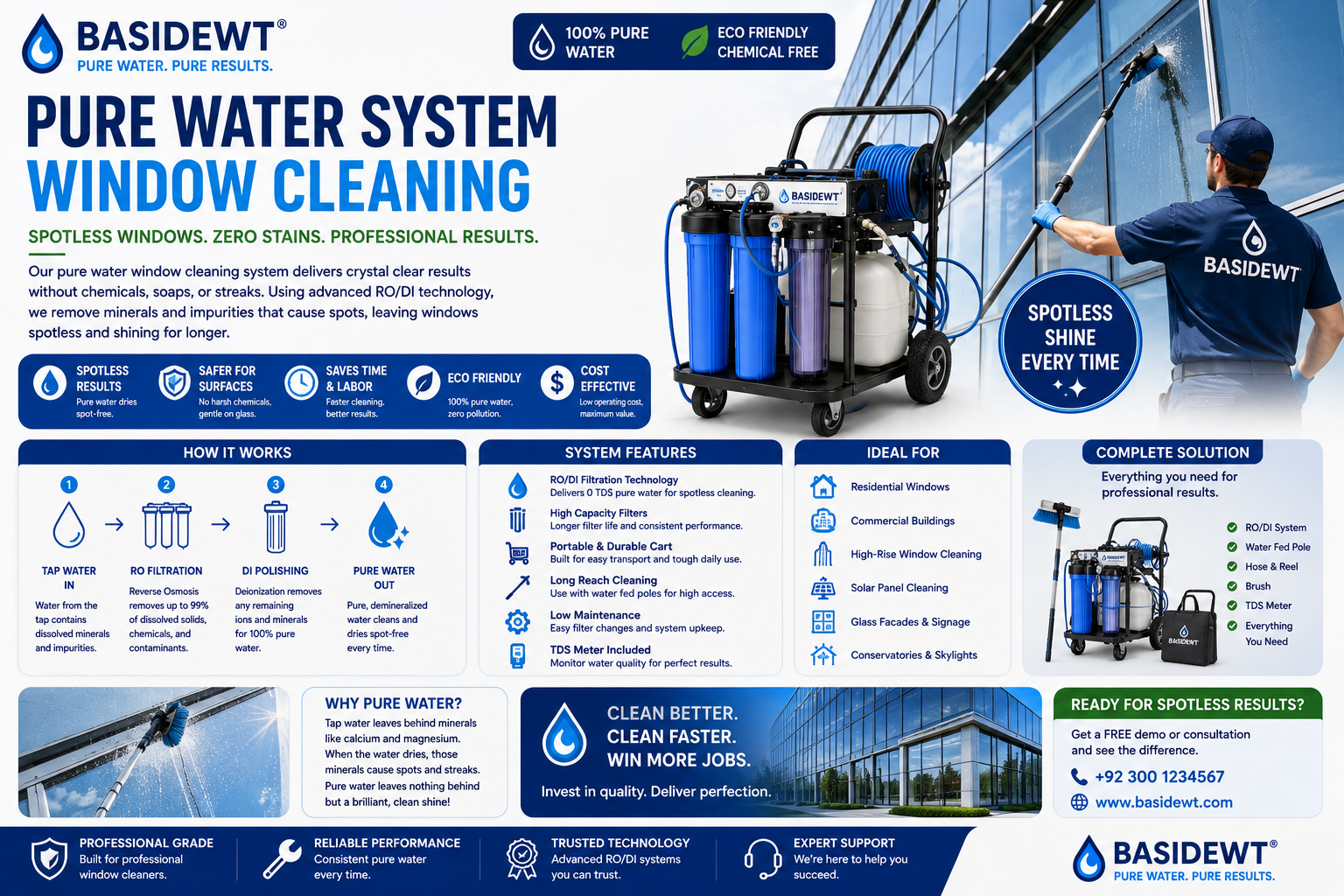
Clean windows play an important role in the appearance of homes, offices, retail stores, and commercial buildings. However, keeping exterior glass spotless can be challenging when ordinary water contains dissolved minerals. These minerals can remain behind as water evaporates, creating streaks and spots that reduce the clarity of the glass. Modern water purification technology offers a practical alternative for professional cleaners who want consistent results while improving efficiency. By combining purified water with suitable cleaning equipment, operators can simplify exterior maintenance and achieve a cleaner finish with less repetitive polishing.
Understanding the Importance of Water Quality
Water quality has a direct influence on window cleaning results. Tap water naturally contains minerals such as calcium and magnesium, along with other dissolved substances. Although these materials may not be visible while water is flowing, they can become noticeable after evaporation.
For professional cleaners, this can create additional work. A window may appear clean immediately after washing but develop spots as the remaining water dries. Removing those marks can require extra wiping, which increases labor and slows down the cleaning process.
Water purification addresses this issue by reducing the dissolved substances before the water reaches the glass. This makes water quality an important consideration when designing an efficient exterior cleaning operation.
How Purified Water Supports Cleaner Glass
A pure water system window cleaning method uses treated water with a very low concentration of dissolved minerals. The objective is to provide water that can rinse dirt away while leaving minimal mineral residue during drying.
The cleaning process generally involves agitating the glass with a brush and allowing purified water to carry loosened dirt away. When the surface is properly rinsed, the treated water can evaporate without producing the same level of mineral spotting associated with untreated water.
The Science Behind the Process
Purification systems can use different technologies depending on the quality of the incoming water. Reverse osmosis can remove a large proportion of dissolved substances, while deionization can further reduce ionic contaminants.
The result is water with substantially fewer dissolved solids. This does not mean the water is chemically identical in every application, but it can be sufficiently purified for professional exterior glass cleaning.
Equipment Used by Window Cleaning Professionals
A modern pure water system window cleaning setup may contain several filtration stages and supporting components. Typical equipment can include pre-filters, reverse osmosis membranes, deionization vessels, pumps, hoses, storage tanks, and water-fed poles.
The arrangement depends on the operator's needs. Residential cleaners may prefer compact portable systems, while commercial operators may require larger tanks and higher-capacity pumps.
The Function of Pre-Filtration
Pre-filters help protect the main purification components by removing larger particles and certain contaminants from incoming water. They can extend the useful life of more expensive filtration equipment when maintained correctly.
Because different water sources have different characteristics, cleaners should test their supply before selecting a filtration configuration. Understanding the starting water quality makes it easier to determine how much purification is required.
Water-Fed Poles and Efficient Cleaning
Water-fed poles are one of the most useful tools associated with purified-water cleaning. These poles can carry water directly to a brush positioned at the end of the pole, allowing operators to clean many elevated windows while standing safely on the ground.
A pure water system window cleaning arrangement paired with a water-fed pole can make the cleaning process more systematic. The brush loosens dirt, while the water helps rinse contaminants from the glass and surrounding frames.
This approach can be especially useful for multi-story residential properties, storefronts, offices, and other buildings where ladder movement would otherwise consume considerable time.
Reducing Dependence on Ladders
Working from ground level can improve efficiency and reduce some risks associated with repeatedly climbing ladders. Instead of moving a ladder from one window to another, an operator can often reposition the pole more quickly.
Nevertheless, cleaners should evaluate every work area for hazards. Electrical cables, traffic, unstable ground, overhead structures, and severe weather can all create safety concerns.
Selecting the Right System for Your Business
Choosing a pure water system window cleaning solution requires consideration of several factors. Water quality is one of the most important because it determines the purification workload. Cleaning volume is another major factor because high-volume operations need greater storage and production capacity.
A professional should also consider transport requirements. Mobile cleaners need systems that fit comfortably in their vehicles and can be moved between properties without unnecessary effort.
Residential Cleaning Requirements
A small residential cleaning business may not need a large commercial purification plant. A compact system with an appropriate storage tank can provide sufficient capacity for routine work.
The key is to choose equipment that meets actual demand. A system that is too small may require frequent refilling, while an unnecessarily large setup can add cost and transportation difficulties.
Commercial Cleaning Requirements
Commercial window cleaning often involves larger buildings and more extensive glass surfaces. These operations may benefit from larger storage tanks, stronger pumps, and filtration systems designed for higher daily water consumption.
Businesses should estimate average water use rather than selecting equipment solely by appearance or maximum specifications. The goal is to create a balanced system that supports productivity without excessive operating costs.
Maintaining Purification Equipment
A pure water system window cleaning setup requires regular attention to maintain consistent performance. Filtration components gradually become less effective as they collect or remove contaminants from incoming water.
Pre-filters should be inspected and replaced when necessary. Reverse osmosis membranes need suitable operating conditions and periodic maintenance. Deionization resin also has a limited capacity and eventually needs replacement or regeneration.
Monitoring Dissolved Solids
Water-quality meters can help cleaners determine whether their purification system is functioning properly. Monitoring dissolved solids provides an early warning when filtration performance begins to decline.
Regular testing is preferable to waiting until visible spots appear on windows. If water quality starts changing, the operator can investigate the filters or purification stages before poor results affect customers.
Improving the Cleaning Technique
Good equipment works best when paired with effective technique. Operators should thoroughly agitate dirty glass before the final rinse. Frames and corners can hold substantial amounts of dirt, so these areas should not be ignored.
During a pure water system window cleaning process, the final rinse is particularly important. The cleaner should ensure that loosened dirt and contaminated water are removed from the entire glass surface.
Weather conditions should also be considered. Strong sunlight can cause rapid evaporation, while wind may carry dust onto recently cleaned surfaces. Adjusting the cleaning sequence to local conditions can help maintain better results.
Benefits Across Different Property Types
Purified-water cleaning can serve a wide range of applications. Residential windows can be cleaned efficiently, while commercial buildings can benefit from streamlined maintenance routines.
Retail stores may use the method to maintain attractive storefront glass. Offices can schedule regular exterior cleaning without relying heavily on traditional ladders. Schools, apartments, and other large properties may also benefit from water-fed cleaning technology.
The method is particularly useful when windows are numerous, elevated, or difficult to access.
Considering Efficiency and Operating Costs
A pure water system window cleaning investment should be evaluated according to long-term value rather than purchase price alone. Faster cleaning, reduced polishing, and improved access can potentially lower labor requirements.
The system may also reduce the need for chemical cleaning products in many exterior applications. However, operators should consider filter replacement, water consumption, maintenance, transportation, and equipment repairs when calculating operating costs.
A properly sized system can provide a good balance between productivity and ongoing expenses.
Developing a Professional Maintenance Routine
Reliable results require consistency. Before each job, cleaners should inspect hoses, connectors, brushes, pumps, poles, and filtration equipment. Identifying small problems early can prevent interruptions during larger projects.
After cleaning, equipment should be stored appropriately. Protecting components from unnecessary exposure to sunlight, dirt, extreme temperatures, and physical damage can help extend their service life.
A documented maintenance routine can be particularly valuable for larger cleaning companies where multiple employees use the same equipment.
Conclusion
Water quality is an often-overlooked part of professional window cleaning, yet it can strongly influence the final appearance of exterior glass. Purification technology helps reduce dissolved minerals that can cause spotting, while water-fed poles provide a practical way to reach many elevated windows from ground level.
A pure water system window cleaning approach can improve efficiency when the equipment is correctly selected, maintained, and operated. By testing source water, choosing suitable filtration, monitoring water quality, and applying careful cleaning techniques, professional cleaners can create a dependable process for maintaining clear and attractive glass across residential and commercial properties.
 English
Join our community to interact with posts!