
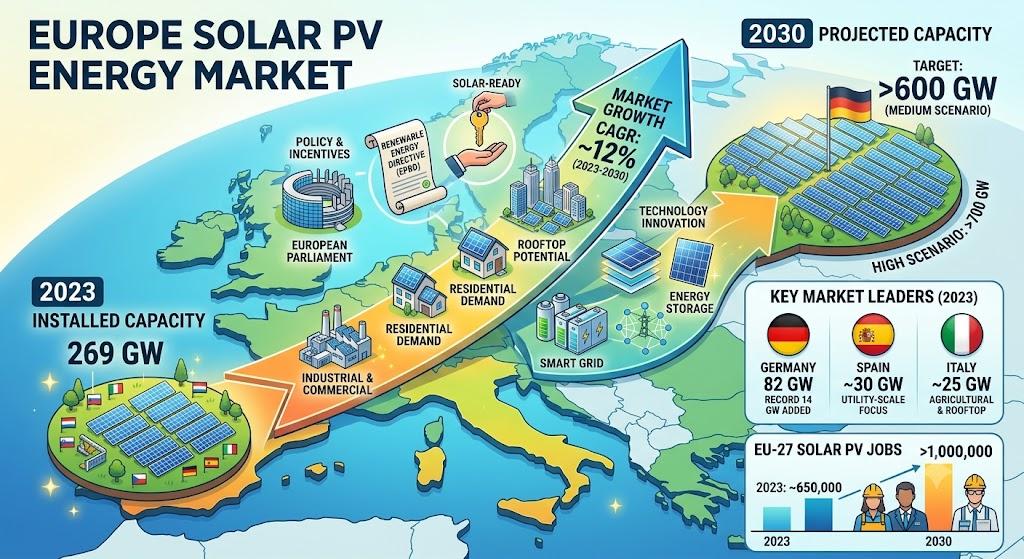
Europe Solar PV Energy: Competition Shifts Toward Execution
Competition across Europe’s solar photovoltaic sector is becoming less about simply adding capacity and more about securing durable economic value. Developers, equipment providers, utilities, investors, and service companies are competing in a market where grid access, contract quality, project execution, and operational flexibility can influence outcomes as strongly as technology. This is changing how participants think about competitive positioning and portfolio strategy.
Module efficiency and equipment pricing remain important. Better performance can improve generation from limited land, while procurement discipline can lower capital requirements. Yet hardware advantages alone may not protect project returns if a site faces connection delays, export restrictions, or weak electricity prices during periods of high solar production.
Grid expertise is becoming a competitive capability. Developers that understand transmission and distribution constraints can prioritize locations with credible reinforcement plans and manageable connection timelines. Early engagement with network operators can also help identify technical requirements before construction. In congested markets, a strong grid strategy can differentiate a developer even when several competitors control similarly attractive land.
Contract structuring is another source of advantage. Power purchase agreements can create revenue visibility, but sophisticated teams examine counterparty quality, settlement mechanisms, imbalance exposure, shaping requirements, and termination clauses. Auction-based support can provide different forms of stability, while two-way contracts for difference may influence the allocation of market upside and downside. Companies that can combine commercial knowledge with project finance expertise may secure better risk-adjusted outcomes.
Operational capabilities matter increasingly as well. Solar assets are exposed to changing weather, market prices, network instructions, and equipment conditions. Forecasting, monitoring, inverter controls, and dispatch systems can help operators manage these variables. In markets with frequent congestion or price volatility, operational excellence can become a direct revenue-protection capability rather than simply an efficiency function.
Storage creates another competitive dimension. Developers able to integrate batteries with solar can potentially shift energy away from weak pricing periods and participate in additional market services. The advantage depends on local rules, asset configuration, trading expertise, and degradation management. Nevertheless, storage readiness can provide flexibility that standalone generation may lack.
Commercial and industrial portfolios can also create competitive differentiation. Aggregators that build diversified customer bases may spread counterparty and load-shape risk across multiple sites. Behind-the-meter generation can capture value through avoided retail purchases, while larger portfolios can benefit from standardized installation, monitoring, financing, and maintenance processes.
Geographic diversification is another strategic consideration. Southern European markets may offer solar resources, while northern and central markets can provide different demand characteristics, grid conditions, or policy environments. A balanced portfolio can reduce dependence on one regulatory framework or weather regime, although diversification does not eliminate local infrastructure risks.
For investors examining Europe Solar PV Energy Market Share, competitive assessment should therefore extend beyond installed capacity. Important indicators include pipeline quality, grid access, contracted revenue, customer concentration, storage capability, operating performance, and financing strength. A company with fewer megawatts may still possess a competitive position if its projects have superior locations and more resilient cashflows.
The next competitive cycle is likely to favor integrated capabilities. Successful participants will connect development, grid strategy, engineering, contracting, financing, and operations rather than optimizing each function independently. Partnerships and acquisitions may also become more important as companies seek specialized expertise or access to high-quality project pipelines.
Europe’s solar industry remains attractive, but competitive advantage is becoming harder to achieve through volume alone. Firms that combine technical capability with market intelligence and disciplined execution can protect returns more effectively. As the market matures, the leaders may be defined not by who builds the most capacity, but by who consistently turns photovoltaic assets into reliable, flexible, and bankable energy businesses.
 English
Join our community to interact with posts!