
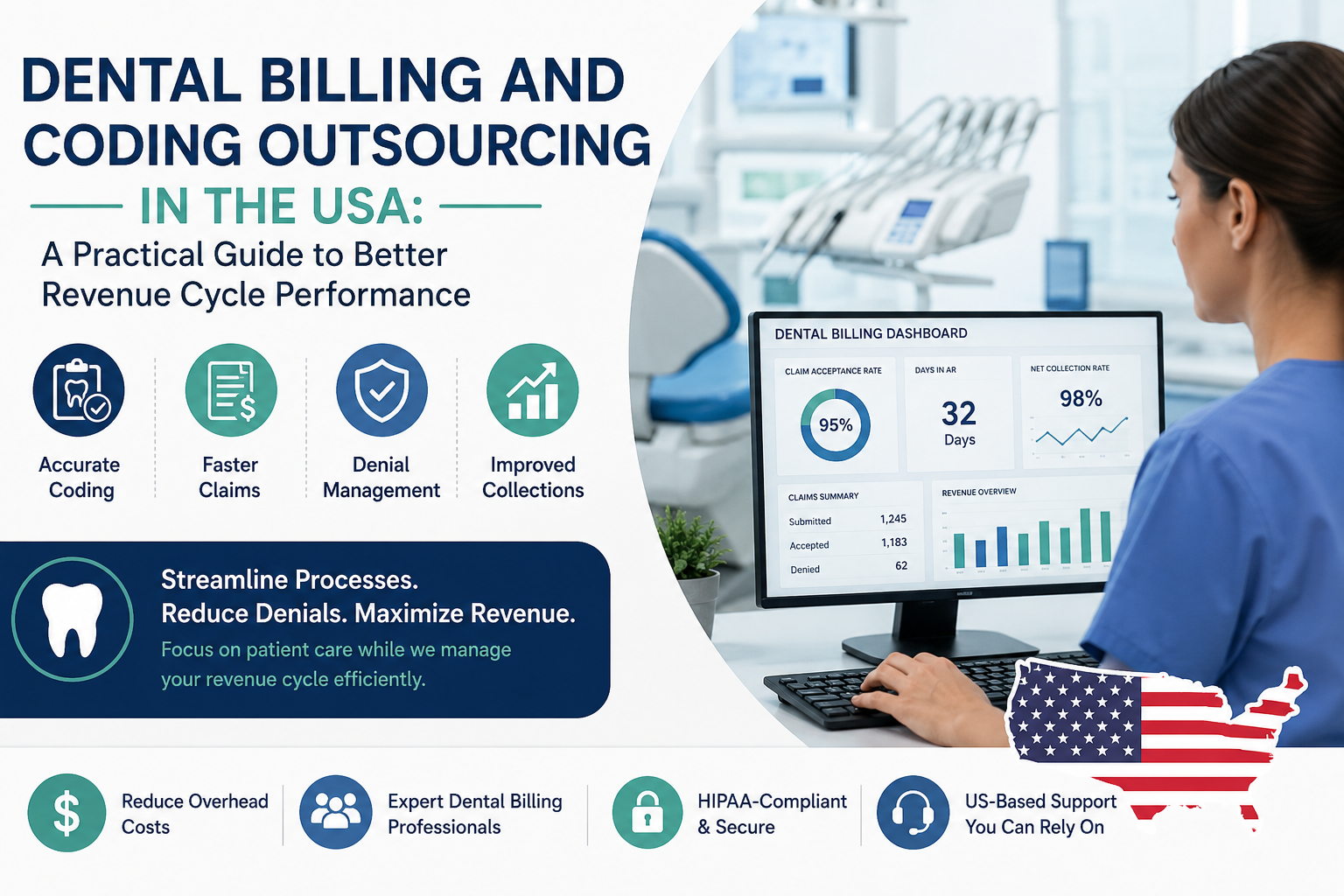
Running a dental practice involves much more than treating patients. Providers also have to manage insurance claims, patient payments, coding requirements, eligibility checks, documentation, and follow-ups. When these administrative tasks are not handled properly, even a busy dental office can experience delayed payments, rejected claims, and revenue leakage.
This is where medical dental billing becomes an important part of practice operations. Dental billing is no longer limited to submitting claims after an appointment. Modern billing requires a coordinated process that connects clinical documentation, coding, insurance verification, claim submission, payment posting, denial management, and accounts receivable follow-up.
For dental practices in the USA, having a reliable billing process can make a significant difference in financial performance. Whether a practice handles billing internally or works with external dental billing providers, understanding how the process works can help owners and administrators make better decisions.
What Is Medical Dental Billing?
Medical dental billing refers to the financial and administrative process used to submit, track, and collect reimbursement for dental-related services. Depending on the treatment and insurance coverage, a dental practice may deal with dental insurance, medical insurance, or both.
Certain procedures performed in dental settings may have a medical component, particularly when treatment is connected to an underlying medical condition, trauma, surgery, or other qualifying circumstances. This makes accurate documentation and coding especially important.
A typical billing process may involve:
- Patient registration and insurance verification
- Eligibility and benefit verification
- Clinical documentation review
- Procedure and diagnosis coding
- Claim preparation and submission
- Claim status monitoring
- Payment posting
- Denial analysis and appeals
- Patient balance management
- Accounts receivable follow-up
Each step affects the next. A small error during registration or coding can eventually result in a denied claim or delayed reimbursement.
Why Dental Practices Are Paying More Attention to Billing
Dental practices operate in an environment where operating costs continue to matter while reimbursement processes can become increasingly complicated. Staff members may spend hours contacting payers, correcting claims, checking eligibility, and following up on outstanding balances.
For a small practice, these responsibilities can quickly become overwhelming.
For example, imagine a patient receives a procedure that could potentially qualify for medical insurance coverage. If the practice submits the claim without sufficient documentation or uses an inappropriate code, the payer may reject it. The billing team then has to investigate the reason, correct the claim, gather documentation, and resubmit it.
The treatment itself may have been completed correctly, but the practice still experiences a financial delay because the administrative process was not handled correctly.
This is one reason many practices evaluate specialized dental billing company services rather than treating billing as a secondary office task.
The Role of Dental Billing Companies
Dental billing companies support practices with some or all of the financial processes associated with claims and reimbursement. Their responsibilities can vary depending on the practice's requirements.
Some practices may need help only with claim submission and follow-up. Others may outsource the complete billing workflow, including eligibility verification, payment posting, denial management, and accounts receivable.
A capable billing partner should understand that every practice has different requirements. A multi-location dental organization, for example, may need stronger reporting and centralized billing controls than a small independent office.
When evaluating dental billing companies in USA, practices should look beyond simple claim submission. Important areas to consider include:
- Experience with dental and medical claims
- Knowledge of payer requirements
- Coding expertise
- Denial management capabilities
- Insurance verification processes
- Accounts receivable follow-up
- Payment posting accuracy
- Reporting and communication
- Data security and compliance procedures
- Ability to scale with the practice
The right partner should function as an extension of the practice's administrative team rather than simply acting as a claims processor.
How Dental Billing RCM Works
Dental billing RCM, or dental revenue cycle management, covers the financial journey from patient scheduling through final payment.
The process begins before treatment. Insurance eligibility and benefits can be verified so the practice has a clearer understanding of the patient's coverage. After treatment, the clinical information is translated into appropriate billing codes and submitted to the payer.
Once a claim is submitted, the work is not necessarily finished.
The billing team may need to:
- Monitor claim status.
- Identify rejected or denied claims.
- Correct billing errors.
- Submit additional documentation when required.
- Appeal eligible denials.
- Post insurance payments accurately.
- Reconcile outstanding balances.
- Follow up on aging accounts receivable.
This complete approach helps prevent claims from simply sitting unresolved in the billing system.
A practice that focuses only on getting claims out the door may still have significant revenue tied up in unpaid or denied claims. Effective revenue cycle management looks at what happens after submission as carefully as what happens before it.
Common Medical Dental Billing Challenges
Billing problems are rarely caused by one single issue. They often develop from several small process gaps.
1. Incorrect Patient Information
An incorrect date of birth, member ID, insurance plan, or demographic detail can cause a claim rejection. These errors may appear simple, but correcting them repeatedly consumes staff time.
2. Eligibility Problems
A patient may believe a procedure is covered, while the actual benefit structure may be different. Verifying eligibility and benefits before treatment can help reduce unexpected billing problems.
3. Coding Errors
Incorrect procedure or diagnosis coding can affect reimbursement and claim acceptance. Coding should reflect the services actually documented in the patient's record.
4. Incomplete Documentation
Some medical-related dental claims require supporting documentation. Missing clinical notes, radiographs, treatment information, or other records can create additional delays.
5. Denied Claims
A denied claim should not automatically be treated as lost revenue. The reason for denial should be reviewed to determine whether correction, resubmission, or appeal is appropriate.
6. Aging Accounts Receivable
Unresolved claims can remain outstanding for weeks or months. Without consistent follow-up, older balances can become increasingly difficult to collect.
Medical Billing Services and Dental Practices
Although dental billing has its own rules and workflows, some practices also require broader healthcare billing expertise. This is particularly relevant when services may involve medical insurance or when a dental organization operates alongside other healthcare services.
Professional medical billing services can support processes such as claim preparation, payer follow-up, denial management, payment posting, and accounts receivable management.
The distinction between dental and medical billing should still be respected. A billing team should understand which services belong under dental insurance, which may qualify for medical coverage, and what documentation each payer expects.
The goal is not to force every dental claim through a medical billing process. Instead, the objective is to use the appropriate workflow for each service and payer.
The Importance of Medical Coding Services
Accurate coding is central to successful reimbursement.
Medical coding services help translate documented clinical information into standardized codes used for billing and reporting. In situations where dental treatment involves medical insurance, coding accuracy can become particularly important.
Coding teams need to work from the documentation rather than selecting codes simply because they appear financially attractive. The code should accurately represent the service, diagnosis, and circumstances supported by the patient's record.
When coding and documentation do not match, the practice may face claim delays, denials, payer inquiries, or compliance concerns.
For organizations handling both healthcare and dental-related services, integrated medical billing and coding services can provide a more coordinated approach between documentation, coding, and reimbursement.
Credentialing Also Affects Revenue
Billing begins long before a claim reaches an insurance payer. Provider enrollment and credentialing can have a direct effect on whether a practice can successfully participate with particular insurance networks.
Credentialing services may assist practices with provider enrollment, payer applications, recredentialing, documentation collection, and related administrative requirements.
A credentialing problem can create a situation where a provider is treating patients but encounters difficulties receiving expected reimbursement. Keeping enrollment information current is therefore an important part of the revenue cycle.
Credentialing should not be viewed as an isolated administrative activity. It connects directly with payer participation, reimbursement, and practice growth.
What to Look for in Dental Billing Providers
Choosing among dental billing providers requires more than comparing service prices.
A practice should first identify where its current revenue cycle is struggling. Is the biggest issue claim rejection? Aging A/R? Insurance verification? Denial follow-up? Payment posting? Coding?
Once the primary problems are identified, practices can compare providers based on their ability to solve those specific issues.
Useful questions to ask include:
- How do you monitor rejected and denied claims?
- How frequently is outstanding A/R followed up?
- What reporting will the practice receive?
- How are coding issues identified?
- How are payer-specific requirements monitored?
- How are patient balances handled?
- What happens when a claim requires additional documentation?
- How does the team communicate unresolved billing issues?
The answers can reveal whether a provider has a structured process or simply offers basic billing support.
When Outsourcing Makes Sense
Not every dental practice needs to outsource its entire billing operation.
Some practices have experienced internal teams and only need support during periods of growth. Others may have limited administrative staff and benefit from a comprehensive external billing operation.
Outsourcing can be particularly useful when:
- Claims are frequently delayed or rejected.
- Staff spend excessive time on insurance follow-up.
- A/R continues to increase.
- Billing responsibilities distract front-office employees from patients.
- The practice is opening additional locations.
- Internal billing expertise is limited.
- Management needs better revenue-cycle reporting.
The best approach depends on the practice's size, specialty, payer mix, staffing model, and financial objectives.
Building a More Reliable Revenue Cycle
A strong billing process does not depend on one person remembering every task. It depends on consistent workflows.
Dental practices can strengthen their revenue cycle by establishing clear procedures for eligibility verification, documentation, coding review, claim submission, payment posting, denial management, and A/R follow-up.
Performance should also be monitored using meaningful indicators. Depending on the practice, these may include:
- Claim rejection rate
- Denial rate
- Days in accounts receivable
- Aging A/R
- Clean claim performance
- Payment posting turnaround
- Outstanding insurance balances
- Patient collection performance
Looking at these indicators regularly can help management identify where revenue is getting delayed.
How 247 Medical Billing Services Can Fit Into the Process
For practices and healthcare organizations looking for broader billing support, 247 Medical Billing Services offers solutions that can fit into different stages of the revenue cycle. The focus can include medical billing services, medical coding services, medical billing and coding services, revenue cycle management services, and credentialing services.
The value of an external billing partner is not simply the number of claims submitted. A well-managed process should help practices understand where claims are being delayed, why denials occur, and where administrative gaps may be affecting collections.
For a dental organization that also interacts with medical insurance or operates across healthcare services, having access to broader revenue-cycle expertise can provide additional administrative support without replacing the practice's clinical decision-making.
Final Thoughts
Medical dental billing has become an important operational function for practices that want to protect revenue while reducing administrative pressure. Accurate information, appropriate coding, timely claims, effective denial management, and consistent A/R follow-up all contribute to a healthier financial cycle.
Whether a practice manages billing internally or works with one of the many dental billing companies in USA, the most important consideration is having a process that is accurate, transparent, and consistent.
As dental practices grow and payer requirements become more complex, billing should be treated as part of the overall business strategy rather than simply an administrative task. With the right systems, trained professionals, and appropriate support, practices can spend less time chasing unresolved claims and more time focusing on patient care.
Frequently Asked Questions
1. What does medical dental billing mean?
Medical dental billing refers to the billing and reimbursement processes associated with dental services, including situations where certain qualifying dental procedures may be billed through medical insurance. It involves eligibility, documentation, coding, claim submission, payment posting, denials, and follow-up.
2. What do dental billing companies typically handle?
Dental billing companies may handle insurance verification, claim submission, coding support, payment posting, denial management, accounts receivable follow-up, and billing reports. The exact services depend on the provider and the practice's requirements.
3. Why is dental revenue cycle management important?
Dental revenue cycle management helps coordinate financial activities from patient registration through final payment. It can help practices identify rejected claims, manage denials, reduce unresolved A/R, and improve visibility into the overall billing process.
4. Can dental services be billed to medical insurance?
Some dental-related procedures may qualify for medical insurance depending on the patient's condition, the service provided, the payer's policy, and the supporting documentation. Practices should verify applicable payer requirements rather than assuming that a procedure automatically qualifies.
5. What is the difference between dental billing and medical billing?
Dental billing generally focuses on services covered by dental insurance, while medical billing deals primarily with healthcare services covered under medical insurance. However, some dental procedures can have medical relevance, making knowledge of both billing environments useful for certain practices.
6. When should a dental practice consider outsourcing billing?
A practice may consider outsourcing when internal staff struggle with claim follow-up, denials, coding, eligibility verification, or growing A/R. Outsourcing may also make sense when the practice is expanding and needs additional billing capacity without significantly increasing its internal administrative workload.
 English
Join our community to interact with posts!