
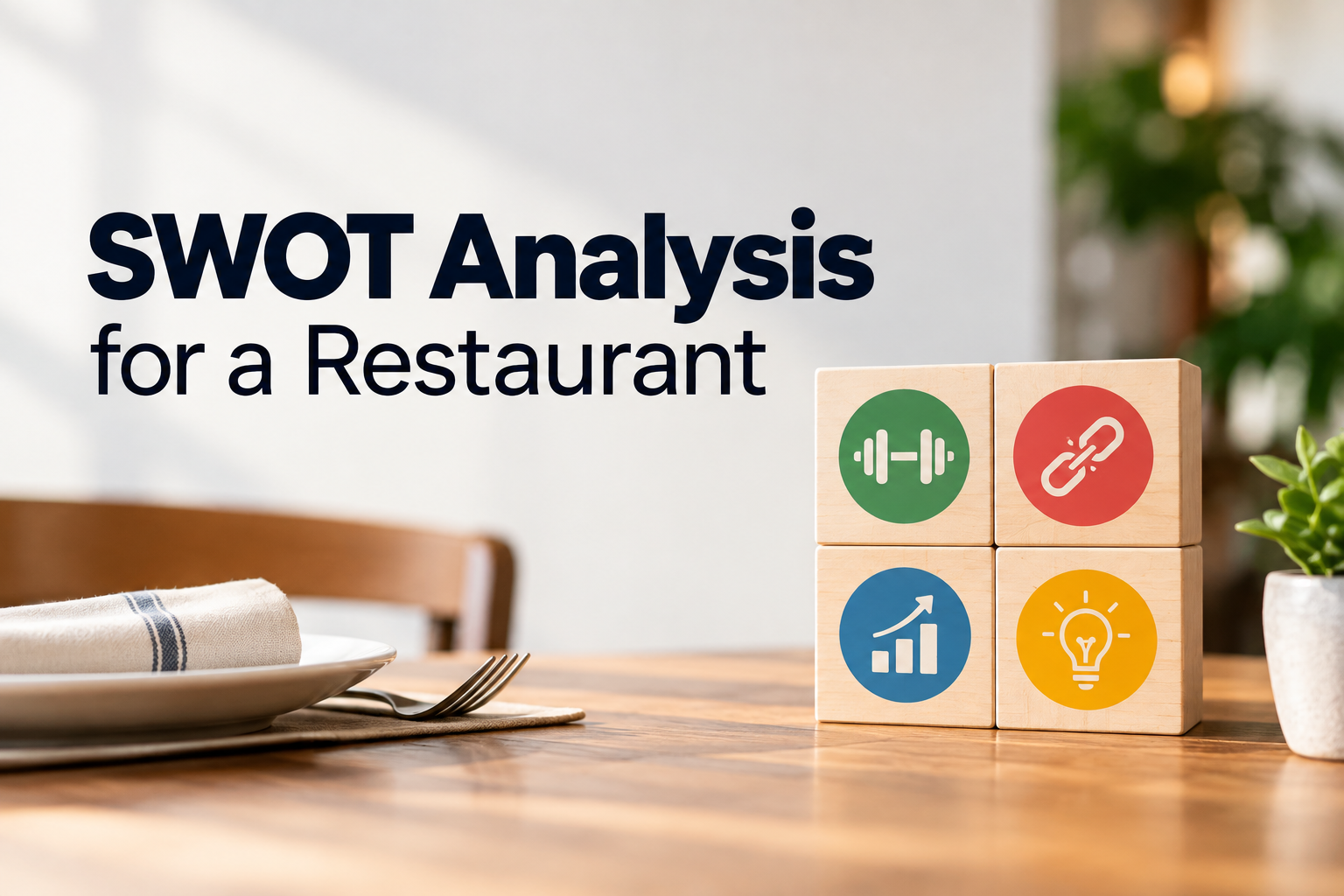
If you are researching restaurant swot analytics, you are likely trying to answer a practical question about a restaurant, food-service business, or hospitality operation. The useful way to approach this topic is to move beyond a short definition and look at how the issue affects real decisions. Restaurant operators work with connected variables: customer demand, pricing, labor, food costs, location, competition, technology, and cash flow. Changing one of these variables can affect several others, so a good analysis should consider the full picture.
This guide explains restaurant swot analytics in straightforward terms and shows how an operator can apply the idea when planning, evaluating, or improving a restaurant. The goal is not to rely on a single statistic or generic rule. Instead, the focus is on measurable assumptions, local evidence, operational realities, and repeatable decision-making.
Learn more about restaurant swot analytics to explore the topic in greater detail.
What a restaurant SWOT analysis is
A SWOT analysis organizes business observations into four categories: strengths, weaknesses, opportunities, and threats. Strengths and weaknesses are generally internal factors the business can influence, while opportunities
and threats describe external conditions in the market. The framework is useful because it forces an operator to look beyond revenue and examine the full competitive position.
Strengths
Strengths can include a distinctive menu, strong brand recognition, efficient kitchen layout, experienced management, loyal customers, favorable reviews, proprietary recipes, a convenient
location, or a compelling price-to-value relationship. A strength is most useful when it can be connected to a measurable customer or financial advantage.
Weaknesses
Weaknesses might include slow service, high food waste, limited parking, inconsistent quality, weak digital visibility, high occupancy costs, narrow menu
appeal, or dependence on one sales channel. Listing weaknesses honestly is important because a SWOT exercise is not a marketing brochure.
Opportunities
Opportunities can arise from unmet local demand, new customer segments, delivery, catering, daypart expansion, partnerships, technology, menu extensions,
or changes in the surrounding trade area. Each opportunity should be tested against the restaurant's resources and economics.
Threats
Threats can include new competitors, rising wages, ingredient inflation, changing consumer preferences, delivery-platform costs, regulatory changes, construction, reduced foot
traffic, or shifts in the local population. Threats are not predictions; they are conditions that deserve monitoring and contingency planning.
How to make SWOT specific
Avoid vague statements such as 'great food' or 'lots of competition.' Instead, write observations that can be verified. For example, a strength could be 'high repeat-order
rate among weekday lunch customers,' while a weakness could be 'kitchen ticket times increase sharply during the 12–1 p.m. peak.' Specific statements lead to specific actions.
Turning SWOT into strategy
After completing the four categories, connect each item to a decision. Use strengths to capture opportunities, address weaknesses that
block opportunities, use strengths to reduce exposure to threats, and create contingency plans for weaknesses that could amplify threats.
Competitive research
A restaurant should compare nearby businesses on menu, price, reviews, positioning, service format, hours, delivery coverage, promotions, and customer experience. The goal
is not to copy competitors. It is to identify gaps and determine what the proposed restaurant can do credibly better or differently.
Reviewing the analysis
SWOT should not be a one-time document. Markets change as competitors open, prices move, neighborhoods develop,
and customer behavior shifts. Review the analysis periodically and update it when new evidence changes an assumption.
From analysis to action
The final output should be a short list of priorities with owners, deadlines, and measurable outcomes. For example, if a weakness is slow lunch
service, the action might involve prep changes, staffing adjustments, and a target ticket-time improvement. This turns SWOT from a classroom exercise into an operating tool.
A practical way to use information about restaurant swot analytics is to create a simple decision worksheet. Start with the question you need to answer, list the evidence available, identify the assumptions that could change the result, and decide what additional information would reduce uncertainty. For example, if the issue affects site selection, compare multiple locations using the same criteria. If it affects profitability, calculate the relevant costs using actual operating assumptions. If it affects menu performance, connect sales data with recipe and labor information. This prevents a broad topic from becoming an abstract research exercise.
It is also important to separate facts from assumptions. Historical data can describe what happened in a particular market or period, but it does not automatically predict what will happen at a new restaurant. Industry benchmarks can be useful reference points, but local rent, wages, competition, customer mix, menu pricing, and operating model can produce very different economics. Whenever possible, replace generic assumptions with evidence from the actual trade area and the proposed operation.
Another useful practice is scenario planning. Build a conservative case, an expected case, and a stronger case. Change the variables that matter most, such as transactions, average check, labor hours, food prices, occupancy costs, or marketing spend. The purpose is not to predict the future precisely. It is to understand how much room the business has when conditions are different from the original plan.
Finally, review the analysis after launch or after a major business change. Restaurant markets evolve. Competitors open and close, customer behavior changes, costs move, and operating teams learn from experience. A document that was accurate at opening can become outdated later. Regular reviews make the information useful instead of leaving it as a one-time planning exercise.
For a deeper resource on restaurant swot analytics, visit the linked guide and then explore Restaurant Site Finder for additional restaurant research tools and information.
A final consideration is implementation. Assign responsibility for each action, set a review date, and record the metric that will indicate whether the change worked. This creates a feedback loop between research and operations. In a restaurant environment, small improvements in purchasing, scheduling, menu design, service speed, or local marketing can compound over time when they are measured consistently. The same principle applies when evaluating a new concept or location: make the assumptions visible, test the most uncertain ones first, and avoid committing significant capital until the evidence supports the plan.
A final consideration is implementation. Assign responsibility for each action, set a review date, and record the metric that will indicate whether the change worked. This creates a feedback loop between research and operations. In a restaurant environment, small improvements in purchasing, scheduling, menu design, service speed, or local marketing can compound over time when they are measured consistently. The same principle applies when evaluating a new concept or location: make the assumptions visible, test the most uncertain ones first, and avoid committing significant capital until the evidence supports the plan.
A final consideration is implementation. Assign responsibility for each action, set a review date, and record the metric that will indicate whether the change worked. This creates a feedback loop between research and operations. In a restaurant environment, small improvements in purchasing, scheduling, menu design, service speed, or local marketing can compound over time when they are measured consistently. The same principle applies when evaluating a new concept or location: make the assumptions visible, test the most uncertain ones first, and avoid committing significant capital until the evidence supports the plan.
A final consideration is implementation. Assign responsibility for each action, set a review date, and record the metric that will indicate whether the change worked. This creates a feedback loop between research and operations. In a restaurant environment, small improvements in purchasing, scheduling, menu design, service speed, or local marketing can compound over time when they are measured consistently. The same principle applies when evaluating a new concept or location: make the assumptions visible, test the most uncertain ones first, and avoid committing significant capital until the evidence supports the plan.
 English
Join our community to interact with posts!