
Market Overview
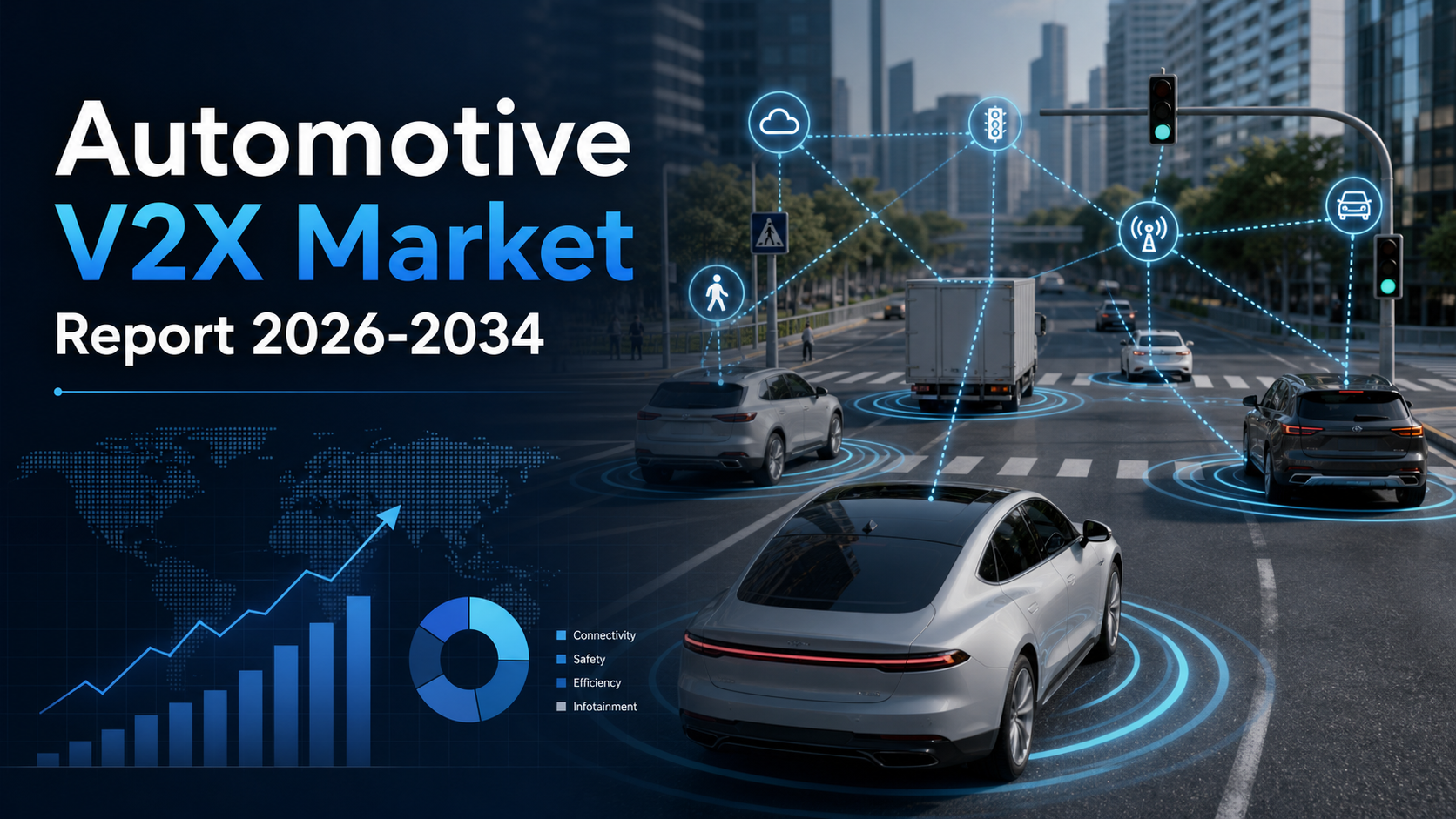
According to IMARC Group's latest research publication, "Automotive V2X Market Size, Share, Trends and Forecast by Communication, Connectivity, Vehicle Type, and Region, 2026-2034", the global automotive V2X market size reached USD 8.30 Billion in 2025. Looking forward, IMARC Group expects the market to reach USD 102.55 Billion by 2034, exhibiting a growth rate (CAGR) of 31.25% during 2026-2034.
This detailed analysis primarily encompasses industry size, business trends, market share, key growth factors, and regional forecasts. The report offers a comprehensive overview and integrates research findings, market assessments, and data from different sources. It also includes pivotal market dynamics like drivers and challenges, while also highlighting growth opportunities, financial insights, technological improvements, emerging trends, and innovations. Besides this, the report provides regional market evaluation, along with a competitive landscape analysis.
How 5G and Autonomous Driving are Reshaping the Future of Automotive V2X Market
-
By 2030, connected vehicles are expected to represent nearly 95% of global new vehicle sales, while level three and level four autonomous vehicles are projected to rise from 1% to around 12%.
-
The global 5G rollout is gaining strong momentum, with nearly 390 networks launched worldwide and 5G population coverage reaching around 60%.
-
The electric car market reached a record level, with sales increasing by 20% from 2024 to exceed 20 million units globally.
-
In October 2025, Dubai's Roads and Transport Authority upgraded its traffic systems by combining AI with V2X technology, expected to reduce congestion by up to 37%.
-
In May 2026, Polestar and charging operator Clever are testing V2X technology in selected Danish homes, allowing EVs to power households, return electricity to the grid, and provide backup energy during outages.
Grab a sample copy of this report: https://www.imarcgroup.com/automotive-v2x-market/requestsample
Key Trends in the Automotive V2X Market
-
5G NR-V2X Sidelink and Network-Assisted V2X: 5G NR-V2X sidelink and network-assisted V2X enable ultra-reliable, low-latency communication for advanced safety and autonomous driving applications. NR-V2X sidelink allows direct communication between vehicles, pedestrians, and infrastructure without relying solely on cellular networks, while network-assisted V2X leverages 5G infrastructure for broader coverage and cloud connectivity. Together, these technologies support cooperative driving, platooning, collision avoidance, and real-time traffic management. As 5G deployment expands globally, adoption of next-generation V2X communication platforms is accelerating.
-
AI-Integrated V2X Technology: AI-integrated V2X technology enables vehicles to interpret real-time data from nearby vehicles, traffic signals, road sensors, and cloud systems. AI helps predict hazards, optimize routes, and support faster driving decisions in complex traffic environments. In October 2025, Dubai's Roads and Transport Authority upgraded its traffic systems by combining AI with V2X technology, moving beyond conventional signal timing toward real-time connected traffic management. The system is expected to reduce congestion by up to 37% and deliver live traffic updates directly to vehicle dashboards. It enables faster hazard detection, smoother routing, safer driving decisions, and more efficient urban mobility.
-
V2P and Vulnerable Road User V2X: V2P (Vehicle-to-Pedestrian) and vulnerable road user V2X are emerging as governments and automakers prioritize road safety. These solutions enable vehicles to communicate with pedestrians, cyclists, and other vulnerable road users through smartphones, wearable devices, and connected infrastructure. Real-time alerts help drivers detect potential collision risks, especially in blind spots and complex urban environments. As smart city initiatives expand and safety regulations become stricter, adoption of V2P technologies is expected to increase significantly.
-
V2G Energy Management and EV Smart Charging: V2G energy management and EV smart charging are emerging as EVs increasingly communicate with grids, chargers, and energy platforms. In May 2026, Polestar and charging operator Clever are testing V2X technology in selected Danish homes, allowing EVs to power households, return electricity to the grid, and provide backup energy during outages. The joint pilot is Denmark's first complete V2X solution, demonstrating how the Polestar 4 can act as a mobile power bank to lower energy costs, support grid stability, and improve energy resilience. As EV adoption rises, V2G-ready communication systems are becoming important for connected mobility and smart energy ecosystems.
-
Cloud-Enabled V2X Infrastructure Development: Cloud-enabled V2X infrastructure development providing scalable platforms for real-time data collection, processing, and distribution. Cloud systems enable vehicles, roadside infrastructure, and traffic management centers to share information seamlessly across large geographic areas. In August 2025, DENSO Products and Services Americas and AT&T Connected Solutions collaborated to provide cities and automakers with customizable services, certified hardware, and software for safer and more efficient mobility. The partnership combines AT&T's nationwide cellular network and cloud-based Intelligent Transportation Platform with 5.9 GHz C-V2X for localized safety-critical applications. DENSO's MobiQ V2X On-Board Unit supports hybrid communication through embedded cellular and 5.9 GHz modems, enabling interoperability for next-generation transportation systems. As connected vehicle volumes increase, cloud-enabled V2X infrastructure is becoming essential for efficient, secure, and intelligent transportation ecosystems.
Growth Factors in the Automotive V2X Market
-
5G Network Rollout: 5G network rollout enables ultra-low-latency, high-bandwidth, and highly reliable communication between vehicles, infrastructure, pedestrians, and cloud networks. Compared to previous wireless technologies, 5G supports real-time data exchange required for advanced driver assistance systems (ADAS) and autonomous driving. The global 5G rollout is gaining strong momentum, with nearly 390 networks launched worldwide and 5G population coverage reaching around 60%. During the year, 5G access expanded to an additional 400 million people, while coverage outside mainland China is expected to rise from 50% to nearly 85%. This expansion directly supports the automotive V2X market by enabling low-latency, high-speed communication between vehicles, infrastructure, pedestrians, and cloud networks. Wider 5G availability strengthens C-V2X deployment, improves real-time safety alerts, and supports advanced connected and autonomous driving applications.
-
Smart City and Intelligent Transportation Investment: Smart city and intelligent transportation investment are creating connected road infrastructure that can communicate with vehicles in real time. Investments in smart traffic signals, roadside units, traffic monitoring systems, and digital road networks support vehicle-to-infrastructure communication. These systems improve traffic flow, reduce congestion, and enhance road safety through collision alerts and hazard warnings. As cities modernize mobility infrastructure, demand for V2X-enabled vehicles and communication platforms continues to rise.
-
EV and Connected Vehicle Platform: The electric car market reached a record level, with sales increasing by 20% from 2024 to exceed 20 million units globally. As EV adoption expands, demand for V2X-enabled functions such as smart charging, route optimization, battery monitoring, and safety alerts is also increasing. Modern EVs and connected vehicles are equipped with advanced sensors, telematics systems, and software-defined architectures that support real-time data exchange. V2X technologies enhance battery management, route optimization, charging station connectivity, and safety functions. As automakers expand connected and electric vehicle portfolios, demand for V2X-enabled communication systems continues to accelerate.
-
Vehicle-to-Infrastructure (V2I) Deployment for Traffic Optimization: Vehicle-to-Infrastructure (V2I) deployment for traffic optimization enables vehicles to communicate with traffic signals, road sensors, toll systems, and smart highways in real time. American Association of State Highway and Transportation Officials (AASHTO), with support from U.S. DOT and Transport Canada, is assessing connected vehicle field infrastructure needs for future V2I deployment. The study supports agency planning and expects a mature connected vehicle ecosystem by 2040, with up to 80% of traffic signals and 25,000 roadside locations becoming V2I-enabled. As cities invest in intelligent transport systems, demand for V2X hardware, software, and communication platforms is expected to grow.
-
Vehicle-to-Grid (V2G) and Smart Charging Communication Platforms: Vehicle-to-Grid (V2G) and smart charging communication platforms enable EVs to communicate with charging stations, power grids, and energy management systems. These platforms support bidirectional energy flow, smart load balancing, and optimized charging based on grid demand and electricity prices. As EV adoption grows, automakers and infrastructure providers will need reliable V2X communication systems for charging coordination and grid integration. This expands demand for V2X software, connectivity modules, and smart mobility-energy platforms.
Leading Companies Operating in the Global Automotive V2X Industry
-
Qualcomm Incorporated
-
NXP Semiconductors
-
Commsignia
Automotive V2X Market Report Segmentation
Breakup By Communication
-
Vehicle-To-Vehicle (V2V)
-
Vehicle-To-Infrastructure (V2I)
-
Vehicle-To-Pedestrian (V2P)
-
Vehicle-To-Grid (V2G)
-
Vehicle-To-Cloud (V2C)
-
Vehicle-To-Device (V2D)
Vehicle-to-Vehicle (V2V) leads the communication segment, driven by its critical role in collision avoidance, cooperative driving, and real-time safety alerts between vehicles. V2V communication enables vehicles to exchange speed, position, and trajectory data, enhancing situational awareness and reducing accident risks. As connected vehicle adoption accelerates, V2V remains the foundational V2X communication application.
Breakup By Connectivity
-
Dedicated Short-Range Communication (DSRC)
-
Cellular V2X (C-V2X) Communication
Cellular-V2X (C-V2X) communication leads at 63.5% (2025), due to its ability to provide reliable, low-latency communication across vehicles, infrastructure, pedestrians, and networks. Its compatibility with existing 4G LTE and evolving 5G networks enables broader coverage and scalability than alternative technologies. C-V2X also supports advanced applications such as collision avoidance, cooperative driving, and autonomous vehicle operations, driving widespread industry adoption.
Dedicated short-range communication (DSRC) at 36.5%, by enabling direct, low-latency communication between vehicles and roadside infrastructure without relying on cellular networks. Its proven performance in safety-critical applications such as collision warnings, intersection safety, and emergency vehicle alerts continues to support deployment in intelligent transportation systems.
Breakup By Vehicle Type
-
Passenger Cars
-
Commercial Vehicles
Passenger cars lead at 72.4% (2025), due to their high global production volume and rapid adoption of connected vehicle technologies. Automakers are increasingly integrating V2X with ADAS, infotainment, navigation, and safety systems in passenger vehicles. Rising consumer demand for safer, smarter, and semi-autonomous driving experiences further supports V2X deployment in this segment.
Commercial vehicles at 27.6% reflect trucking platooning V2X, emergency vehicle priority V2X, and public transit bus signal priority V2X. The integration of V2X in commercial fleets supports logistics optimization, fuel efficiency, and safety improvements across freight and public transportation operations.
Breakup By Region
-
Asia-Pacific (China, Japan, India, South Korea, Australia, Indonesia, Others)
-
Europe (Germany, France, United Kingdom, Italy, Spain, Russia, Others)
-
North America (United States, Canada)
-
Latin America (Brazil, Mexico, Others)
-
Middle East and Africa
Asia-Pacific leads the global automotive V2X market with a 38.7% share, driven by strong vehicle production, rapid 5G deployment, and smart mobility investments. The region dominates due to strong vehicle production, rapid connected car adoption, and large-scale smart mobility investments in China, Japan, South Korea, and India. Government-backed smart mobility programs, intelligent transport investments, and strong EV growth further support regional dominance.
Europe follows with 27.1%, supported by road safety regulations, autonomous driving pilots, and connected vehicle programs. The region is driven by strong road safety regulations, autonomous driving pilots, smart city programs, and OEM-led deployment of connected vehicle technologies. North America accounts for 21.6%, backed by ITS investments, C-V2X trials, and telecom-automotive partnerships. The region is driven by investments in intelligent transportation systems, C-V2X trials, 5G infrastructure, and strong participation from automakers, telecom firms, and technology providers.
Latin America holds 7.2%, with growth supported by urban mobility modernization and traffic management needs. The region is gradually adopting V2X technologies through urban mobility upgrades, traffic management improvements, and growing interest in connected vehicle safety applications. The Middle East and Africa represent 5.4%, emerging through smart city projects and intelligent road infrastructure development. The region is supported by smart city projects, intelligent road infrastructure, and connected mobility initiatives in countries such as the UAE and Saudi Arabia.
Recent News and Developments in Automotive V2X Market
-
June 2025: Qualcomm Technologies, a subsidiary of Qualcomm Incorporated, completed the acquisition of Autotalks, a specialist in direct V2X communication solutions. The acquisition strengthens Qualcomm's portfolio of production-ready, automotive-grade V2X technologies for vehicles, roadside infrastructure, and two-wheelers.
-
August 2025: DENSO Products and Services Americas and AT&T Connected Solutions collaborated to provide cities and automakers with customizable services, certified hardware, and software for safer and more efficient mobility. The partnership combines AT&T's nationwide cellular network and cloud-based Intelligent Transportation Platform with 5.9 GHz C-V2X for localized safety-critical applications. DENSO's MobiQ V2X On-Board Unit supports hybrid communication through embedded cellular and 5.9 GHz modems, enabling interoperability for next-generation transportation systems.
-
October 2025: Dubai's Roads and Transport Authority upgraded its traffic systems by combining AI with V2X technology, moving beyond conventional signal timing toward real-time connected traffic management. The system is expected to reduce congestion by up to 37% and deliver live traffic updates directly to vehicle dashboards.
-
May 2026: Polestar and charging operator Clever are testing V2X technology in selected Danish homes, allowing EVs to power households, return electricity to the grid, and provide backup energy during outages. The joint pilot is Denmark's first complete V2X solution, demonstrating how the Polestar 4 can act as a mobile power bank to lower energy costs, support grid stability, and improve energy resilience.
Note: If you require specific details, data, or insights that are not currently included in the scope of this report, we are happy to accommodate your request. As part of our customization service, we will gather and provide the additional information you need, tailored to your specific requirements. Please let us know your exact needs, and we will ensure the report is updated accordingly to meet your expectations.
About Us
IMARC Group is a global management consulting firm that helps the world's most ambitious changemakers to create a lasting impact. The company provide a comprehensive suite of market entry and expansion services. IMARC offerings include thorough market assessment, feasibility studies, company incorporation assistance, factory setup support, regulatory approvals and licensing navigation, branding, marketing and sales strategies, competitive landscape and benchmarking analyses, pricing and cost research, and procurement research.
Contact Us
IMARC Group
134 N 4th St. Brooklyn, NY 11249, USA
Email: sales@imarcgroup.com
Tel No:(D) +91 120 433 0800
United States: +1-201971-6302
 English
Join our community to interact with posts!